Oregon Symphony for large wind orchestra (op. 67, 1977)
I. Ouverture, II. Andantino, III. Adagio, IV. Finale
Picc., 2 Fl., 2 Ob., Clar. in E-Flat, 3 Clar. in B-flat, Bass Clar. in B-flat, Bssn., 2 Alt. Sax. in E-Flat, Tenor Sax in B-flat, Baritone Sax. in E-Flat, 3 Tpt. in B-flat, 4 Hrn. in F, 2 Trb., Tub., Baritone Tub. in B-flat, Bass Tub., Db. (E-bass optional), Perc. <5 Players> (timp., snare drum, bass drum, vibra, xyl., bongos, wood block, tamb., 5 cymbals., pair of cymbals, ratchet, triangle, conga, tam tam, gong, temple block, slit drum, tom tom, snapper, claves, bells ad.lib.)
Duration: 23 minutes
Southern Oregon State Symphonic Wind Ensemble | Max McKee
Nordbayerisches Jugendblasorchester | Ernst Oestreicher
Title: - - Length: 132 pages - Date: I. - / II. 22.8.77 /.III. 28.8.77 / IV.10.10.77 Würzburg - Dorfgastein - Location:
Schott Music (score and parts are for sale!)
Score: ED 51871 SHS 1023 / Parts: ED 51872 SHS 1023-50
Printing error in the 1st edition: In the parts for trombone 1, 2 and 3, the following errors should be corrected on page 4, 3rd line: In bar 35, 6 bars must be counted instead of 5 bars rest. Two bars later, 3 bars should be counted instead of 4 bars.

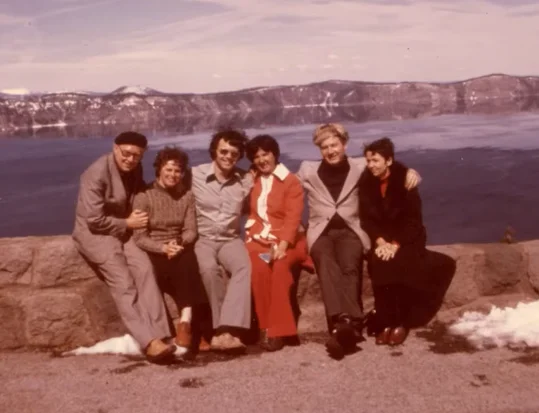

West German composer Bertold Hummel has taken his first look at Oregon and found that its countryside matches what he had in mind when he wrote his latest symphony Oregonsinfonie. What he has seen of the state so far, he said Thursday, also reminds him of Germany's Black Forest.
Hummel arrived in Ashland Wednesday evening with his wife, Inken, in advance of the world-premiere performances of his newest symphonic work.
During an interview on the Ashland campus Thursday, Hummel recalled that he agreed to a request by McKee that be write the Oregon Sinfonie for the SOSC band. That agreement was reached a year ago while McKee was visiting Hummel's home City of Wuerzburg. McKee, director of bands at the Ashland college, was on sabbatical leave at the time, and had been well acquainted with Hummel's music for more than a decade.
Hummel agreed to the commission. But it was not until later, he recalled, that he decided on the title for the work. That came after he had received - as a gift from McKee - an album of Oregon scenes by photographer Ray Atkeson. Scenes of Oregon from that album, he said, helped provide him with inspiration for his Oregon Sinfonie. The 30-minute work, primarily in its final movement, incorporates several American folk tunes, including "Skip to My Lou" "Land of the Empire Builders" (Oregon's state song), and "Tom Dooley."
Hummel laughed when recalling that his 9-year-old Sons were astonished to learn that he was planning to travel to Oregon just because he had written a 30-minute piece of music. "They asked me" Hummel said: "For 30 minutes. you are going all the way to America?"
After his guest appearances in Oregon, Hummel plans to travel to Cleveland, Ohio, for a lecture at Baldwin Conservatory, and then on to Potsdam, N.Y., to lecture at the Crane School of Music.
At Potsdam, Hummel said, he also is scheduled to meet with American composer Aaron Copland, whose music he has long admired.




Preface (Schott Music)
In 1977, Bertold Hummel was commissioned to write a major work for wind orchestra for a visit to the USA the following year. A photo album with scenes from the state of Oregon given to him as a gift inspired the composer to write the Oregon Symphony op. 67.
The premiere took place on 7 April 1978 at a convention of the College Band Directors National Association at Western Oregon University in Monmouth, Oregon, in the presence of the composer.
In November 1986, the Bavarian Music Council and Bavarian Radio organised a concert evening in Friedberg with new compositions for symphonic wind orchestra in order to enrich the contemporary literature for this orchestra, which was also rapidly gaining ground in Germany. The Werneck Youth Wind Orchestra will play the supposed premiere of the first movement of the Oregon Symphony, which Hummel labelled Symphonic Overture op. 81d. This movement was performed by Hummel himself a year later during another American sojourn in Seattle/Washington and published by Schott in the same year.
The complete autograph score was only found again in his estate. With this printed edition, Bertold Hummel's largest symphonic work for wind orchestra is now available to interested conductors and orchestras in an exemplary edition alongside the Sinfonietta op. 39 (1970) and the Musica urbana op. 81c (1981).
The symphony begins immediately in the 1st movement with a majestic theme in the trumpets, which runs through the entire four-movement symphony and is placed in constantly changing contexts. The 2nd movement is a calmly flowing scherzo, which also incorporates the extensive percussion instruments into the motivic and thematic work. The 3rd movement is a reminiscence of the European homeland. The four-part chorale movement by Heinrich Isaac on the song "Innsbruck ich muss dich lassen" is quoted verbatim by a saxophone quartet, interrupted by meditative interjections from the flute and oboe. In the final movement, Hummel finds the regional reference to his host country by including several American folk songs (Tom Dooley, Skip to my Lou), a "jazzy" episode and the complete anthem of the state of Oregon.
With this large overall symphonic framework and a contemporary but always comprehensible tonal language based on historical traditions, Hummel has created one of his great masterpieces, which will find its place in the repertoire of large and important harmony orchestras worldwide.
Ernst Oestreicher (Federal Conductor of the Nordbayerischer Musikbund e. V.)
The first movement opens with a compelling exposition of a motif in the brass, which is immediately followed by a strongly contrasting restatement in the woodwinds and melodic percussion. The powerful chords of the first give way to the calm of the second movement, in which isorhythm is used as a further means of formal cohesion. The third movement centres on Bach's chorale "O Welt, ich muss dich lassen", in the text of which we later read "Damit fahr ich von hinnen." Given the conspicuous use of "Land of the Empire Builders" (Oregon's state anthem) and numerous American folk songs in the finale, it seems obvious that the chorale in the third movement allows for several possible, enigmatic meanings.
(from the programme booklet of the premiere)
Works for (amateur) wind orchestra
At the end of these observations on Bertold Hummel's symphonies, it is necessary to mention his works for amateur music-making. In this area he is fully in the tradition of his teachers Genzmer and Hindemith, who also never lost touch with the practice of non-professional musicians. Naturally, the following maxim applies: the simpler the concept, the more diatonic and reduced the building blocks and sounds. The aspect of colour then recedes into the background and the compositional fracture is more strongly determined by graphic, linear structures, which appear much more conventional.
Of the symphonic works, the pieces for wind orchestra are among the simpler compositions. The Sinfonietta op. 39, written in 1970, and the Musica Urbana op. 81c, which Hummel composed in 1983 and which was launched a year later in his birthplace of Hüfingen under his direction with local players, were composed expressly for amateurs. In 1977, Hummel created the Oregon Symphony op. 67, which was performed for the first time on 7 April 1978 in Ashland/Oregon (USA) in the presence of the composer. Nine years later, on the occasion of his second trip to the USA, Hummel took the Symphonic Overture op. 81d ( the extended first movement of the "Oregon Symphony") with him in his luggage and premiered it on 21 November 1987 in Seattle with the W.I.B.C. Directors Band.
Claus Kühnl (in "Die sinfonischen Werke Bertold Hummels", Tutzing, 1998)