Sinfonietta for large wind orchestra (op. 39, 1970)
I. Fanfare, II. Tempo di Valse, III. Intermezzo, IV. Finale concertante
Picc., 2 Fl., 2 Ob., Cor Angl., Clar. in E-Flat, 3 Clar. in B-flat, Bass Clar., 2 Bssn ., Contra-Bssn ., 2 Alt-Sax. in E-Flat, Tenor-Sax. in B- flat, Baritone-Sax. in E-Flat, 4 Hrn. in F., 3 Cornett in B-flat, 3 Tpt. in B-flat, 4 Trb., Tenor Hrn., Baritone, 2 Tub., Timp., Perc. <3-4> (timp., snare drum, bass drum, field drum, vibra, xyl., 5 cymbals, pair of cymbals, ratchet, triangle, tam tam, gong, 5 temple block, 3 tom tom)
Duration: 18 minutes
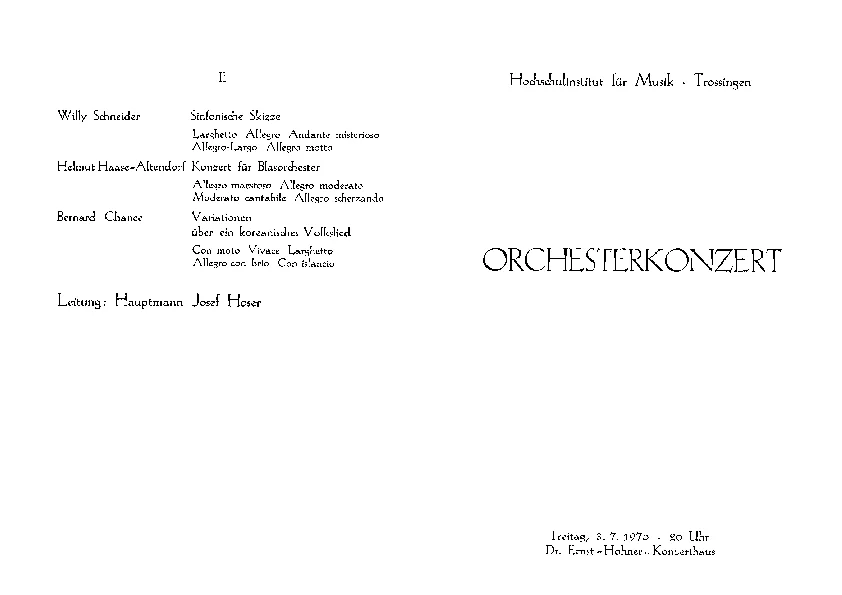
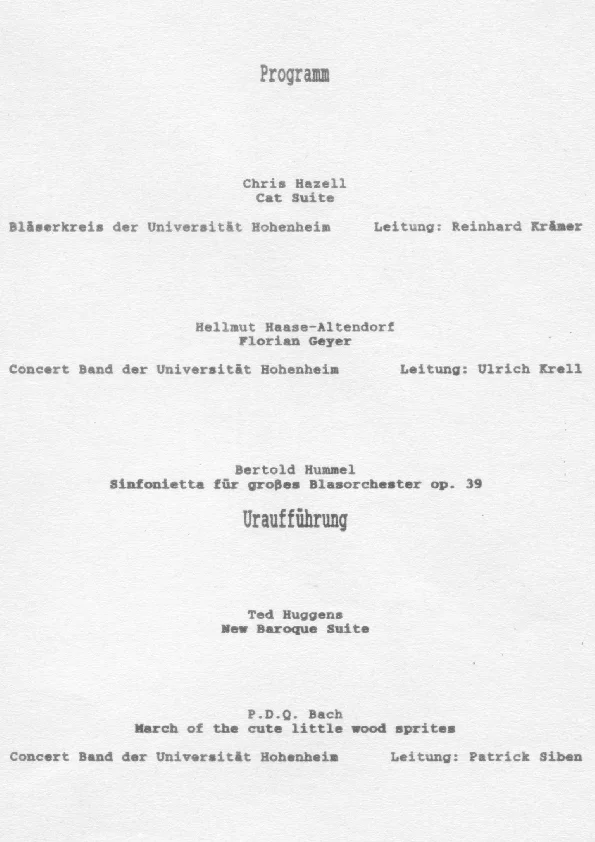
10th Army Music Corps Ulm | Simon Dach (first version without fanfare)
Hohenheim University Concert Band | Patrick Siben (final version with fanfare)
Title: "Sinfonietta" f." gr. wind orchestra (sic.) - Length: 67 pages - Date: 14 April 70 - Storage location: -
Publisher: N. Simrock Hamburg-London (Boosey & Hawkes)
Score and parts: ISMN M-2211-1813-4
Score: ISMN M-2211-1812-7

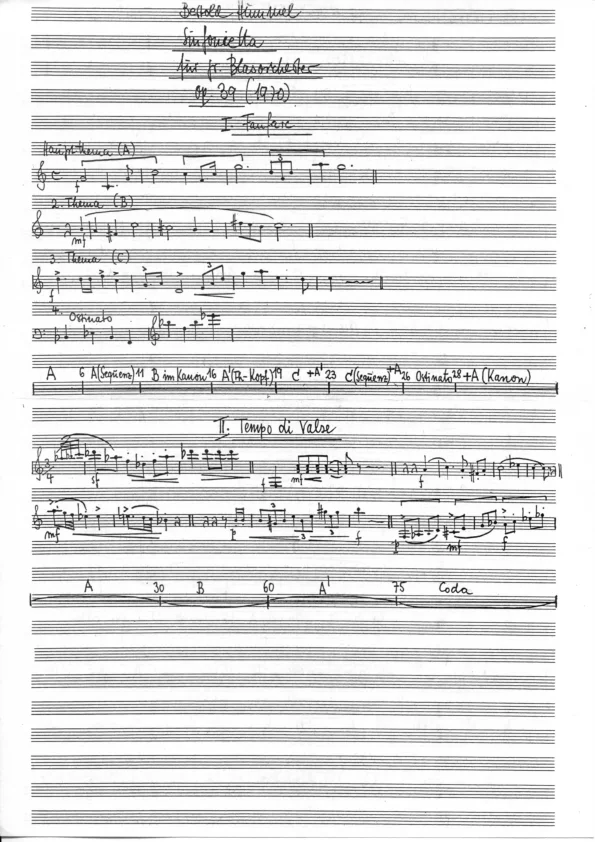
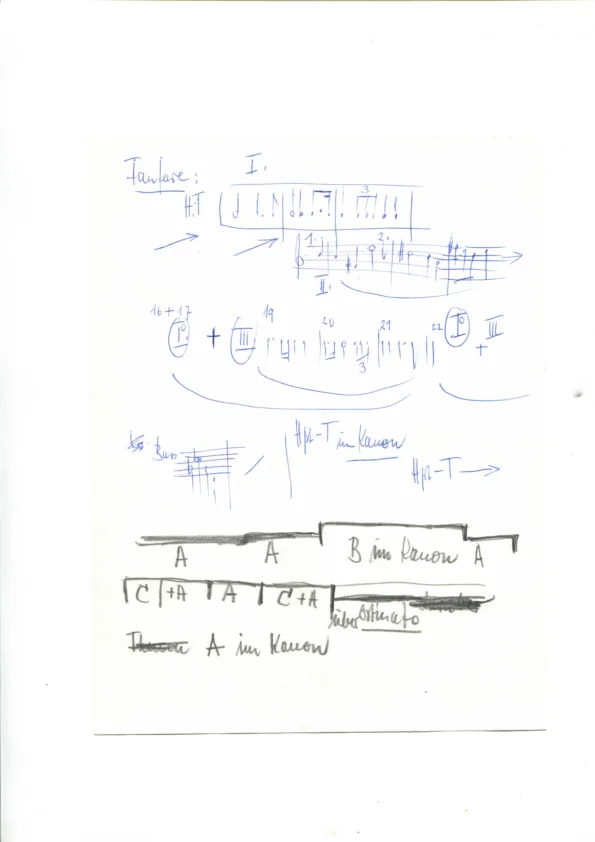
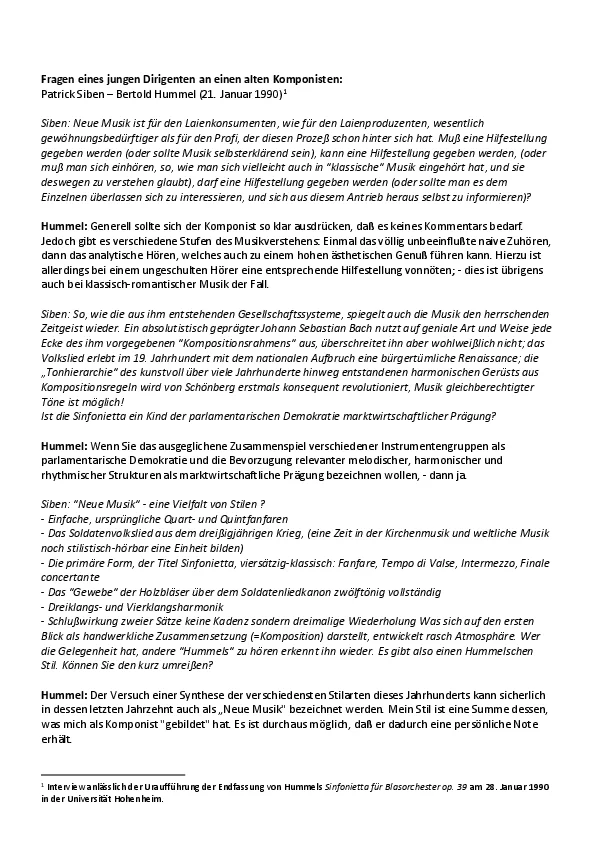
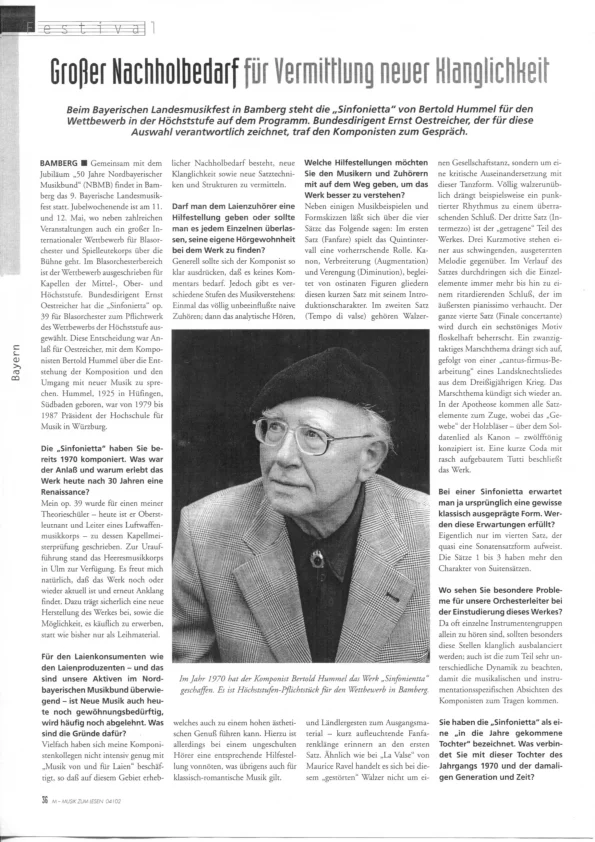




The fifth interval plays a predominant role in the first movement Fanfare. Canon, widening (augmentation) and narrowing (diminution), accompanied by ostinato figures, structure this short movement with its introductory character.
In the second movement Tempo di valse, waltz and ländler gestures are part of the basic material - briefly flashing fanfare sounds are reminiscent of the first movement. Similar to "La Valse" by Maurice Ravel, this "disturbed" waltz is not a ballroom dance, but a critical examination of this dance form. Completely unusual for a waltz, for example, a dotted rhythm leads to a surprising conclusion.
The third movement, Intermezzo, is the "sustained" part of the work. Three short motifs are juxtaposed with an expansive, ornamented melody. In the course of the movement, the individual elements become more and more intertwined until a ritardising conclusion, which fades away in the extreme pianissimo.
The entire fourth movement, Finale concertante, is dominated by a six-note motif. A twenty-bar march theme imposes itself, followed by a "cantus firmus" arrangement of a lansquenet song from the Thirty Years' War. The march theme announces itself again. In the apotheosis, all movement elements come into play, whereby the "fabric" of the woodwinds - over the soldier's song as a canon - is conceived in twelve tones. A short coda with a rapidly building tutti concludes the work.
Bertold Hummel
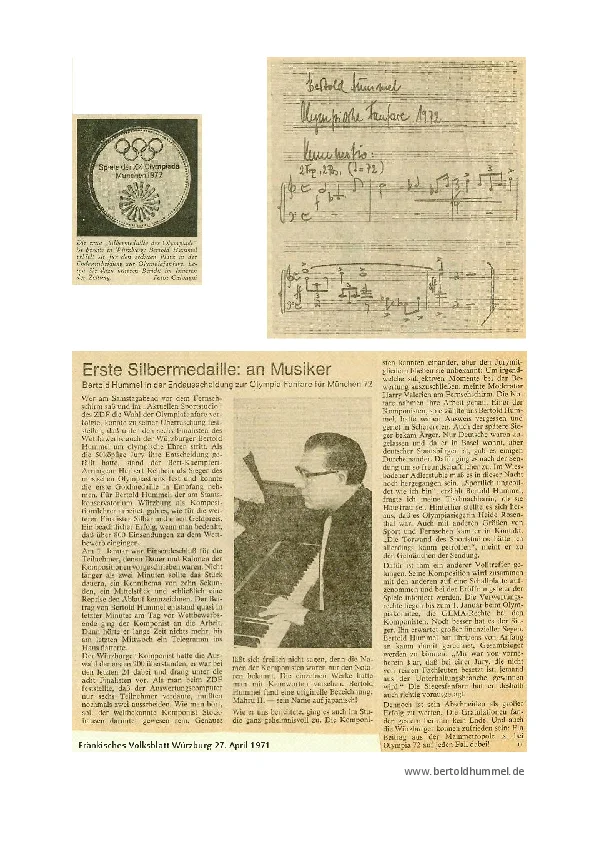
With the 1st movement "Fanfare" (in a slimmer instrumentation) Bertold Hummel applied for the 1972 Olympic fanfare in Munich and was awarded an Olympic silver medal.
At the end of these reflections on Bertold Hummel's symphonies, it is necessary to mention his work for amateur music-making. In this area he is fully in the tradition of his teachers Genzmer and Hindemith, who also never lost touch with the practice of non-professional musicians. Naturally, the following maxim applies: the simpler the concept, the more diatonic and reduced the building blocks and sounds. The aspect of colour then recedes into the background and the compositional fracture is more strongly determined by graphic, linear structures, which appear much more conventional.
Of the symphonic works, the pieces for wind orchestra are among the simpler compositions. The "Sinfonietta" op. 39, written in 1970, and the "Musica Urbana" op. 81c, which Hummel composed in 1983 and which was launched a year later in his birthplace of Hüfingen under his direction with local players, were composed expressly for amateurs. In 1977, Hummel created the "Oregon Symphony" op. 67, which was performed for the first time on 7 April 1978 in Ashland/Oregon (USA) in the presence of the composer. Nine years later, on the occasion of his second trip to the USA, Hummel took the "Symphonic Overture" op. 81d (the extended first movement of the "Oregon Symphony") with him in his luggage and premiered it on 21 November 1987 in Seattle with the W.I.B.C. Directors Band.
Claus Kühnl (in "Die sinfonischen Werke Bertold Hummels", Tutzing, 1998)