2nd string quartet (op. 46, 1972)
I. Mosaics, II. Lamentationes
2 Violins, Viola, Violoncello
Duration: 11 minutes
Sinnhoffer Quartet (Ingo Sinnhoffer | Werner Grobholz | Herbert Blendinger | Franz Amann)
N. Simrock Hamburg-London (Boosey & Hawkes) Pocket score: ISMN M-2211-1330-6 | Parts: ISMN M-2211-1329-0
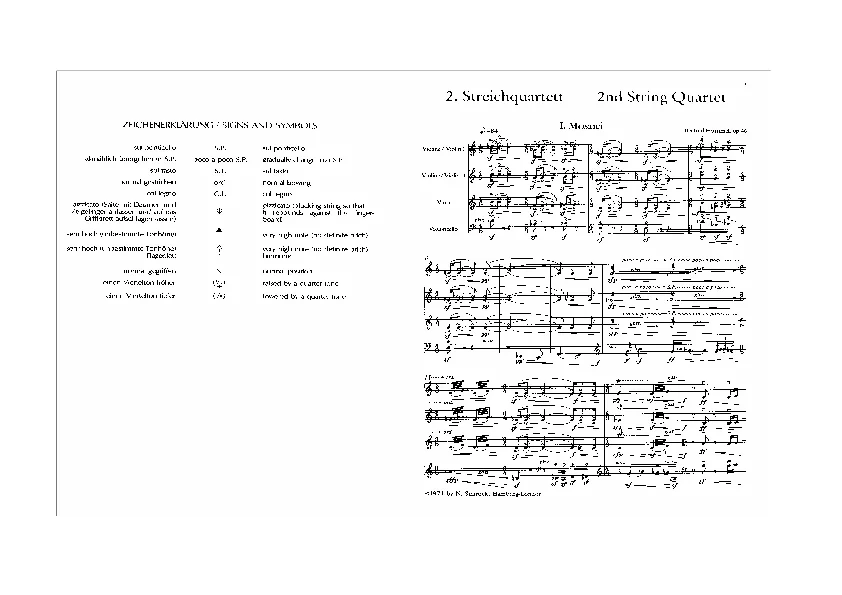
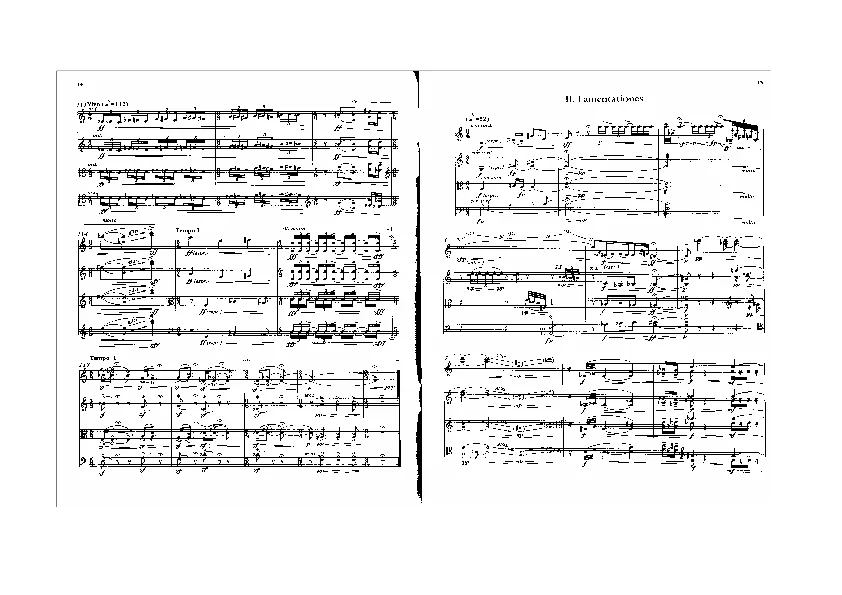
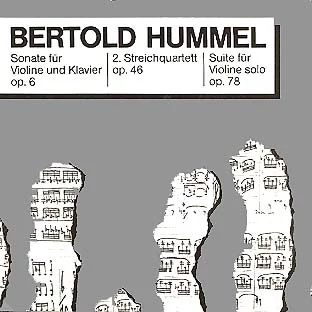
The 2nd String Quartet (1972) by Bertold Hummel is an example of responsible engagement with the genre tradition without any loss of personal style and will to form.
In the first movement ("Mosaici"), elements of the sonata form are reflected and revitalised in the sense of individual expression by incorporating a wide variety of string techniques, with the intervallic structure of small motif cells dominating the treatment of the material. Glissandi, already played in parallel several times in this movement, take on an increasingly constructive significance in the second ("Lamentationes"). In addition, horizontal reflections and a kind of whole-tone scale-related mixture formation take on a formative function in this movement, which is also characterised by motifs. The special merit of this work lies in the compositionally utilised combination of string technique and motivic work.
... a well-performed quartet movement, finely worked out, tonally distinct and harmonious ...




The two movements of the Second String Quartet are entitled "Mosaici " and "Lamentationes". In the first case, the title provides a general visualisation of the movement structure. This presents itself as a differentiated network composed of two specific four-note motifs. The diverse"mosaic"-like constellations and changes of these elementary building blocks result in a constantly changing, colourfully iridescent sound. The tone constellation B-A-C-H plays an essential role in the processing of the four-tone components. The constant presence of three times four tones suggests twelve-tone condensations as an obvious principle within the movement. However, the composer does not subject himself to the strict consistency of dodecaphonic rules (such as Anton Webern), but rather"freely" disposes of the formation of twelve-tone constellations both in the temporal succession and simultaneity of the tones. A cello solo forms the formal centre of the first movement. Corresponding development sections are arranged concentrically around it. The beginning of the movement is echoed at the end of the movement.
In the case of the"Lamentationes", the title refers to the recitation formula according to which the"Lamentations" of the prophet Jeremiah are sung. The liturgical model enters into linear interweavings in the three-part movement and is subjected to manifold transformations. For the tonal realisation of the movement structures, the composer demands that the players use all playing techniques that string instruments allow, both the usual and the unusual.
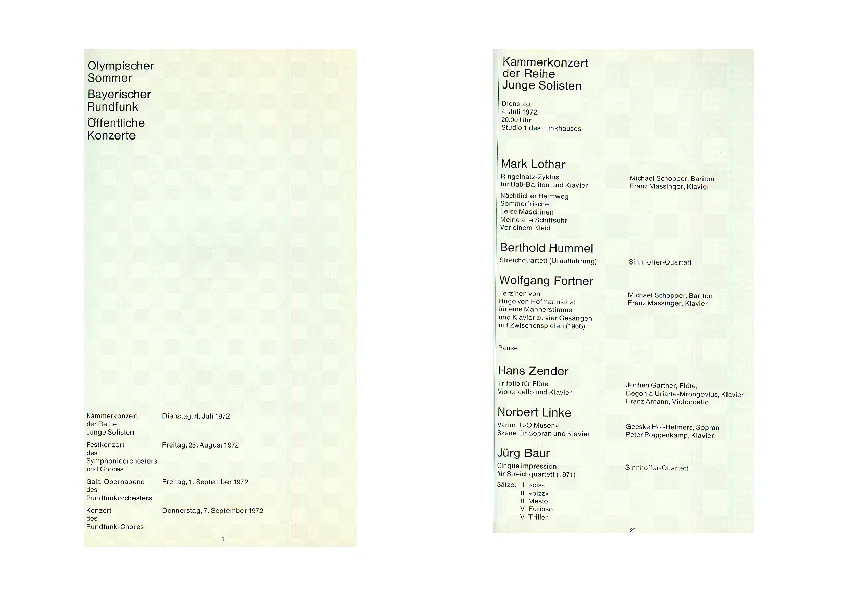
The "2nd String Quartet" op. 46 was commissioned by Bayerischer Rundfunk and premiered at the opening of the "Olympic Summer" concert series in Munich in 1972.
Bertold Hummel
Bertold Hummel was commissioned by Bavarian Radio to write his 2nd String Quartet in 1972, which was premiered by the Sinnhoffer Quartet in a public concert in Munich at the opening of the"Olympic Summer" concert series.
The first movement is entitled"Mosaici". This title can be applied to the movement in different ways. The first thing that strikes the listener is the glassy, bright and luminous overall sound, which is based on compact harmonics and similar sound distortions and is reminiscent of the colour impressions of blue and gold mosaics with a high luminosity and an iridescent surface depending on the incidence of light. However, there is an interpretation that touches far more on the actual formal principle. Small groups of four notes, whose interval constructions are utilised in the sense of Webern's germ cells by unfolding and projecting them into the chordal, result in a dense, almost two-dimensional sound that changes in small groups. This principle, which Hummel used extenso for the first time in his "Metamorphosen über B-A-C-H" (1971) and led to an idiosyncratic solution, is taken up here and intensified in the minutiae. To explain this briefly: In the sense of classical thematic dualism, not just one but two different motivic germ cells (groups of four tones) appear in the quartet, the different constellations of which provide the friction surface for large-scale formal development sections. By twisting the B-A-C-B construction as a third component, i.e. seconds, thirds and their octave displacement, the groupings are fused together. This creates the basis for classical sonata form without the possibility of dramatic development. The culmination point therefore lies in the centre of the first movement in a free passage of the cello marked "quasi cadenza" , in which the heterogeneous particles are brought to a synthesis. Executing, expository and reprise-like sections are arranged largely symmetrically around this centre until the movement concludes with an association of the first beginning.
In the spirit of twelve-tone condensed detail, the movement is basically a permanent development with certain retarding episodes, and, in the wake of corresponding compositional practice, everything is derived horizontally and vertically from the motivic cells. Nevertheless, the movement cannot be described as orthodox dodecaphonal, because the twelve-tone surfaces always arise from an addition to the existing, motivically already determined, to the presence of all tones in a relatively free tone sequence. Furthermore, it is often less the logically deducible interval and pitch relationships than the expressive qualities of high expressivity that determine the sequence and make it easy to overhear. These qualities also incorporate sound techniques of the most modern string treatment, but - as already described - these are functionally bound and used less as an effect for their own sake.
Reflections and inversions and a large tripartite structure characterise the large-scale form of the concluding slow second movement entitled"Lamentationes". The movement quotes the lamentation tone of the Lamentationes Jeremiae, but is so interwoven into motivic sequences that its origin is no longer dominant. The composer utilises the possibilities of expressive linearity even more strongly here than in the first movement. Particular mention should be made of the process of the gradual binding of a tutti glissando, which initially seems to be used quite externally and which appears to melt more strongly into the linearity with each return, until it consistently grows out of the final chord as the last gesture at the very end and makes audible a cancellation of the tonal relationship, possibly even of the sound itself. One thinks of corresponding final endings that call into question what was previously formed, such as in Berg's Lyric Suite or Hindemith's Solo Violin Sonata. This is a very plausible finality here, which does not sound strange at all in view of the undramatic and symmetrical formal progression around a culmination point from the outset.
The quartet is a résumé of all the experiences possible for a composer at this time, and the real novelty of this quartet lies precisely in this fusion of modern string practices - as Hummel already applied them in his "Klangfiguren" - with the motivic-logical organisation of details. What emerges is new, even if it does not shock with anything unusual.
It would be pointless to always look for models for everything. Of course, the two-movement fast-slow sequence has existed before, and listeners have certainly encountered the string effects before, but that is not the point. What is decisive is that an independent work has been created on the basis of precise knowledge of the best quartet compositions, which testifies to a great sense of responsibility and historical awareness.
In it, Hummel has taken stock of everything which, as a background to tradition, prompts him to engage in constant intellectual dialogue.
Klaus Hinrich Stahmer (programme booklet 21.1.1980, Studio for New Music, Würzburg)
In May 1981, Bertold Hummel said in a letter to his friend and conductor Günther Wich that he could also imagine his 2nd String Quartet op. 46 in a choreographed interpretation.