Sound figures for strings (op. 43, 1971/1972)
I., II., III.
Strings (17 solo strings)
Duration: 10 minutes
Camerata Academica Salzburg | Marian Waskiewicz
Title: Klangfiguren - Length: 22 pages - Date: I. 14 July 71 II. 26 July 71 III. 15.I.72 - Location:
Schott Musik International ED 6542 / ISMN: 979-0-001-06959-5 (score and parts are for sale)

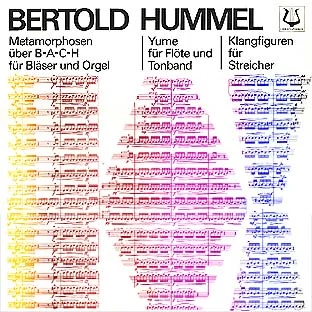
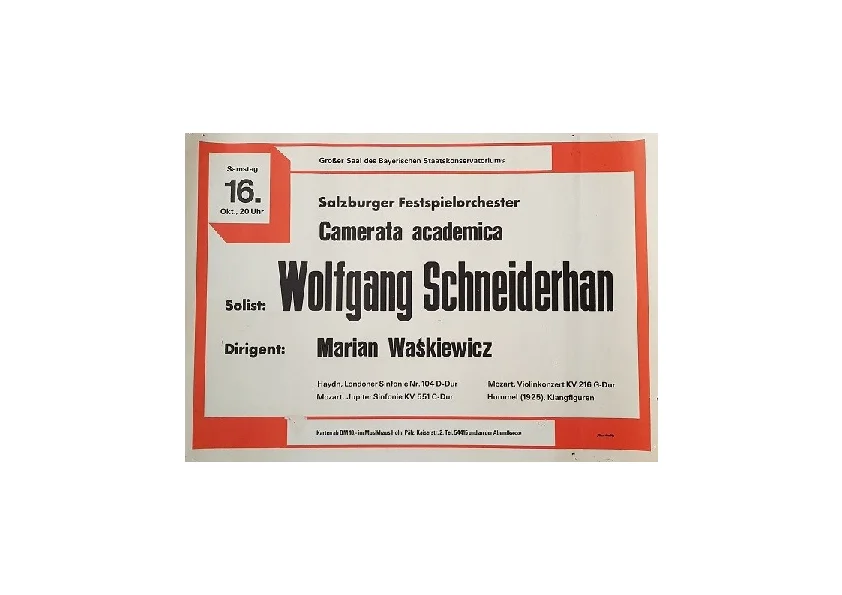
The first movement in particular, which is dense and at times worked in a linear dialogue, left a strong impression. But the unravelling bizarre gestures of figure II and the partly neo-expressionistic, partly "spherical" outbursts and layers of sound in the finale were also captivating.
Bertold Hummel called the opus for 24 strings commissioned by the Camerata Academica in 1971Klangfiguren 1 and 2 - it could also be called"Musikalisches Mobile". Movement of sound is its most prominent feature, technology in its fluctuation - once without electronics - translated purely instrumentally into music. The constant change from glistening shimmering(figure 1) or pizzicato clusters of notes(figure 2) to energetically contrasting blocks of sound, the contrast between logical, compulsive development and the deliberately rough sequence of independent clusters of sounds, between melodic interjections and atonally condensed translations of abstract-optical forms into sounding shapes - all this is what makes this short and entertaining work so appealing.
"Sound Figures by Bertold Hummel" - Experiences of an amateur orchestra with the avant-garde
The Amberg Chamber Orchestra (8/8/4/4/3) chose this work for its 1986 autumn concert alongside Mozart and Stamitz - a sharper contrast is hardly conceivable. The very first rehearsal showed that completely new demands were being made on the players: firstly in the instrumentation (violins divided tenfold, violas and cellos each divided threefold), but also in the playing technique, because Hummel demands harmonics, playing on the bridge, glissandi, string strikes on the fingerboard etc. Especially when it came to listening habits, some people had to rethink: it's not easy to play an "a" when the person next to you is playing "a sharp", the back desk is playing "b" and "c", and so on. However, this work by Hummel thrives precisely on such "clusters". Under our conductor Peter K. Donhauser, we worked through the three movements literally 'bar by bar' in order to capture all the tonal and rhythmic subtleties with which, for example, doubt, hesitation, sudden decision etc. are musically represented.
Perhaps the most important thing for many of our orchestra members was the realisation that the half and whole tone steps in the clusters must be intoned cleanly - even and especially in modern music you can hear impurities! But then came the anxious question: can we expect "something so avant-garde" from our conservative audience, which tends to be "favourably hostile" towards modern music? We took a chance, the conductor spoke a few introductory words and played a few bars and clusters. After the performance: no ovations, but unusually long and friendly applause.
Detlef Barth, Amberg Chamber Orchestra
... a beautiful-sounding and effective piece, music of a free-tonal quasi-impressionism, which should be a pleasant change for chamber orchestras that are primarily focussed on baroque music.
Wolfram Schwinger




Klangfiguren op. 43 was commissioned by the Camerata academica of the Mozarteum Salzburg and has been performed and recorded by several orchestras since its premiere.
In three loosely linked movements, the technical possibilities of 17 solo string players are organised in a variety of ways to create a mobile of changing sounds. The high degree of fusion of the string instruments creates imaginative sound mixtures that take on various degrees of movement, directionality or density. The colourful and attractive sound moments grow apart and form a shape whose idea is fluctuation. Visual ideas such as triangular rotations and the space-time figurations of a mobile provide the basis for the design. The two outer movements are similar in their formal idea and form a symmetrical frame around the jokingly dabbed middle movement. The finale, with the sonorous pathos of a slow movement, brings the "symphonie en miniature" to a close.
Bertold Hummel
Preliminary remarks (Schott ED 6542)
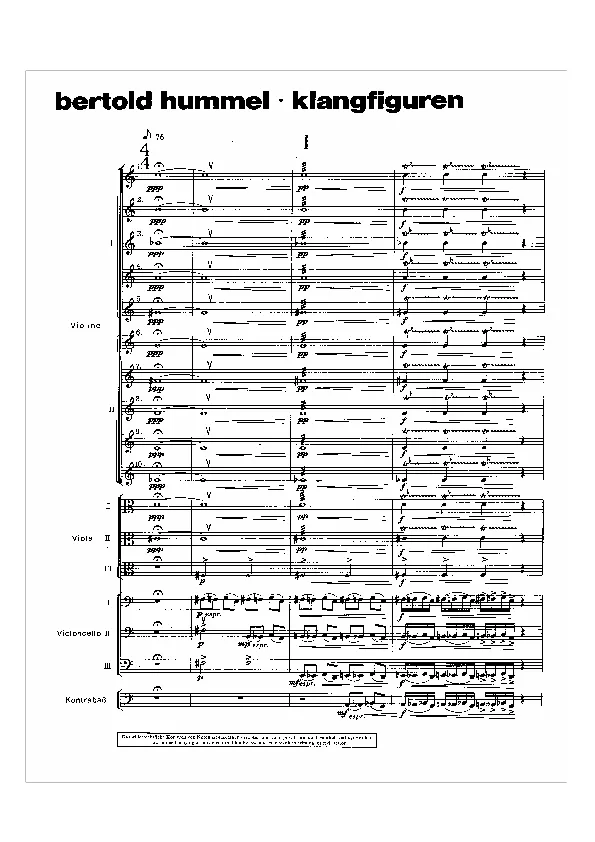
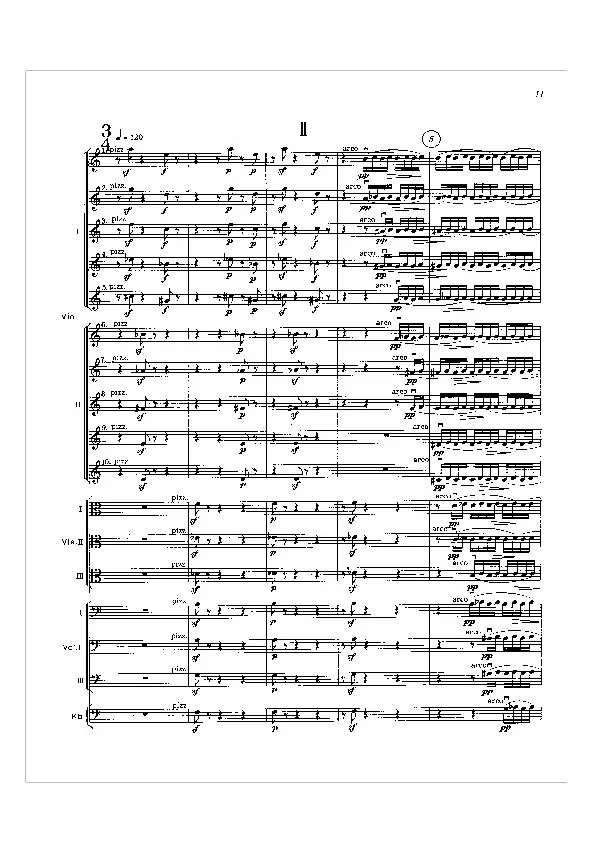
In the sound figures, sounds and playing techniques of New Music, such as clusters (tone clusters), polyphonic chord formations, sound superimpositions, polyrhythms etc. are fixed in exact notation. Klangfigur II, for example, demonstrates the transformation of geometric figures into musical structure. Because of its deliberately simple playing technique in all parts, the main purpose of the work is to be used in orchestral education, especially with amateur orchestras. The effect of the tonal figures depends essentially on a detailed development of the dynamics, tone colour and intonation in the individual voice groups. It is therefore advisable to rehearse the groups that belong together, as they are easily recognisable in the score, separately and thoroughly and to make them aware of the musical processes by listening. In the written-out clusters, as far as possible no individual voices should emerge from the overall sound: this can be studied very well, for example, in bars 1 - 4 of the first piece with violins 1 - 10, viola 1 and 2. It is therefore important that the sound figures, which are composed of many individual elements in a mosaic-like manner, produce a well-balanced overall impression at the end. This should be achieved by a careful, new kind of aural training of the individual player in the sense described above. The realisation of the sound figures is quite within the reach of amateur orchestras, but the pieces can also serve qualified chamber orchestras as useful 'etudes' when developing new musical means or expanding their repertoire. The individual parts are precisely labelled for quicker access to the musical task.
In the three-movement cycle Klangfiguren op. 43, composed in 1971 as a commission from the Camerata academica of the Mozarteum Salzburg and premiered there on 2 October of the same year, densely worked and multi-layered blocks of sound are derived from the division of the string orchestra into 17 individual voices. In addition to passages of polyphonic, linear polyphony - e.g. in the first movement - there are chromatically filled clusters with a strong effect. The expressive content of such tone clusters is of secondary importance compared to the formal and structural structure of the entire composition, which takes centre stage.
The chromatic total is expanded linearly and simultaneously in the opening section of the 1st movement . This is followed by two longer sections in which - based on a four-note model - different types of interweaving of linear and chordal processes take place. The uniformity of the chromaticism in all dimensions gives coherence to the relatively short, cell-like motif structures, which lend the sound network an animated inner life.
Geometric figures such as the rhombus, triangle and rectangle give the 2nd movement contours, with a variety of playing techniques on the string instruments providing the colouring.
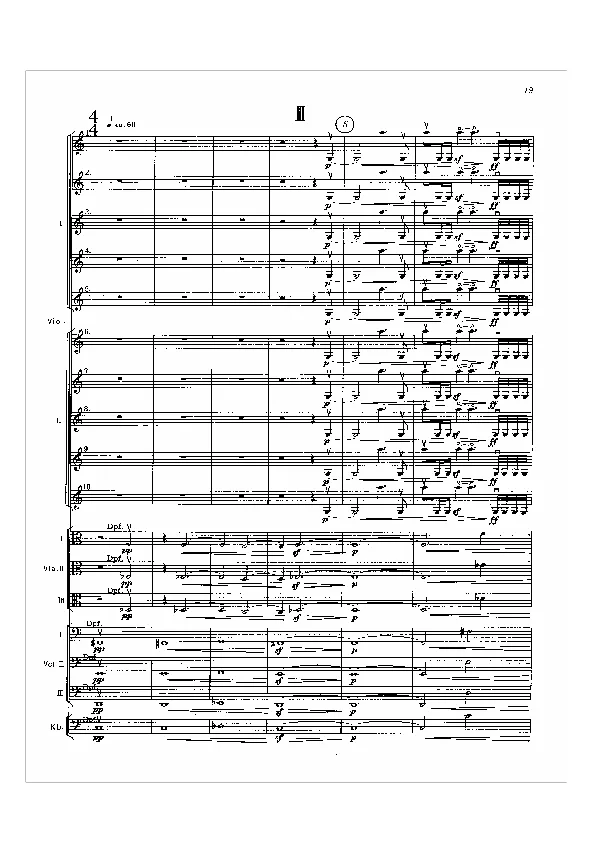
The 3rd movement takes up the motivic compositional technique of the 1st movement again, but derives a greater variety of melodic structures from the total of possible intervallic relationships. The first section opens up the range of intervals from the minor second (melodically exposed) to the major second (chordally exposed) to thirds and fourths. Tritone structures dominate the melody of the powerful second section. The final section begins with a reminiscence of the beginning of the movement, but allows the structures of the first two sections to grow together in a kind of synthesis and swing out in longer melodic arcs before clearly perceptible fourth-fourth structures introduce the closing of the intervallic fan back to the second in the coda.
Dr Klaus H. Stahmer
In May 1981, Bertold Hummel said in a letter to his friend and conductor Günther Wich that he could also imagine his Klangfiguren op. 43 in a choreographed interpretation.