Metamorphoses on the name B-A-C-H for organ and wind instruments (op. 40, 1971)
Dedicated to the memory of my mother
I. Fantasie, II. Choral, III. Toccata
Organ, 2 high, English horn, 2 bassoons, 3 trumpets in C <1. also high B>, 3 trombones
Duration: 22 minutes
Paul Damjakob | Kurt Hausmann | Yashuhito Yamamoto | Ernst-Martin Eras | Karl Kolbinger | Eberhard Buschmann | Edward Tarr Wind Ensemble
Conductor: Christian Fröhlich
Title: Metamorphosen über den Namen "B-A-C-H" für Orgel und Bläser op. 40 written on behalf of the J.S.Bach-Gesellschaft Würzburg - Length: 88 pages - Dated: I. 25.Aug.71 II. 9.Sept.71 III. 5.Oct.71 - Location: Bayerische Staatsbibliothek München
N. Simrock Hamburg-London (Boosey & Hawkes): Loan material
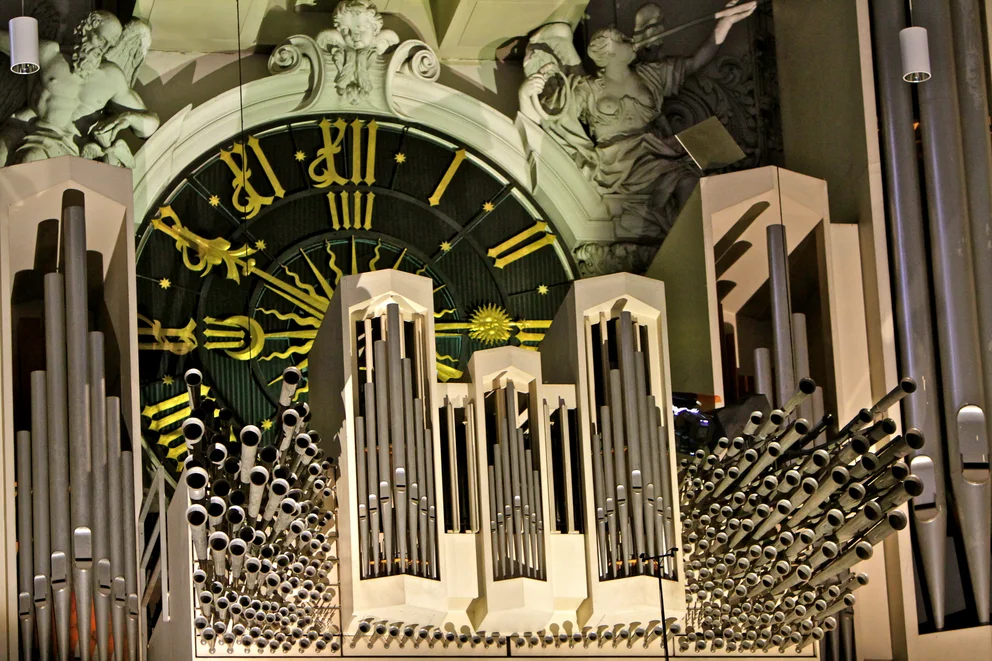
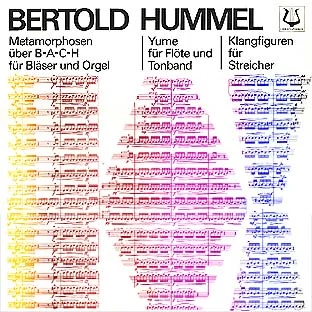
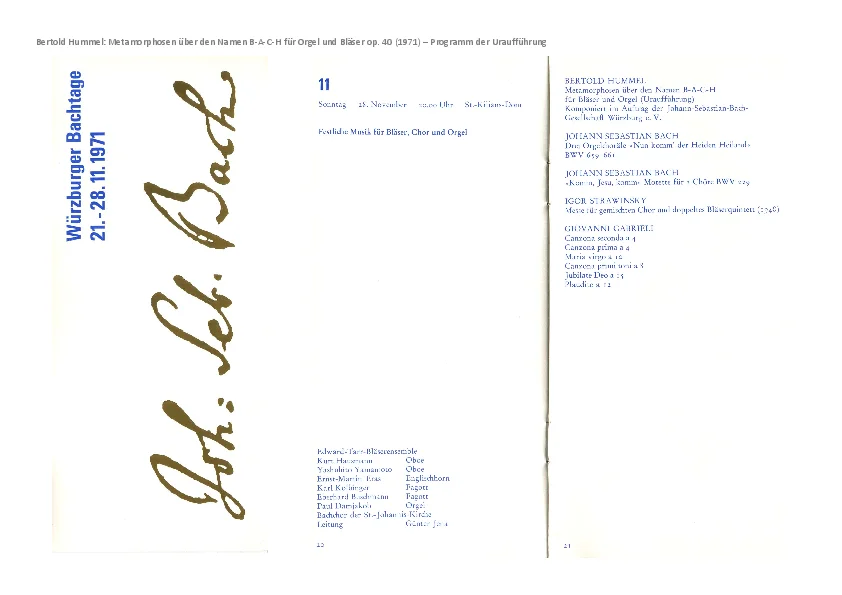
At the end, a highlight not only of this individual concert: Bertold Hummel's "Methamorphosen über B-A-C-H", a painful, haunting, great work.
In his three-movement work - Fantasia, Choral, Toccata - Hummel uses the theme as a building block, as a recurring stopping point; but how differently he worked with the sequence of notes than his predecessors! He uses the classical means of counterpoint; but in addition to inversion and retrograde, augmentation and diminution (down to the minor second), canon and fugato, there are new sound structures with massed clusters of notes, dissonant garlands, torn chord strikes; Hummel knows how to combine the - seemingly contradictory - musical worlds to synthesise an inherently harmonious expression of sound. The fantasy thrives on the constantly varying dialogue between the organ (with quasi-cadenza) and the winds. Haßler's melody "O Haupt voll Blut und Wunden" (O head full of blood and wounds) sounds very distant as a counter-theme in the second movement, which is characterised as a chorale. In the monumental toccata, the B-A-C-H is developed in multiple twists and turns until it dissolves into organ runs and swells, freely soloised (oboe, trumpet), lightly developed in chamber music and finally intensified to a full tutti.
In this opus, counterpoints and flashing cluster chains, meticulously chiselled filigree work and massive clusters of sound arch over a spacious, Baroque-like sound architecture. In the first movement,"Thema-Fantasie", the organ and winds play the B-A-C-B motif in a varied manner; in the chorale movement, the sound spectrum expands, but is repeatedly extinguished to allow sharply lined, chorale-like paraphrases to emerge. The organ, brass and woodwinds build up to an impressive tutti in the third movement, entitled"Toccata".
The"Metamorphoses on B-A-C-H" were performed in a highly impressive manner. Under the expert direction of M. Lehmann, Krause and the wind ensemble of the"basel sinfonietta" did not fail to live up to the quasi-symphonic character and tonal opulence of the work, which was composed in 1971. As for the B-A-C-H theme: it couldn't be more memorable.




The three-movement cycle Metamorphosen über den Namen B-A-C-H op. 40 was composed in 1971 in memory of the death of my mother and is based on the famous four-tone model already used by Bach, which has fascinated and inspired composers throughout the ages. Here it is fused with the techniques of twelve-tone music and provides the basis for the great variety of all chordal and melodic structures. At the beginning of the first movement, it is presented by the organ in its basic form like a motto, before appearing transposed, transformed and processed in a variety of ways in the form of a fantasy. There is not a single bar where the second-third-second model does not appear in one way or another. The organ and wind ensemble initially face each other like a dialogue in larger formal blocks, only to be interlocked with each other later on in the condensed movement or isolated at a central point like a cadenza. At the centre of the composition is the chorale "Wenn ich einmal soll scheiden" performed by the solo trumpet, which evokes thoughts of death and Bach's great Passion settings. The chorale lines are framed by melodic filigree and wind tutti, both again developed from the four-note model B-A-C-B. The baroque toccata in its additive sequence of varied, joyful sections provided the model for the final movement. Here, the contrasting sections - massive chordal towers, virtuoso passagework and cantabile wind ariosi - follow one another without any incoherent arbitrariness: The notes B-A-C-B, which also reappear in their original form at the very end, ensure coherence.
Bertold Hummel / Klaus H. Stahmer 1984
The theme is introduced very cautiously by the organ. The dramatic dialogue between the organ and winds, described as a fantasy - a kind of permanent development of the theme - leads to a solo cadenza by the organ, in which the technical possibilities of the instrument are used, which also leads into a condensed recapitulation. Here the dramatic situation of the first part is taken up again and brought to a conclusion.
The second movement focuses on the chorale "O Haupt voll Blut und Wunden", which is of particular importance in Bach's oeuvre, counterpointed by B flat-A-C-B reflections in arabesque lines. The chorale-free sections have their own development, which finally leads to an episode of extreme calm and relaxation.
The last part of the work is a toccata developed solely from the 4-note motif; concertante elements emerge and are played back to each other by the two instrumental groups, twice abruptly interrupted by recitatives by solo oboe and solo trumpet with subsequent arioso sections. Towards the end of the movement, the structure becomes denser, all the elements of the movement are taken up, leading to an expansive conclusion.
Bertold Hummel 1971
Interview for Bavarian Broadcasting Corporation 1974
Klaushinrich Stahmer:
The paraphrasing of the name B-A-C-H is not just a tribute to the person who commissioned the work, the Würzburg Bach Society. Mr Hummel, what effect do you think Johann Sebastian Bach's work still has after more than 200 years?
Bertold Hummel
The degree of perfection is probably the reason why Bach's works still have a worldwide impact today.
K.S.:
Are there any points of reference for New Music in this?
B.H.:
The polyphony, concertante elements of the Baroque, serial thought models of the highest intellectual discipline are things that can provide the contemporary composer with a wealth of inspiration. Movement types such as fantasia, organ chorale and toccata inspired me to write the above-mentioned work.
K.S.:
Could you say what significance the sacred reference has for your work or, more generally, what role sacred music can play in new music?
B.H.:
I am of the opinion that the sacred space is more suitable than almost any other for conveying a comprehensive spiritual communication. The opportunity to reach the listener, to find him in a self-chosen open-mindedness, is given here like hardly anywhere else.