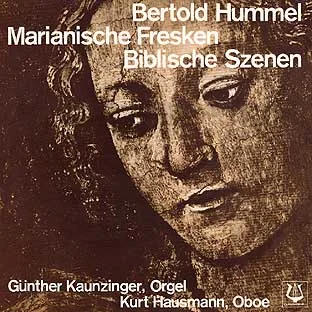
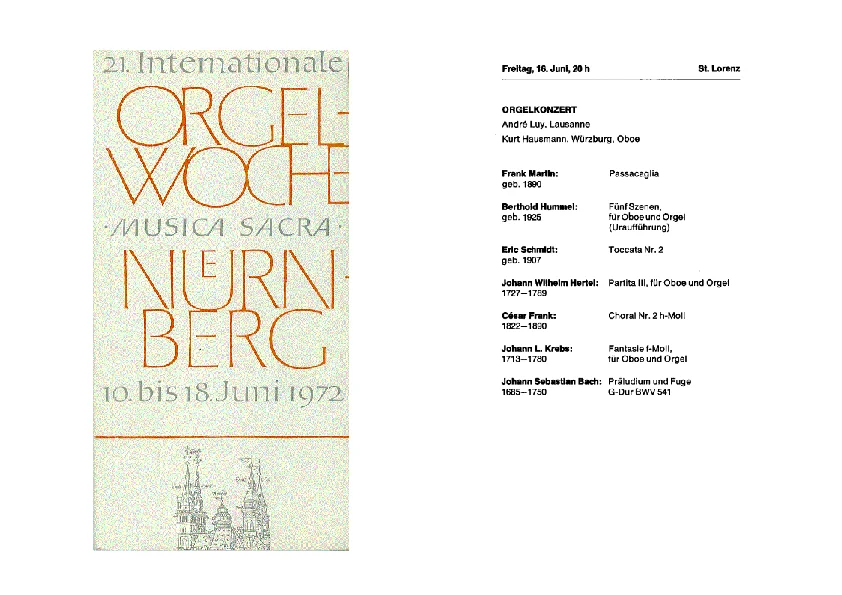
Biblical scenes for oboe and organ (op. 45, 1972)
I. The rebellion of the people, II The faith of Noah, III The Flood, IV The salvation of the ark, V The rainbow
Oboe, organ
Duration: 17 minutes
Kurt Hausmann / André Luy
N. Simrock Hamburg-London (Boosey & Hawkes) ISMN M-2211-0853-1
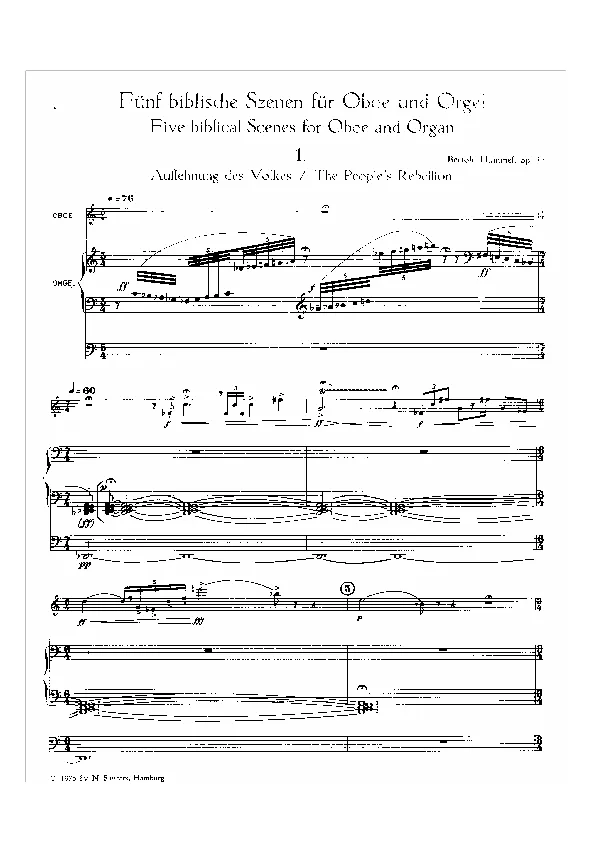
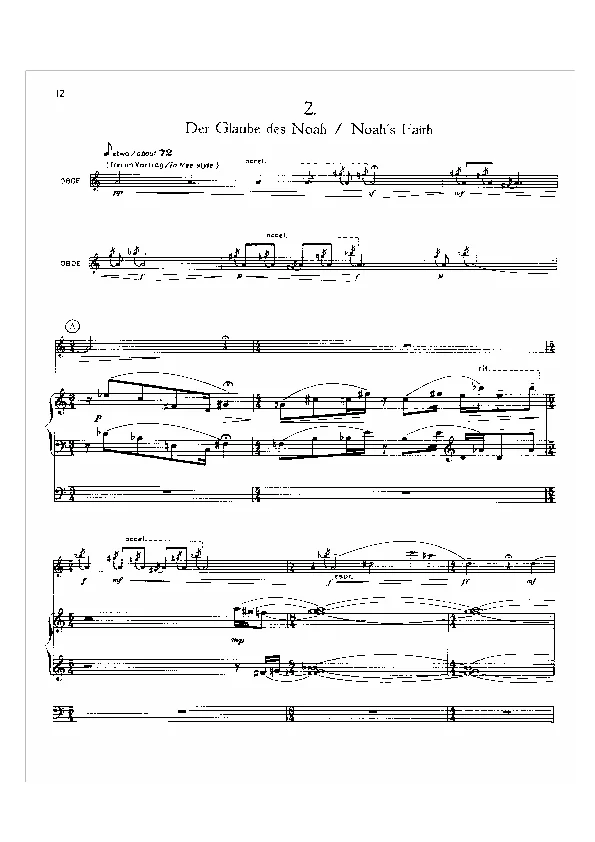

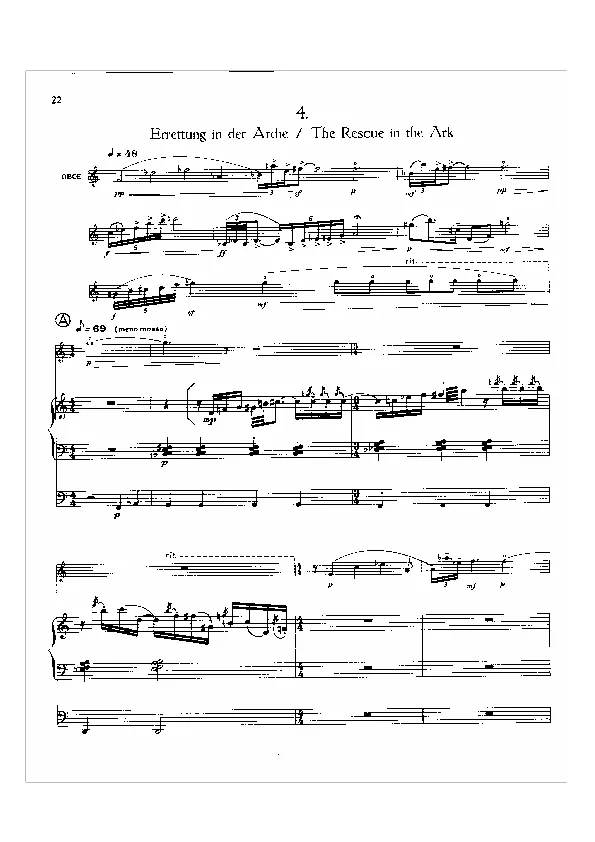
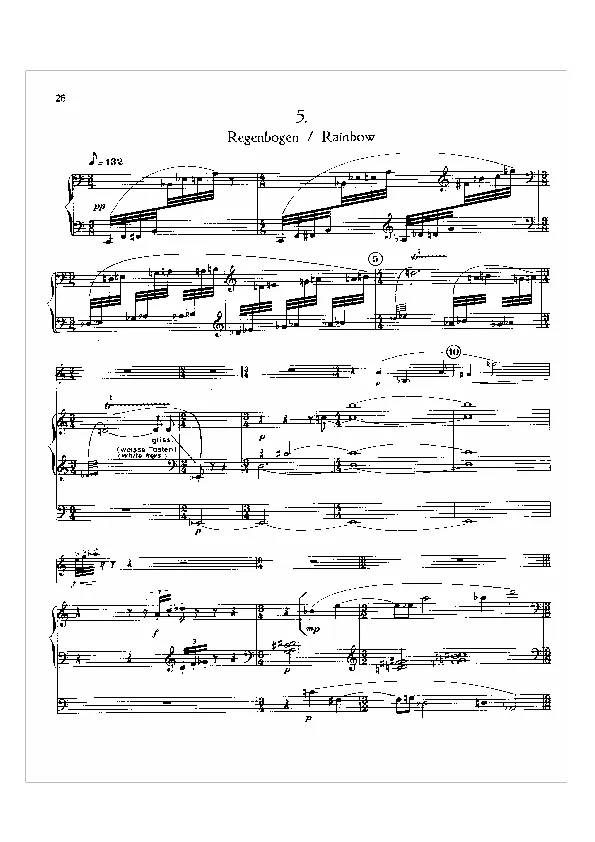

In the "Biblical Scenes", the organ and oboe paraphrase texts from Genesis. Five movements that evoke formal associations such as toccata, meditation, fantasy, elegy and contemplation in the sense of late Romantic, especially French organ music. The oboe repeatedly breaks up the form, creates points of calm, caesuras, works alternatively or additively with the organ. Cantabile, even more expressive solo figures are assigned to it, into which the organ then enters, there are two-part pedal lines, motivic work grows out of recitative-like passages, sharp oboe cries clash with the organ's massive mixtures to create dramatic scenes. Hummel's "Biblical Scenes" are an example of meditative, text-associative sacred music that is well worth hearing.
With his"Biblical Scenes", Hummel has enriched the relevant literature with a very varied and distinctive work. The elegant melody and the always sonorous movement convincingly express full-blooded musicianship.
It's all about the deluge, and one seems to discover correspondingly illustrative traits in Hummel's sounds, which nevertheless do not slide into the platitudinous or garrulous. Wittmann's oboe can be heard with exalted leaps, but also speaking in gentle lamentation and meditative calm, while Düchtel allows the whole variety of colours of his organ to be heard in often extreme combinations. And he even knows how to skilfully use the special birdcall stops of the Pope Benedict organ as a sign of life reawakening after the catastrophe.
Bertold Hummel's "Five Biblical Scenes" for oboe and organ, inspired by texts from Genesis, concentrate on uniform basic materials, emphasise the consistency of several compositional structures, and reflect the basic spiritual idea of the corresponding text passages in a concise manner through vividness, meditation, underpainting and mental images. Hummel's principle remains true to itself here too: clear form, no unessential disjointedness, a keen sense of refined sound effects and condensed expression.
Hummel's Biblical Scenes, partly meditative, partly programmatic in conception, alternate between simple and bizarre melodic progressions, whereby whole-tone scales - characteristic of Hummel's compositional style - repeatedly stand out. The oboe parts of all the works are in the medium difficulty range, with Hummel's scenes certainly being the most demanding. A pleasing enrichment of the repertoire for this combination of instruments.
Christian Schneider




A uniform basic material determines the consistency of the various compositional structures. Freely declamatory sections are juxtaposed with sections with strict formal sequences. The headings are to be understood as the basic spiritual idea of the corresponding movements. A kind of verbal programme, as Olivier Messiaen, for example, prefaced a number of his works. In concert, it makes sense to place the texts before the individual movements.
Bertold Hummel