Three Marian frescoes for organ (op. 42, 1970)
I. Salve Regina, II. Ave Maris Stella, III. Regina Coeli
Organ
Duration: 19 minutes
Hans Musch
Günther Kaunzinger
N. Simrock Hamburg-London (Boosey & Hawkes)
op.42 No.1 Salve Regina ISMN M-2211-0850-0 | op.42 No.2 Ave maris stella ISMN M-2211-0851-7 | op.42 No.3 Regina coeli ISMN M-2211-0852-4
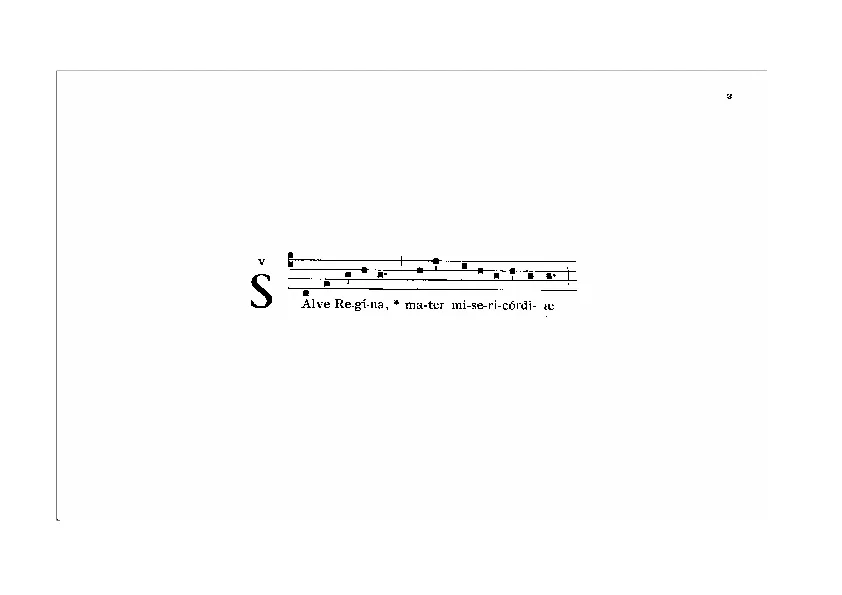
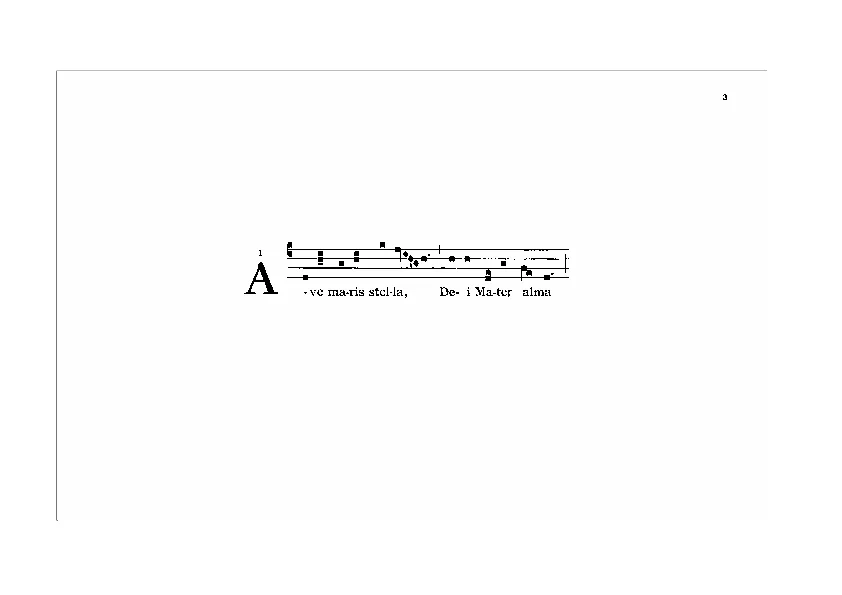
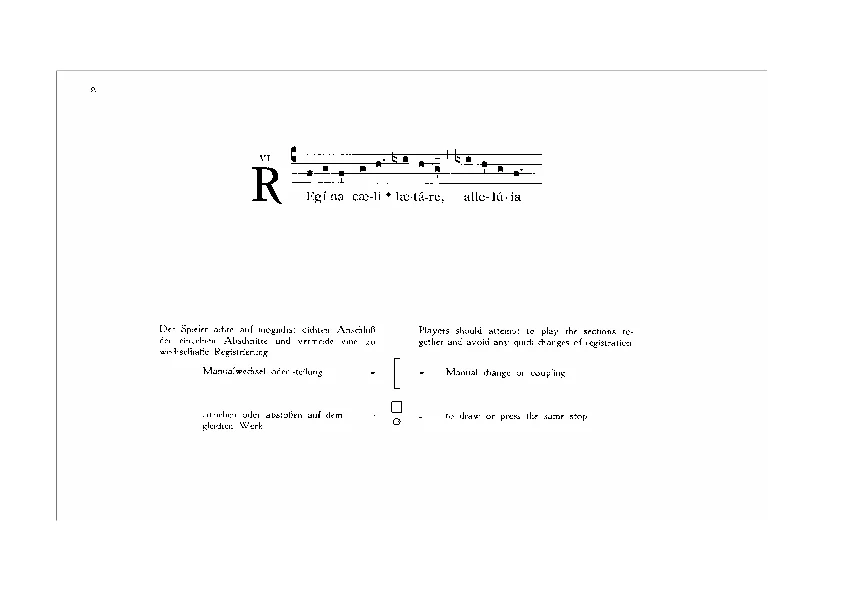
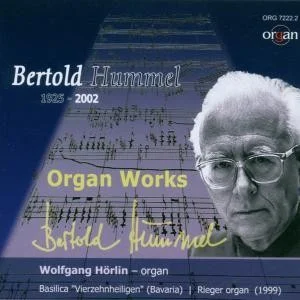
Hummel's"Marian Frescoes" captivate from the first bar, which introduces the Salve Regina like a fanfare. Hummel works masterfully with the organ and the Gregorian material of the three Marian antiphons of the Roman liturgy, allowing quotations to shine through, hiding thematic echoes in multiple paraphrased parts, introducing a cantus firmus , as it were, or powerfully introducing the chorale - as in Regina coeli, which immediately piles up chords over the opening solo pedal. Two festively moving movements exploding with chords frame the calmer, quieter Ave Maris Stella - all three movements are full of tension, dynamics and expression.
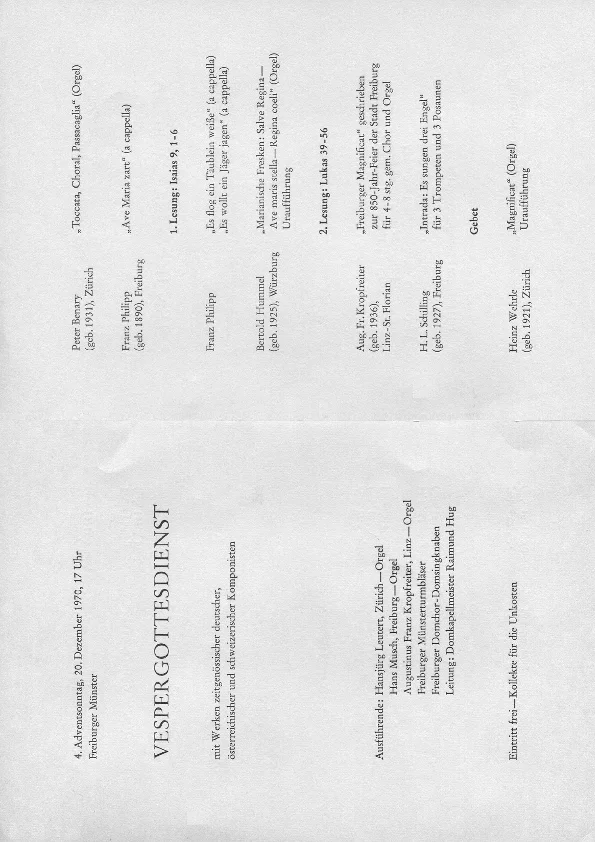
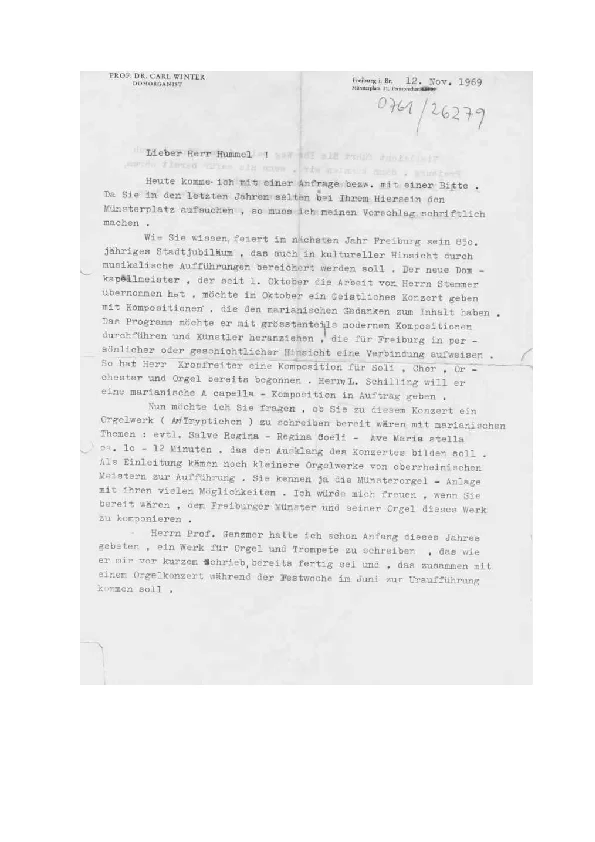
As the final event in the series of concerts celebrating Freiburg's 850th anniversary, Bertold Hummel (composition teacher at the Bavarian State Conservatory in Würzburg), a native of Freiburg, had his say with an attractive world premiere: lecturer Dr Hans Musch created Hummel's "Marianische Fesken" - Salve Regina, Ave maris stella, Regina coeli - in an interplay on the four Freiburg cathedral organs (admittedly from the central console). After one movement had already been presented earlier, the compositional intention was now fully realised in the cyclical relationship and contrast. Bertold Hummel binds gesture-rich, concertante language, often dialoguing, into a strictly structured interplay of forms; proportions and variable repetitions also facilitate access for audiences with a bias towards modern music - a moment in the work of a contemporary that cannot be valued highly enough. In addition, he knows how to select the instrument's resources in a targeted manner and how to colour the lines in a very personal way. The first impression is strongly "French", certainly directly influenced by the Paris State Prize year. In addition, the unique possibilities of the organs in Freiburg Cathedral, which sound "stereophonically" from four places, so to speak, are utilised. The composer and his accomplished interpreter Hans Musch are likely to have devised a maximum registration set-up for the premiere.
I.E.D
Hummel transforms the Gregorian antiphon(Ave Maris Stella) with an improvisatory attitude into a clichéd, imaginative miniature. Tempo, time changes, colourful harmonies, cascades of chords in the pedal and main work, echo effects, melodic interjections and everything applied in a fresco-like manner: here Axel Flierl showed himself to be a master of interpreting contemporary works.
In the final triptych by Bertold Hummel, the significance seems to me to lie above all in the title "Frescoes", namely frescoes that realise in terms of sound what the contemporary designer of a church interior would perhaps also conceive in the form of frescoes: large sound impressions in strong colours, in between restrained colours and gradations and again and again in the original state or in modified adaptation to the colours the respective theme of a fresco, not actually a form-like sequence of graphic elements although strong lines shape the field of each fresco and are thereby guided by a certain improvisational hand. Viewed from the organ, these are large, fixed improvisations that breathe the spirit, structure and content of the three Gregorian chants with a very instrument-appropriate use of sound.
All three of these frescoes thrive on contrast, for example between rapid solo scrolls thrown down like arpeggios and dissonant chord progressions, which are then replaced by almost lyrical elements into which the Gregorian Salve regina is then incorporated as a thematic interlude, or they work with echo-like effects after a melody built on a tritone, or they are arranged in the bitonal technique, i.e. in the simultaneous pairing of different keys(Regina coeli), a work that, like the organ pieces by the French, offers plenty of opportunities to develop creative brilliance and surprising registration effects.
Hummel's Marian frescoes are already ten years old, but they have lost nothing of their choral freshness. Essential music of the contemporary organ scene.
... 20th century music that by no means claims to be avant-garde. Instead, it is gripping, sometimes powerful musical art that moves colourfully between toccata, fantasy and paraphrase.
The tone poem "Regina Caeli" by Bertold Hummel from Würzburg was also powerful with its modern sound, which radiated transcendence, omnipotence and dignity.
Reger continued after the pause for reflection with Joseph Bonnet's"Regina Coeli" from"Drei Marianische Fresken für Orgel" by Bertold Hummel. The musician, who was born in 1925, comes up with rebellious, rolling waves of sound, with dissonances that seem to dissolve in space. Strange bell-glass sounds over recumbent tones, torn, bold and wild climaxes, an aggressive roar lead to almost surprising calming in the very best major tradition.
The best came at the very end: Bertold Hummel's "Regina coeli" from the 3 Marian Frescoes featured immediately appealing sound effects and rhythmic finesse.
Literature list of the German Music Council for the competition "Jugend musiziert": Difficulty level 4/ difficult (intermediate level II)




The starting point is the three Marian antiphons: Salve Regina - Ave Maris Stella - Regina Coeli.
The overall structure of the work is in three movements, fast - slow - fast, and symphonic in character. The basic material taken from the Gregorian model is permanently present in the course of the respective movement. The melodic design principle is often a formulation of the source material set in polytonal tension. The chordal material is also mostly derived from original melodic structures.
Salve Regina: After the appearance of an idea, it is deepened in a variety of ways, almost like a development. The motoric flow is repeatedly interrupted by adagio interjections, which provide a formal structure. The main ideas are summarised once again in the coda.
Ave Maris Stella: The monophony (with echo effect) develops into a variation form in which the individual sections are joined together by transitional brackets, as it were. The arrangement of the sections is arched. The prevailing mood is one of contemplation.
Regina Coeli: Polytonal chord towers are created over the diatonic source material, which dominates the entire movement. Ostinate figures keep the flow moving. At the centre of the movement is a contrapuntal elaboration of the main idea, also set off in tempo.
The diatonic "theme" is contrasted with a phrase characterised by chromaticism, almost as an accompanying contrast. These two elements interpenetrate more and more in the course of the movement and finally merge into a unity.
Bertold Hummel
In Bertold Hummel's Three Marian Frescoes (difficulty level 6), the appealing print and the beautiful orchestration benefit a work that deserves this in every way. The symphonic cycle of monophonic and very organ-like texture is recommended for both liturgical and concert use. The three movements can also be performed individually. Anyone who appreciates a wealth of variety and colour in an organic, continuous style will get their money's worth here.
Zsolt Gardonyi
Cross-reference to further Hummel compositions: Salve Regina and Regina Coeli: Marian Fantasies I-III for basset horn, op 87d