Yume I-IV for flute solo and flute sounds (CD) (op. 41a, 1971)
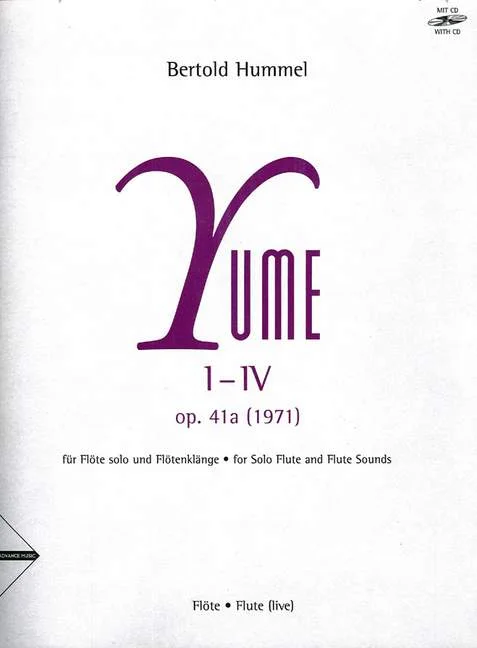
Dedicated to Werner Berndsen in friendship
I., II., III., IV.
Flute, flute sounds (CD)
Duration: 11 minutes
Dennette Derby-McDermott
Title: "Yume" (Traumgesichte) I-IV op. 41a for flute solo and flute sounds (tape montage) dedicated to Werner Berndsen in friendship - Length: 16 pages (clarinet part 4 pages) - Dated: I. 28.III.71 / II. 21.IV.71 / III. - / IV. - - Location: Bayerische Staatsbibliothek Munich
Schott Music ADV 8501 / ISMN: 979-0-2063-0209-1
The CD accompanying the sheet music edition contains the tape sounds as well as a complete recording of the piece, interpreted by Werner Berndsen.
The edition was awarded 1st prize at the National Flute Association's Newly-Published Music Competition 1996
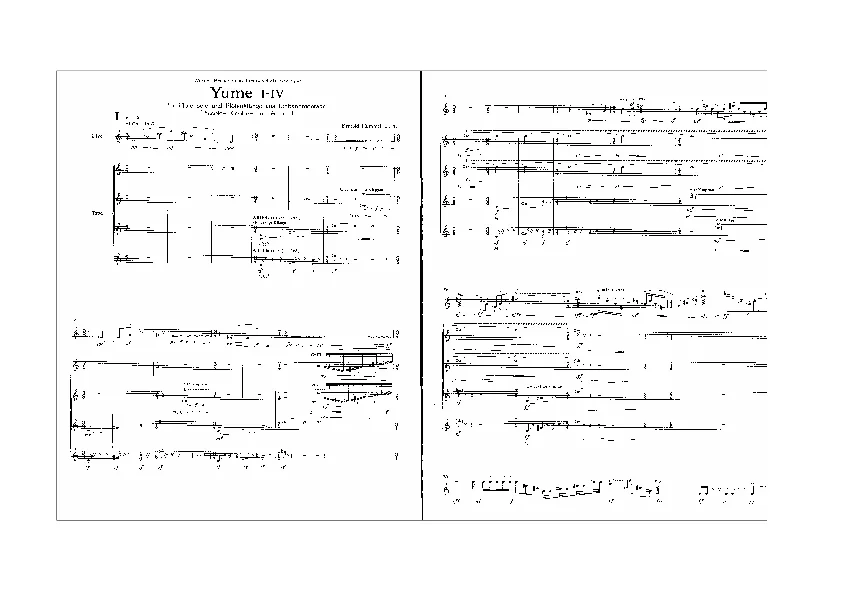

Bertold Hummel: YUME III
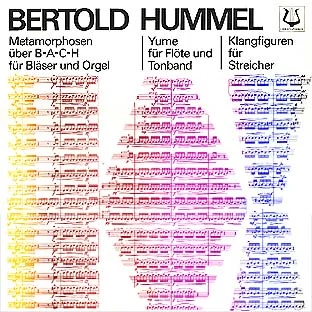
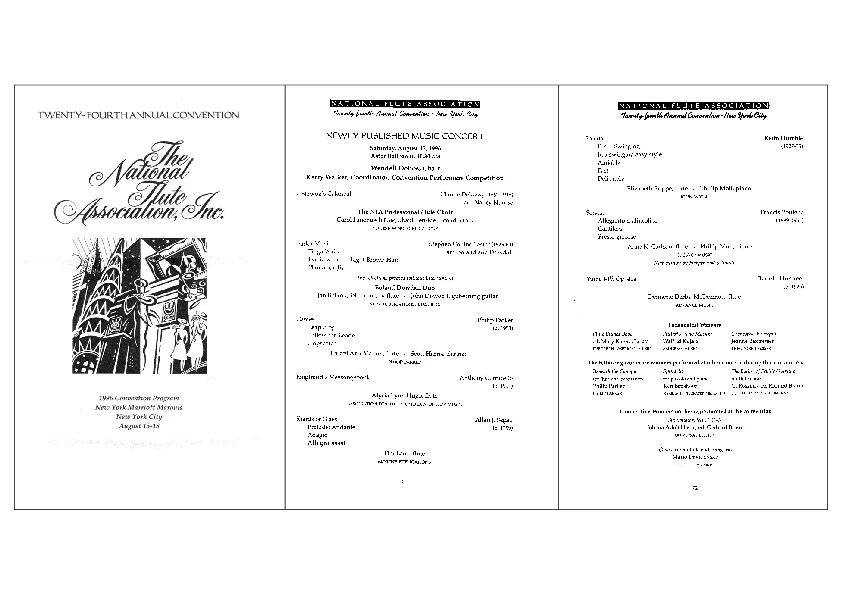
The Advance Music edition from 1992 contains a CD on which the complete work is recorded first and then the flute sounds without solo flute, as they are played to the performer during performances. Electronic manipulations create unexpected flute sounds (...) These extremely colourful effects are based on a well thought-out structure that characterises all of Bertold Hummel's compositions (...) The work, which despite its complexity seems playful, impresses players and listeners alike. It was awarded 1st prize in the National Flute Association USA competition for new publications in 1996.
Esther Alt set the mood for the evening with Bertold Hummel's Yume I/II (1971) . The musician was effortlessly at home with the sound effects of the tape flute, which was electronically ramped up to an enormous spectrum with mega key noises and deeply resonating bass notes, and achieved a rare synthesis between electronics and acoustics to create the transparent image of a "pure flute" that the old master Hummel had wished for and saw fully realised in this interpretation.
This work amazed and fascinated in equal measure. Tones, sounds and scales from various flutes are recorded here, distorted beyond recognition, processed into rhythms or clusters. In a dialogue with the live flute, fantastic effects and correspondences emerge and new horizons open up. In Jens Becker, an ideal cast was found for the interpretation. With the utmost seriousness and skill, he brought the work, which incidentally won a coveted prize in the USA, to life and made the tension as effective as the cheerfulness inherent in the composition.
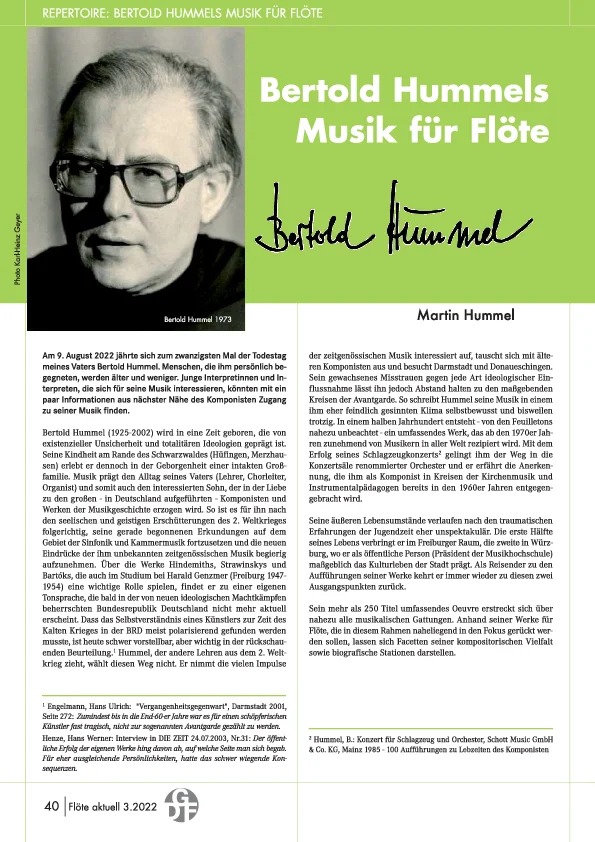
Martin Hummel: Bertold Hummel's Musik für Flöte. Flöte aktuell 3.2022, pp. 40-44, Frankfurt 2022.
Susanne Farwick: Studien zur zeitgenössischen Musik für Flöte solo in der zweiten Hälfte des 20. Jahrhunderts, Peter Lang Internationaler Verlag der Wissenschaften, Frankfurt am Main 2009, pp. 272-273




The work Yume I-IV, written in 1971 at the suggestion of my colleague Werner Berndsen, owes its title to the Japanese word "Yume", which means "dreams".
In four sections, a tape is played to the "live solo flute", which only stores sounds, melodies, rhythms and noises produced by flute instruments (piccolo, large flute, alto flute). These tape actions are alienated by various manipulations - such as double and half speed, rewind, reverb effects, etc. - are alienated.
Yume I - The melodic structures performed by the live solo flute - accompanied by gong-like sounds - condense in a cadence and relax again towards the end.
Yume II - Relentless movement sequences create a "homunculus" impression - more pleasurable than threatening.
Yume III - The lines of the live solo flute derived from a three-note motif dominate this very calm section.
Yume IV - Over polymetric, percussion-like layers, a two-part canon plays in various sound levels, losing itself in the outermost pp.
Bertold Hummel
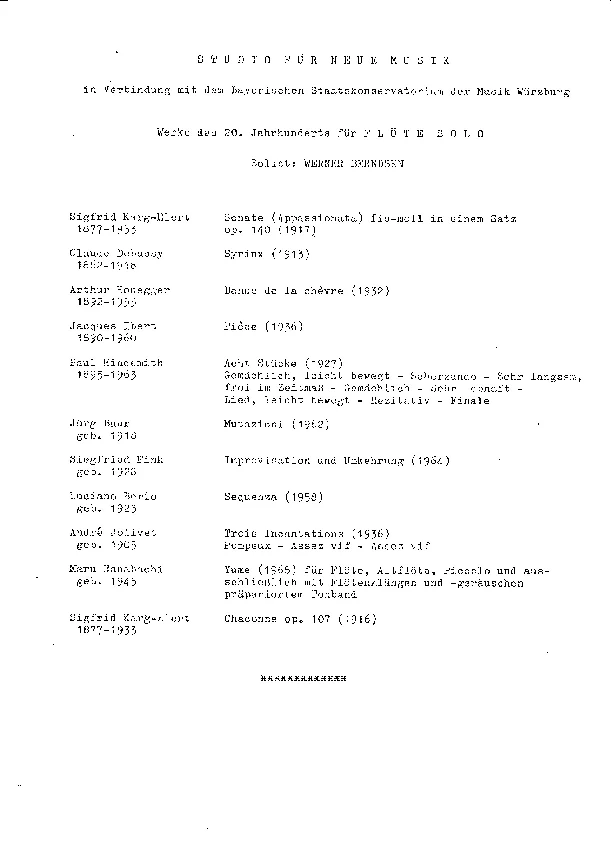
Yume has its own and truly very special genesis. The work was composed in March and April 1971 after Hummel had asked me to show him some special tonal features on the flute, such as gong-like sounds, a fast band pass, glissandi, key noises, click effects, key percussion effects, cymbal effects, tremolos, octaves, etc. These effects can be sonically processed, altered and amplified by means of a tape recording so that they can be played meaningfully with a live flute. These effects can be processed, altered and amplified by a tape recording in such a way that they make sense in combination with a live flute and, above all, cannot be replaced by real musicians playing. This means that the use of a tape during a concert has a legitimate justification and in no way saves on performers. I realised the extensive and complicated score for the 4-8 flutes on the tape (since replaced by a CD) at home by copying several tape recordings over each other several times in a very short time, as the premiere took place on 11 May 1971. Our staircase at home served as the recording room and I had to repeat some of the recordings because birds in the garden wanted to join in. The composer hadn't planned for that. In the studio, I then painstakingly put everything together true to the score. Later, when Bavarian Radio showed interest in this composition, I added the live flute to the tape, again in the small hall of the Bavarian State Conservatory for Music in Würzburg, of course.
Werner Berndsen
"I wonder whether a flautist will ever be found to re-record the flutes. With today's technical means, this would be much easier than in 1971. However, I have nothing against my "work" being included from time to time."
Werner Berndsen in a fax to the composer on 24 November 1999
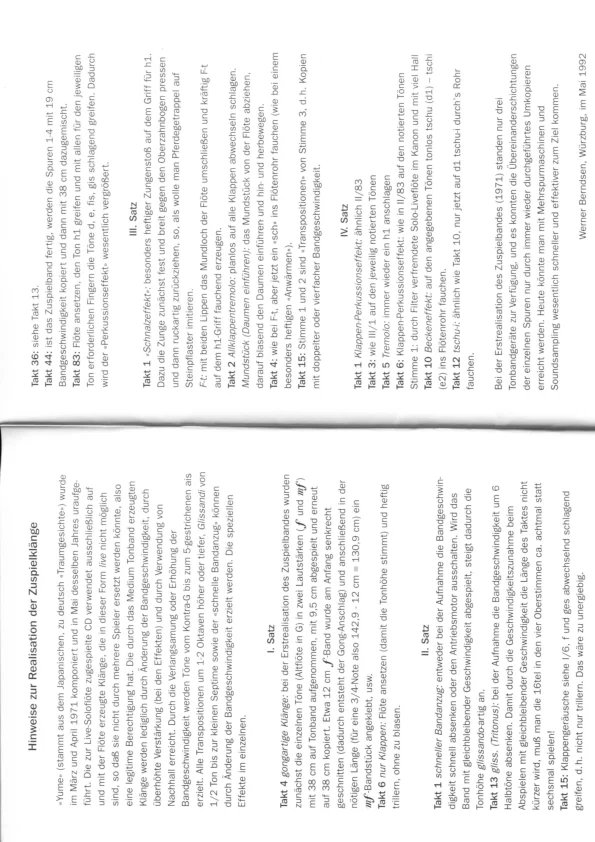
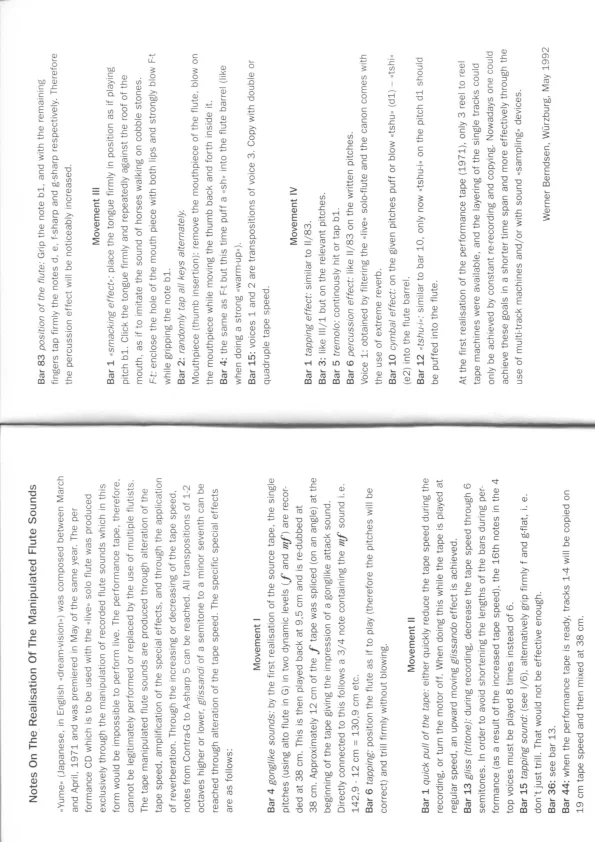
1st movement: gong-like sounds/glissando/only keys/flutter tongue/echo
2nd movement: fast band attack/tritone glissando/glissando 1/2, 1, 1 1/2 tone/recording of individual bars at double speed and also backwards in crab
3rd movement: click effect (tongue click with flute in place)/glissando by moving the thumb in the head joint/all key tremolo/blow into the mouthpiece, all air through the pipe (hissing)/glissando (1 minor seventh)/ fading in of individual bars at double tempo/flageolet and glissando of the solo flute
4th movement: key percussion effect/snapping effect/tremolo/ copy of the solo flute in canon with reverb/cymbal effect/flutter tongue/flutter tongue+trill/glissando (tritone).
Thomas Richter
And Bertold Hummel had another colleague for whom he wrote a thoroughly independent, indeed downright idiosyncratic piece: the flutist Werner Berndsen with his affinity for tape technology and electronics. "Yume op. 41a for flute solo and flute sounds" can only be performed with the aid of a tape (or more recently CD) recording, because the flute sounds manipulated on the sound carrier cannot be produced live. Using the genuine techniques of the recording studio, recorded flute sounds were further processed and brought into the vicinity of electronically generated sounds, resulting in a special kind of sound situation that makes the Japanese title "Yume" - which means "dream faces" - understandable. When Hummel created this opus, electronics were still in their infancy in Würzburg. Nevertheless, he provided a significant impetus for the rejuvenation of equipment and the purchase of synthesizers and additional electronic devices. Never again did Hummel engage with the primal experience of sonority, which here takes on the status of primary effect, as intensely as in this piece. And yet this score also betrays the systematiser and constructor! When electronic music in the late sixties tended towards the popularity and non-committal nature of electronic manipulations used to great effect, Hummel followed the path of thoroughly organised sound structures laid out by Stockhausen. This proximity to Stockhausen was no coincidence, as Hummel had invited the then head of the electronic studio at Cologne's WDR to Würzburg for a composer's evening that was to write a piece of Würzburg music history. Regardless of all the superficially effective tape manipulations on the flute sound, Hummel structured a quintet structure with a dialogue character. However, the score reveals little of what is ultimately heard after the electronic processing.
Klaus Hinrich Stahmer (in: Chamber music as a personal confession, Tutzing 1998)
In May 1981, Bertold Hummel said in a letter to his friend and conductor Günther Wich that he could also imagine a choreographed interpretation of Yume I-IV, op. 41a.