Metamorphoses for guitar (op. 37, 1969/1978/1990)

Movement titles
I. Rezitativ, II. Intermezzo, III. Melancholy, IV. Finale
Instrumentation
Guitar
Duration: 8 minutes
Premiere
4 december 1974,
Regensburg / University
Jürgen Libbert
Publisher
N. Simrock Berlin-London (Boosey & Hawkes) ISMN M-2211-0858-6
Printing error: p. 7: 1st line: 32nd notes from g to d sharp must be 64th notes | 2nd line, 2nd bar: 16th notes of the lower part must be played staccato.
p. 8, 4th line, chord on the third last quaver: highest note a flat instead of a
First edition: N. Simrock Hamburg-London 1975


Op. 37, Version 1978
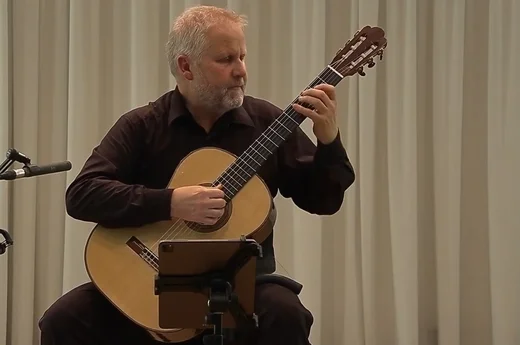
Op. 37, 1990 version





The Würzburg composer Bertold Hummel wrote his four-movement *Metamorphosen* in 1969 and dedicated it to the guitarist Siegfried Behrend. Hummel does not use the twelve-tone technique in the strict Schoenbergian sense, but more freely, much as Alban Berg did. Hummel thus allows himself to restart a row – each movement has its own, related to the others – even before he has used up all its notes. His approach to twelve-tone rows is characterised by transpositions, fragmentation and repetitions, resulting in the creation of tonal fields. The title *Metamorphoses* describes a fundamental principle of all composition, indeed of all the arts: that of transformation, of changing.
The first movement, ‘Recitative’, demonstrates a fundamental metamorphosis, as it were – that of a single note which, at the outset, is set in motion, first charging itself with energy, as it were, before traversing the tonal space. Starting from the note E – due to the tuning, E is the centre of gravity of the guitar’s sound – the Recitative gradually conquers the entire tonal space, so that, after about a third of the way through, with the prominent high notes E-sharp"' and ‘a’’’, having touched upon the twelve notes of an octave at least once and thus established the basic outline of the scale. The scale is then explored in sections to test its interpretative possibilities. The final three bars are a quintessence. The entire scale runs below the ‘e’ ( the note to which the first string is tuned). This once again presents the full range of notes at the composer’s disposal.
The performance instruction ‘burlesque’ for the second movement, the Intermezzo, not only tells the performer how to play this piece, but also characterises the three-part piece (A-B-A’) itself. There are at least four aspects to the burlesque: the wide interval leaps in the sequence, the cuckoo’s call (notes 6, 7, 8 and 4 of the inverted series), the inverted series preceding the final chord, and the fact that the series usually appears in inversion, that is, upside down.
The third movement, ‘Melancolia’, evokes the style of lute songs. A melody adorned with scale passages unfolds over series tones condensed into chords.
The finale, a motoric roundelay, is defined by an eight-note row. The main interval is the second. Through what are at times excessive repetitions, Hummel shapes this into a kind of pendulum motion that runs counter to the driving impulse: The piece treads water, seems to get bogged down – and then abruptly breaks free again. It is only through this very distinctive mode of progression that the finale reaches its final chord. This time, the tension resolves so suddenly that the series (as an inversion) tumbles headlong down to A, the tonic. An A major chord promptly follows: unbroken tonal brilliance – that is Bertold Hummel’s little surprise to round things off nicely.
Thomas Wirth (in the CD booklet “Metamorphosen – Kurt Hiesl, guitar”, AHO-Recording 1997)
Foreword ( to the new edition published by Simrock)
Bertold Hummel wrote *Metamorphoses for Guitar*, Op. 37, in 1969 at the suggestion of the guitarist Siegfried Behrend, and in doing so engaged intensively with the sonic possibilities of this instrument for the first time in his extensive body of work.
In four movements, each with its own distinct character, he transforms – in keeping with the title – the twelve-tone row assigned to each movement in a free manner, so that fields of tonality continually emerge through transpositions, fragmentations and repetitions. The beauty of sound and comprehensible musical processes are at the forefront of the compositional concept.
This edition incorporates all the changes my father made since the first printing in 1975, at the suggestion of Anton Stingl (1978) and Siegfried Behrend (1990), and based on his own experiences with two later works for guitar in 1985 and 1990 (Concertante Music for Guitar and String Quartet and String Orchestra, Op. 89a/b, and Phantasus – song cycle based on Arno Holz, Op. 93).
Martin Hummel