Tripartita for organ (op. 12, 1955)
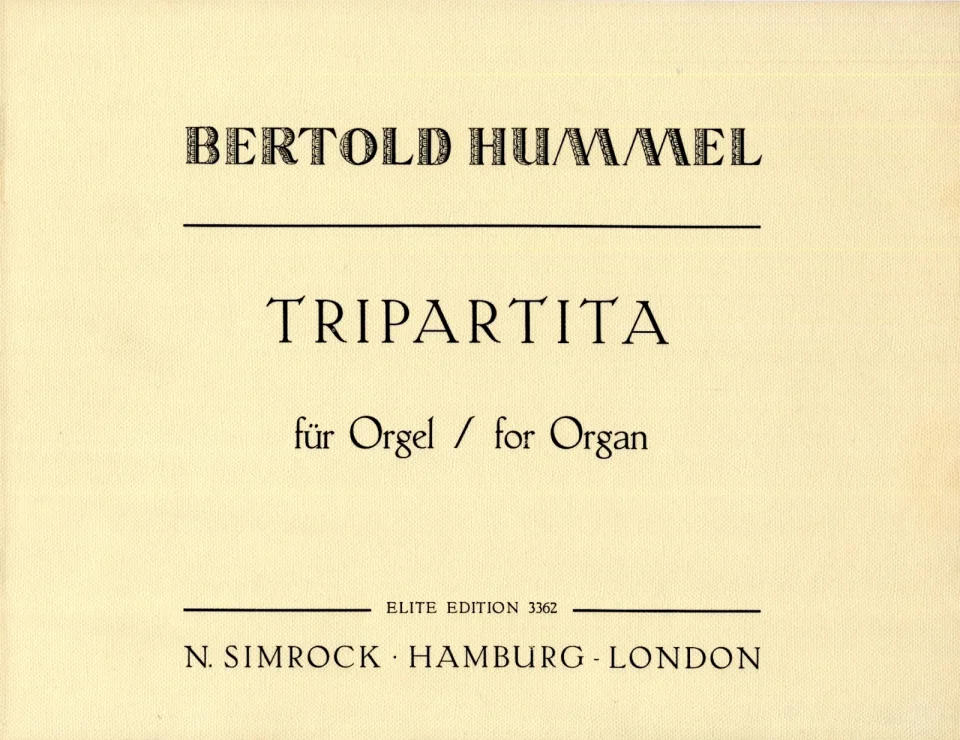
I. Ostinato, II. Fantasia, III. Toccata
Organ
Duration: 11 minutes
Max Kempf
N. Simrock Hamburg-London (Boosey & Hawkes) ISMN M-2211-1335-1
in a letter to Simrock on 25.9.1971: 1st movement tempo indication: quarter note = 152
in a letter to Larry D. Crummer 1981: 1st movement tempo indication: crotchet note = 172 / 2nd movement: quaver note = 76-88 depending on room acoustics / 3rd movement: the last two bars pesante and big ritardando - long fermata!
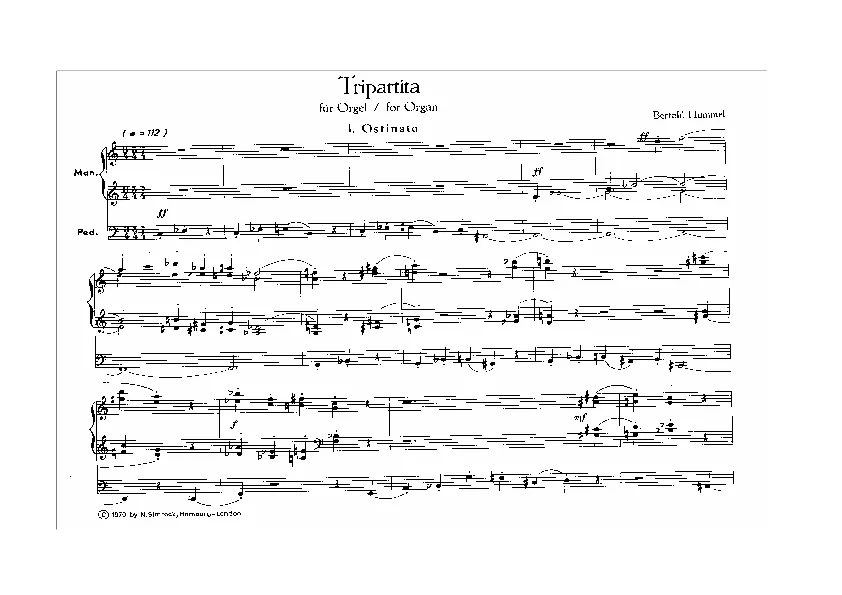
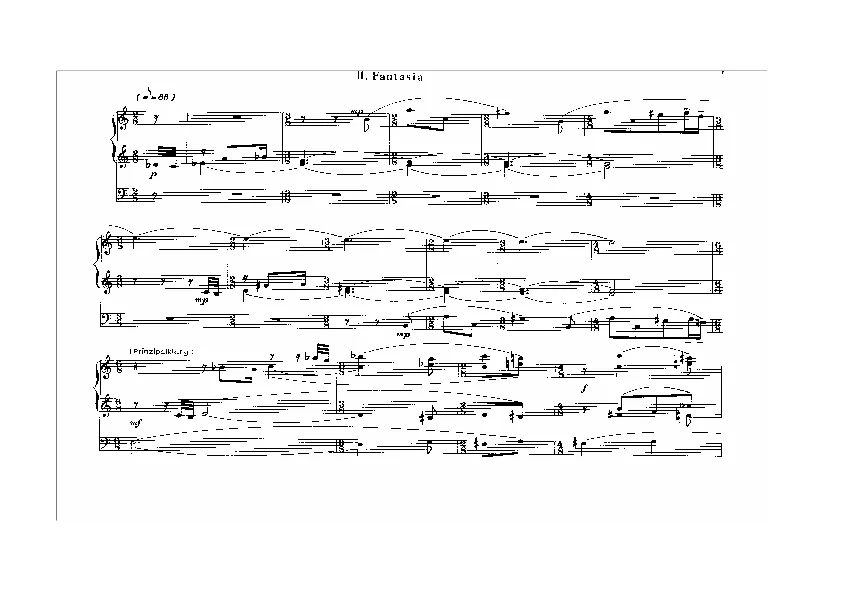
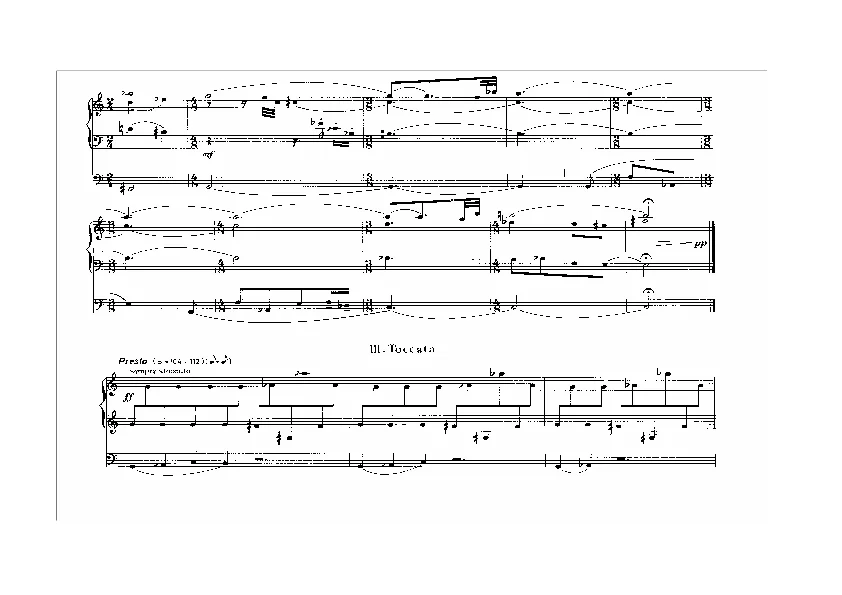

The tightly structured ‘Tripartita’ begins briskly with a harmonic phrase, its syllabic pattern punctuated by rests and spread across a distinctive pedal line. The fundamental line serves as a formal structural device; it adds further intervals to a three-note motif until the pre-planned total is reached after a stretch of twenty-one bars. One is reminded of Boris Blacher’s technique of variable metres. The slow middle movement arises from the combination of three thematic elements. Whilst the harmonic colouring prevails at the outset, it is now above all the concisely drawn melodic contour that dominates. Through manifold transpositions and inversions, new perspectives on the same idea continually open up. The third movement is conceived as a fast run with note repetitions and octave shifts, played manualiter and, apart from the conclusion, in unison. This new work captivates the listener with its fresh, unclichéd inventiveness. The formal structure is thoroughly original in its details and does not rely on any hackneyed formula, whilst the sounds—some of which are very sharply defined—are placed with such economy that their necessity is immediately apparent on first listening.
H.L. Schilling
Literature list of the German Music Council for the competition "Jugend musiziert": Level of difficulty 3-4/ medium-difficult-difficult (intermediate level I-II)




The Tripartita op. 12 was composed between 1 and 10 October 1955 and consists of three movements - fast-slow-fast - based on the creative principle of variable metre. Block-like structures predominate in the 1st movement, while arioso elements with short motifs dominate the 2nd movement. The almost monophonic toccata-like finale rounds off the work with virtuosity.
Bertold Hummel
Bertold Hummel composed the Tripartita for organ in 1955 and it consists of three movements: Ostinato, Fantasia and Toccata.
The first movement is not only based on a melodic motif that develops from a germ cell of 2 notes and is constantly repeated, but also on a sequence of 3/4 - 5/4 - 7/4, which is maintained in this arrangement from beginning to end. (double ostinato)
In the Fantasia, the quiet second movement, a meditative melody frames three differently structured verses.
The virtuoso Toccata is characterised by the rapid repetitions of notes, which can only be played on an excellent organ. Characteristic here are the bar units that shorten by one beat and then grow again - clearly audible in the pedal motif.
Josef Trompke
The Tripartita is committed to repetition and variation technique. This is made clear by the first movement's designation Ostinato. Chord layers and runs alternate here over a recurring time signature (3, 5, 7). The harmonic elements of the first part are also used in the fantasia, which works with a few, very small rhythmic motifs. A pedal motif, which is altered by shortening the bar, and a sequence of runs that spread across the entire manual range by enlarging the bar are the building blocks of the final, virtuoso toccata.
Christian Weiherer (in the booklet of the CD "Orgelportrait St. Michael, Aichstetten)