Quintet for oboe, clarinet in B-flat, horn in F, bassoon and piano (op. 106, 2001)
I. Reminiscences, II. Recitative with chorale, III. capriccio
Oboe, clarinet in B-flat, horn in F, bassoon, piano
Duration: 17 minutes
Ralf Ebner | Venelin Piperov | Till Heine | Johannes Schuster | Andreas Skouras
Title: Quintet for piano, oboe, clarinet in B-flat, horn in F and bassoon - Length: 28 pages - Dated: I. 25.3.01 II. - III. 3.5.01 - Location: Bavarian State Library, Munich
Vogt & Fritz (score and parts) VF 1369 / ISMN: 9790202602560
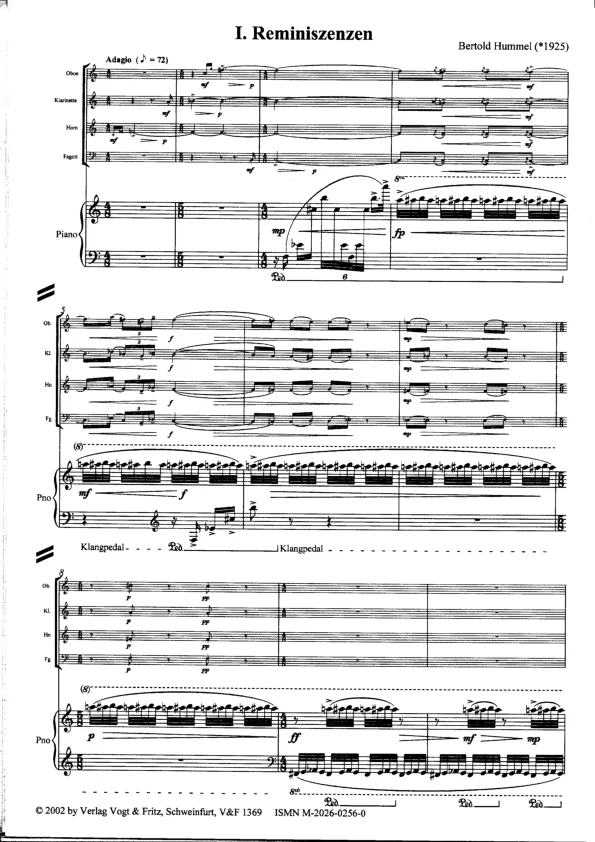
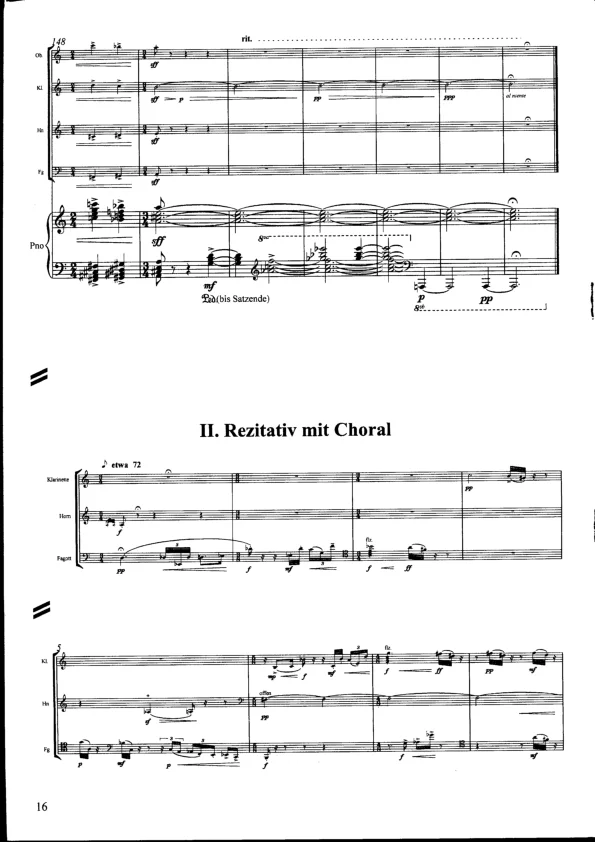
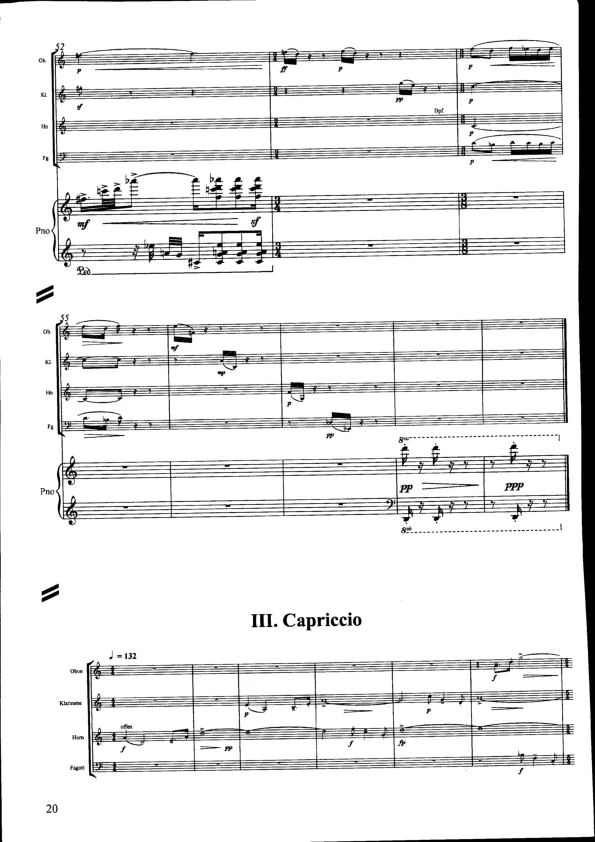

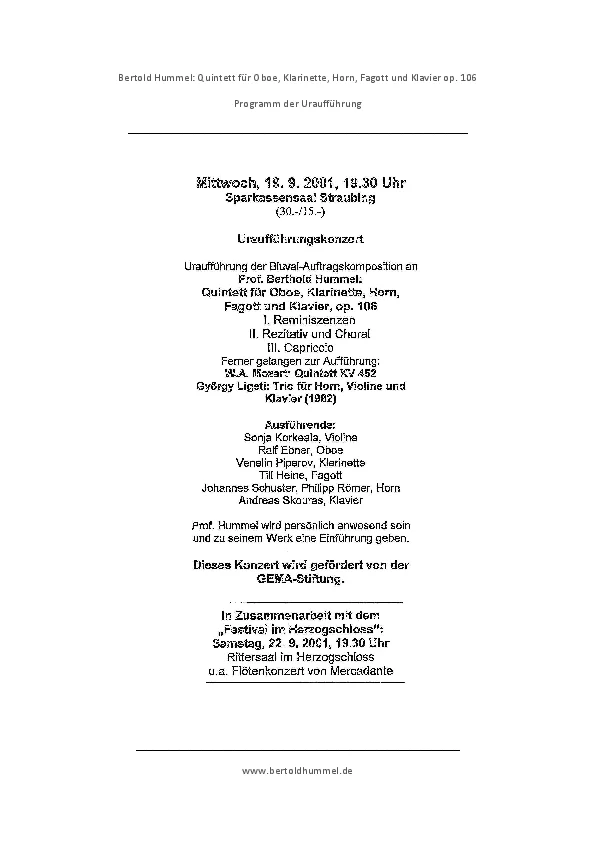
The Quintet op.106, written as a commission for the BIuval Festival 2001 and premiered in Straubing on 19 September 2001, makes quite different demands. It is written in the classical scoring of Beethoven's op. 16 and Mozart's K. 452, and refers directly to them by modifying Mozart in the 2nd movement "Recitative with chorale" and also quoting him directly at the end.
The approximately 18-minute quintet is written for a professional ensemble and makes corresponding demands. These are not only of a technical nature, as the piece is easy to play; it requires good ensemble playing skills and joint music-making. This is the danger of the piece: the many tempo changes, insertions, quotations and recitative sections mean that the overall context is lost and it seems to consist too much of individual parts. The performers must counteract this powerfully, as the piece is perfectly suited to complement a concert with Mozart or Beethoven (see above).
Eberhard Holbein
In view of the enormous challenge - Mozart's famous Quintet K. 452 was the model and inspiration for the composition - we got to know a completely different Hummel, one who unites the enormous range of musicality that characterises him and the diversity of his creative methods as if in a burning mirror. Just how well he knew how to write especially for wind instruments is documented by a rich segment of his oeuvre, just think of his saxophone quartets. Hummel's op. 106 with its brief Mozart quotations is not stingy with the virtues to be found in other of his compositions: Exciting metamorphosis of the material, linked with striking rhythms, especially in the first movement, juxtaposition of quite different musical states from simple to highly artificial, generally rich sound fantasy in harmonious balance. One can only wish that the work does not lead a predominantly pigeonholed existence.




The reminiscences (1st movement) deal with intervals that repeatedly play a favoured role in my works: minor second, minor third, fourth, tritone and seventh. Two tempo levels - Adagio and Vivace - alternate twelve times in the course of the movement, with the Adagio part decreasing and the Vivace part increasing. In many cases, up to six-part mixtures arise, which in the Adagio could be interpreted more as a depiction of nature, in the Vivace more as rhythmically moving structures.
The 2nd movement, Recitative with Chorale, gives the individual instruments the opportunity to comment on the chorale-like sections. The first bar of the Larghetto (K.V. 452) is heard three times at the end of each chorale line, once in Mozart's original sound shortly before the end of the movement.
The Capriccio (3rd movement) begins with a signal-like introduction, which is followed by a dance-like theme that dominates the entire movement with its variable metre. It is interrupted several times, once by a waltz, later by a chorale-like episode and by a metamorphosis of the introductory bars. A small musical question mark is added to the supposed conclusion.
Bertold Hummel
Commissioned by the Bluval-Festival Straubing 2001