Playing keys - Little piano album for my grandchildren (op. 103d, 1996-2000)
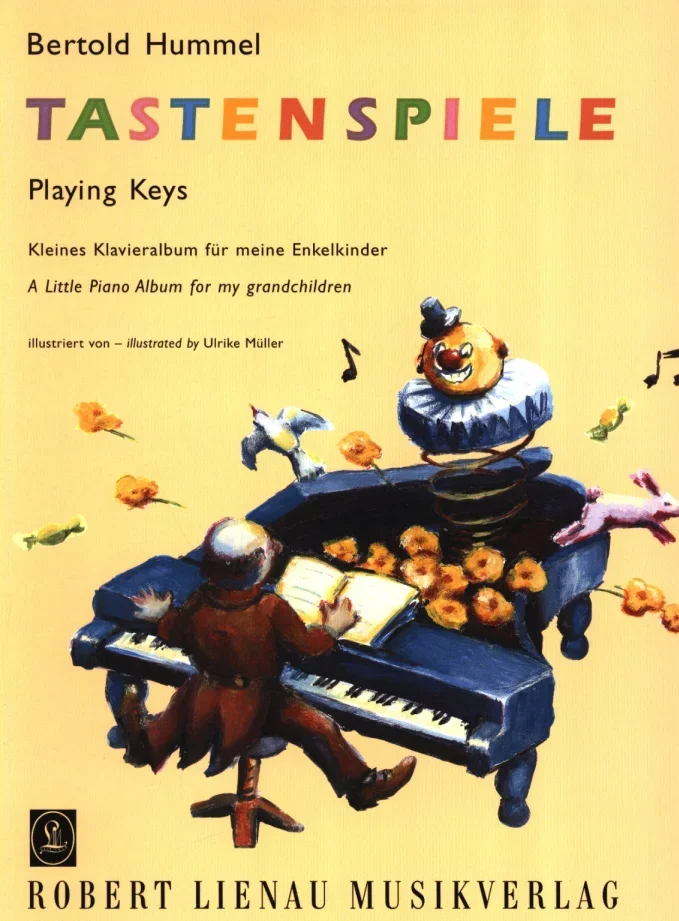
for my grandchildren
1st Semper idem, 2nd Praeludium, 3rd Little Melody, 4th Caravan, 5th Lullaby, 6th Choral, 7th Scherzando, 8th Stall Magic, 9th Folk Song, 10th The Clown, 11th Fingerplay, 12th Serenade, 13th The Cuckoo, 14th Elegy, 15th Little March, 16th Barcarole
Piano
Duration: 25 minutes
Titles: 1. for Anna Semper idem (ostinato aeolian on white keys) / 2. for KLARA Präludium / 3. Kleine Melodie für Anja / 4. for RAFAEL Karawane (black keys) / 5. for Charlotte Wiegenlied / 6. for SILJA Choral / 7. for JOSEPHINE Scherzando / 8. for VIOLA Budenzauber / 9. for MIRJAM Volkslied "Durchs Wiesetal gang i jetzt na ..." / 10. for Fabian GAME-BOY | Ba-Rock-Ino / 11. for SVEN Fingerspiel (black and white keys) / 12. serenade for Laura Sophia / 13. for Simon Der Kuckuck / 14. for INKEN Elegie / 15. for Jakob kleiner Marsch / 16. barcarole for Julia
Scope: 1. 2 p. / 2. 2 p. / 3. 1 p. / 4. 2 p. / 5. 1 p. / 6. 1 p. / 7. 2 p. / 8. 2 p. / 9. 2 p. / 10. 1 p. / 11. 2. p / 12. 1 p. / 13. 2 p. / 14. 1 p. / 15. 1 p. / 16. 3 p.
Date: 1. 26 May 98 (Azores) / 2. - / 3. - / 4. 12.4.97 / 5. 13.1.2000 / 6. - / 7. - / 8. - / 9. 13.1.99 / 10. 12.8.99 / 11. 27.9.99 / 12. 16.10.99 / 13. 31.5.96 / 14. 17.12.94 / 15. 31.8.98 / 16. July 99
Storage location:
Robert Lienau Musikverlag Frankfurt RL 40790 / ISMN M-011-40790-5
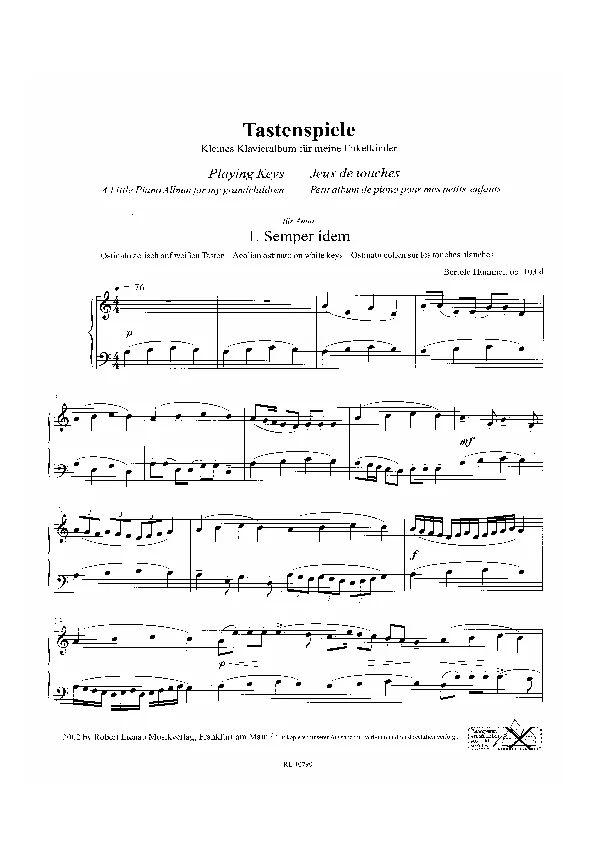
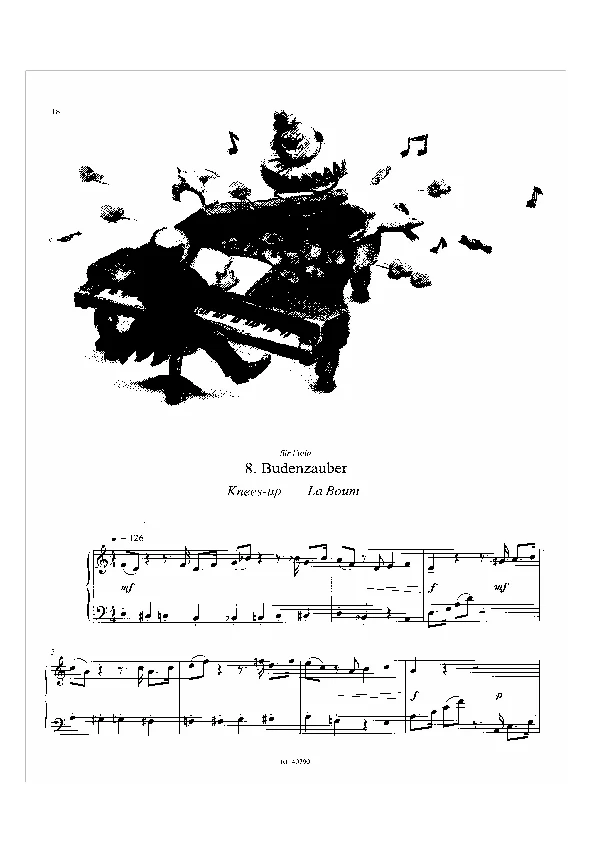

The "Tastenspiele" are a collection of 16 easy to medium-difficult piano pieces written by the composer for his grandchildren. One is tempted to speak of modern "Kinderszenen"; the pieces are appealing, varied, musically sophisticated and suitable for introducing children but also adults to contemporary sounds. The wonderful illustrations by Ulrike Müller make the book a pleasure for the eye as well.
Belonging to the school of Hindemith and Genzmer, he was already open in the 1950s to a "plurality of compositional methods". Familiar with Gregorian chant from his childhood on, he increasingly developed interest in modal procedures, going as far as dodecaphony - but he was at the same time fascinated by tonal extensions such as polytonality or Messiaen's sound colour theories and the rhythmical accomplishments of other cultures.
The composer of this book is then genuinely eclectic, has written music "suitable for children" in a child-like spirit, but has produced a real firework of colours and styles. A super book, an absolute "must" for all who have children to give presents to or are still child-like themselves.
Finger games, magic, clapping and no fear of crooked sounds: 16 light character serenades, loving souvenirs for the youngest children's foreplay, now available in memoriam.
My pupils are particularly fond of the dedications: with a detective's instinct, they speculate and ponder why "The Clown" is intended "for Fabian", whether this lively, insistent "Scherzando" corresponds to the character of Josephine, or whether Rafael ("Caravan") perhaps likes to play on black keys. After all, each of the pieces in Bertold Hummel's keyboard works is dedicated by name to one of his 16 grandchildren. In his piano album, Bertold Hummel turns young piano players into jugglers: Left and right hands throw balls to each other in double counterpoint or transport melodies to other octaves by crossing the hands. The independence and coordination of the hands and fingers are stimulated by a combination of large and small playing spaces and movements, and by differentiated articulation and dynamics. Hummel always maintains a balance between complexity and simplicity: rhythmically or melodically more difficult phrases are supported by ostinato figures or become structuring pattern building blocks themselves.
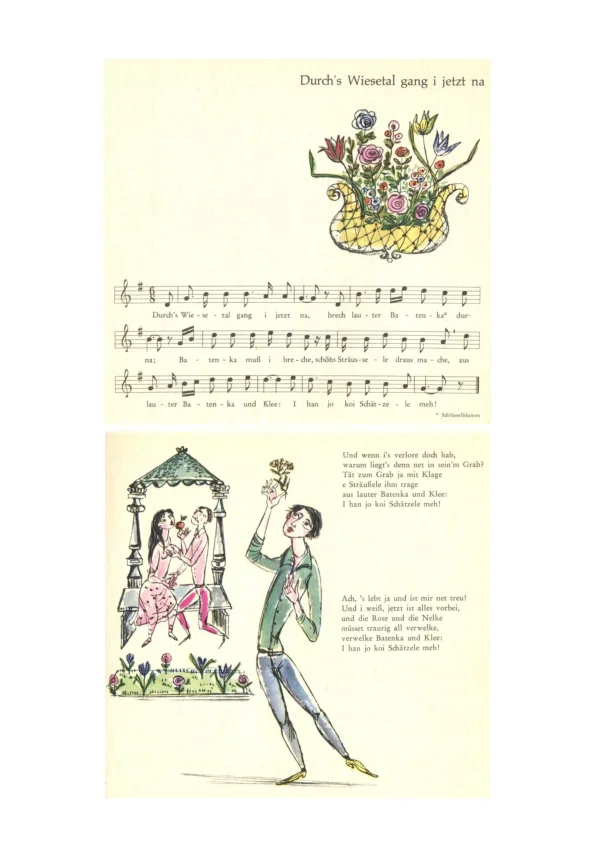
Meaningful titles encourage interpretation, inspiring the imagination in the search for a suitable arrangement. The "Barkarole" "for Julia" must undulate with verve, the "Wiegenlied" "for Charlotte" must develop a calm flow, the "Budenzauber" "for Viola" must play cheekily, "Semper idem" "for Anna" must unobtrusively present the permanence of an ostinato motif. Hummel utilises a broad stylistic palette, ranging from pentatonic to chromatic, from modal to free tonality, from chorales to jazzy patterns. With this compositional diversity, which also includes the skilful use of disruptive factors (non-harmonic insertions structure the "Choral", seventh chords falling in the circle of fifths alienate the simple melody of "Durchs Wiesetal gang i jetzt na" (in "Volkslied")), it makes sense to talk to pupils about compositional variations. It will be worthwhile to work on the pieces in this collection as examples and under certain aspects. (Level of difficulty: upper elementary level)
Maria Zeidler-Kröll
With the children's pieces by Bertold Hummel, the programme included ingeniously entertaining cabinet pieces.
The 16 pieces by the author, who died a few months ago, are expressly dedicated to his 16 grandchildren. The result is not only a fixation on a limited level of difficulty (upper lower level, lower intermediate level), but also a categorisation according to the temperament and performance skills of the recipient. This is what makes this collection so uniquely appealing. Very different styles are presented, from folk song to jazz rhythms and sounds, from simple homophony to free-tonal counterpoint, from uniform quaver movement to off-beat rhythms. Each piece is based on a distinct musical or technical idea. In almost all of the pieces, however, a fundamental concern shines through: to allow the multifaceted piano sound to be experienced in an exemplary way in the contrast between high and low, forte and piano, legato and staccato, pedal sound. With this in mind, the pieces are precisely labelled (sometimes contestable, e.g. in No. 3) and challenge the pupil's attention in different ways. The booklet thus provides a variety of musical and technical experiences and, with its characterising titles and the amusing illustrations by Ulrike Müller, is always a source of new pleasure.




In spring 2002, shortly before I left for Greece, I discovered a volume of sheet music entitled TASTENSPIELE by Bertold Hummel in the window of a music shop in Munich. I bought the book and took it with me to the desert island, where I played from it every morning before going to work. These miniatures had a great effect on me and always brought me back to myself.
Wilfried Hiller