Benedicamus Domino for organ (op. 102, 1997)
Benedicamus Domino
Organ
Duration: 17 minutes
Petr Rajnoha
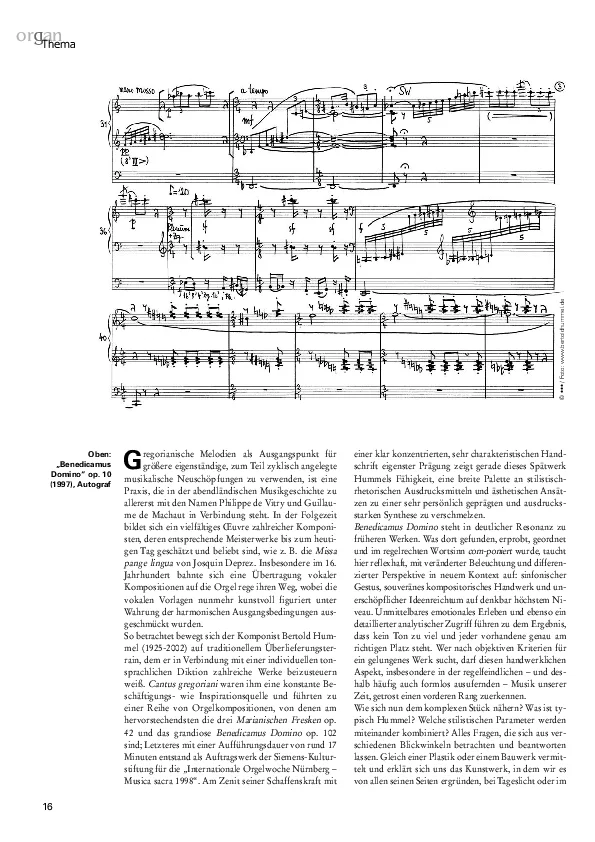
Title: "Benedicamus Domino" for organ op. 102 - Length: 26 pages - Date: 30.9.97 - Location: Bayerische Staatsbibliothek Munich
Schott Music ED 8919 / ISMN: M-001-12438-6
Misprint: page 9, bar 73: Pedal: 4th quaver instead of small d must be played with a small Bb
Sul Bi Yi, the winner of the competition, presented another of Hummel's chorale arrangements, the large-scale "Benedicamus Domino" op. 102. She succeeded most conclusively in creating a whole from the individual contrasting elements of Hummel's tonal language and developing a lively arc of tension from the melodic chorale, virtuoso movement, colourful harmonic surfaces and the sound of birdsong.




The Gregorian melody of the "Benedicamus Domino" is the source material of my organ composition op. 102, which was written in August and September 1997 for the International Organ Week Nuremberg - Musica Sacra 1998 as a commission from the Siemens Cultural Foundation.
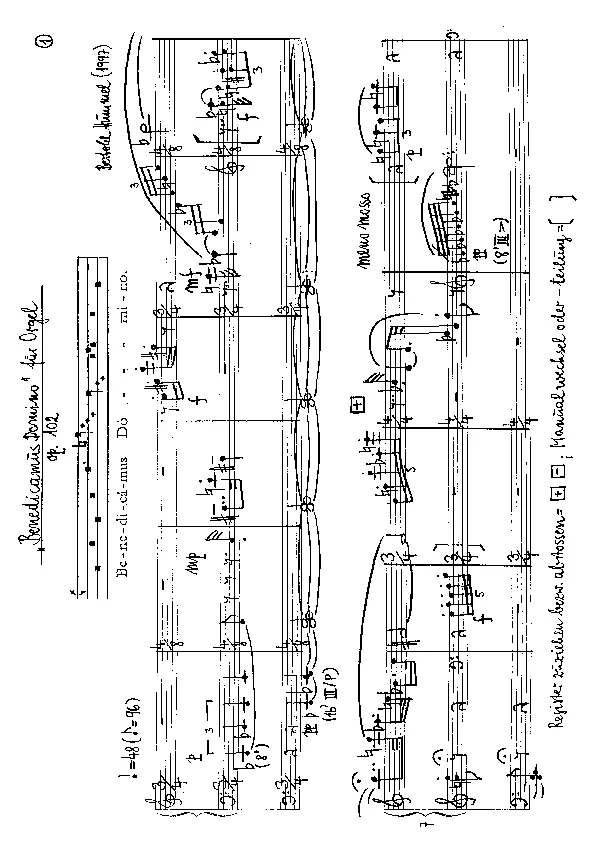
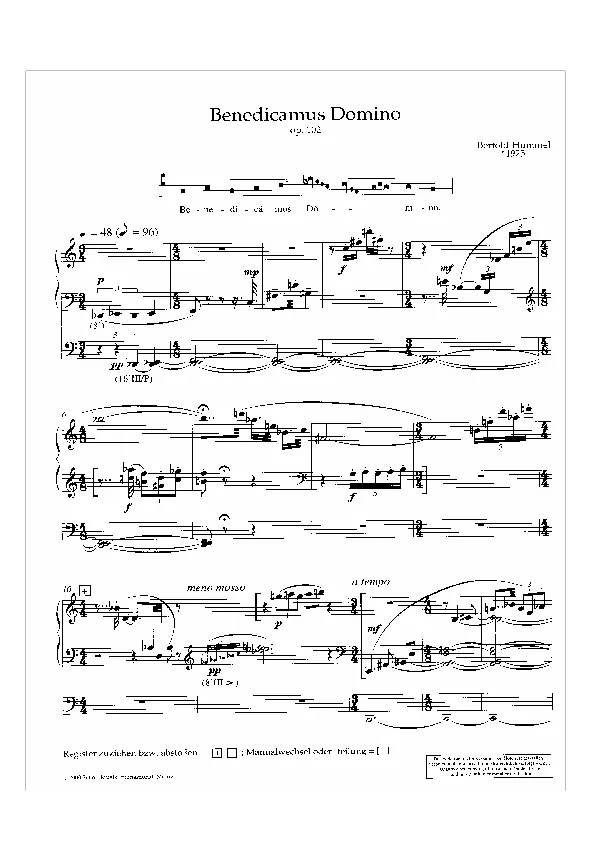
Above a pedal cluster derived from the beginning of the "Benedicamus", a theme is heard in the manual which is a combination of the chorale melody in tritone displacement, supplemented by comments which can all be derived from the basic material. This 1st introductory complex is repeated in sequence with slight changes.
This is followed by a rapid section in which the 4 versions of a 12-note row are placed in the pedal, each continued with toccata-like ornamentation. There is a 1st exposition of the chorale theme with fully chromatic changes before the Allegro is taken up again and led to a 1st dynamic climax. Here the chorale theme appears in countermovement over an ostinato pedal figure in 2 waves. A three-part calm progression brings the theme and its tritone-shifted form and its continuation in arioso character. The resumed toccata-allegro leads to a further dynamic climax. A brief arioso retrospective interrupts the forward-moving metamorphoses. A third dynamic climax is reached and quickly reduced.
In the "golden section" of the work, a passacaglia now begins over a 12-note sequence, which leads to the apotheosis of the entire work. After reaching the greatest possible sonority, a dynamic reduction is made to the extreme pp. The chorale theme is heard one last time, faltering. The piece ends with one of the characteristic runs of the Allegro section.
The work utilises the tonal and technical possibilities of a large organ.
The interpretation should give the impression of a broadly conceived fantasy with metamorphoses.
Bertold Hummel
A Gregorian Benedicamus Domino serves Bertold Hummel as the starting point for his organ work op. 102. Right at the beginning, the organ introduces the basic material of the piece: the incipit of the chorale (consisting of whole-tone steps) is contrasted with intervallic material (the tritone, which is to be formed by three whole-tone steps), whole-tone scales mediate between the two constituents. A new element is introduced by the solo pedal, whose motivic material can be traced back to semitone steps. This ultimately acts as the trigger for the entry of the complete chorale, in parallel fourths and initially in a quiet flute register. The musical design elements that are now complete: tritone/whole tone scale, semitone connection, parallel displacement are now performed in an intensified form before the chorale sounds fortissimo. A song-like middle section is repeatedly interrupted and ultimately replaced by toccata-like insertions enriched with repetitive groups. A final upswing leads to an apotheotic hymn of praise in order to bring the final entry of the chorale as a kind of swan song in a quiet register (accompanied by the vox caelestis). Repetitive segments on a small scale and repetitions of individual parts on a large scale structure the work; the technique of accompanying the chorale with parallel shifted chords can be interpreted as a reminiscence of the medieval organum (and similar procedures such as fauxbourdon).
Dr Andreas Jacob
Benedicamus Domino was commissioned by the 47th International Organ Week Nuremberg 1998 as a compulsory piece for the final round of the organ interpretation competition for the "Johann Pachelbel Prize".