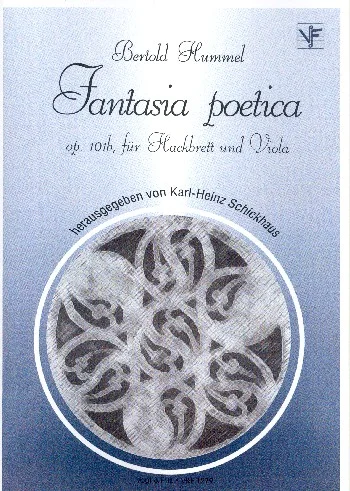
Fantasia poetica 'in memoriam Wolfgang Borchert (op. 101b, 1997)
for hammered dulcimer and viola
Dedication
for Karl-Heinz Schickhaus
Instrumentation
Hammered dulcimer, viola
Duration: 16 minutes
Premiere
23 November 1997,
Munich, Gasteig
Thomas Weber | Karl-Heinz Schickhaus
Autograph
Title: Fantasia poetica op. 101b for viola and dulcimer - Length: 21 pages - Date: 24.3.97 - Location: Bayerische Staatsbibliothek Munich
Publisher
Vogt & Fritz VF 1279 / ISMN M 2026-0219-5
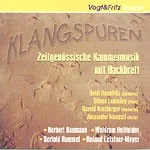

Programme for the world premiere of Op. 101b




The Fantasia poetica was written at the suggestion of dulcimer specialist Karl-Heinz Schickhaus and is a tribute to the poet Wolfgang Borchert (1921-1947), who died young and who - like Bertold Hummel - experienced the horrors of the Second World War as a teenager. The one-movement work places high demands on the instrumentalists. Different sound characters, tempo and time changes and extreme dynamics characterise the themes, which are derived from the letters that can be set to music. The work concludes with a passacaglia that fades into nothingness.
Heidi Ilgenfritz: Analysis of works (excerpts)
In 1997, Karl-Heinz Schickhaus planned a matinee "In memoriam Wolfgang Borchert" as part of the Munich Dulcimer Concerts. It was to take place on the Sunday of the dead, 23 November, which was only three days after the 50th anniversary of Borchert's death. Karl-Heinz Schickhaus asked Bertold Hummel to compose a piece that had something to do with Wolfgang Borchert. He suggested dulcimer and viola to the composer as the instrumentation.
Bertold Hummel, who had himself been a prisoner of war for a short time, describes Borchert's best-known work "Draußen vor der Tür" as the radio play of his generation. Before he began work on Fantasia Poetica , he first reread this "play that no theatre wants to play and no audience wants to see", as Borchert's subtitle puts it, in order to really grasp the mood. But he also made a certain formal reference.
As in a narrative, the Fantasia Poetica is a sequence of different themes. Hummel does not compose the form, but the individual sections of the work are comparable to Beckmann's stations. The reference is clearest at the end of the theatre piece and the Fantasia Po etica: "Draußen vor der Tür" ends with the repeated question:
"Why are you silent? Why?
Does no one give an answer?
Does nobody, nobody give an answer??"
In the same way, Hummel repeats the last theme several times, slowing and widening it and finally letting it end with pizzicato harmonics in pianissimo. He places a fermata lungo over the last note and writes al niente (into nothingness) as a final instruction.
Hummel uses three cryptograms in the Fantasia Poetica.
1. firstly, I would like to discuss the musically realisable letters of
W-O-L-F-G-A-N-G B-O-R-C-H-E-R-T,
because Hummel reveals these to the player in the cover sheet. This name appears for the first time in the first part in bars 65/66 in the viola and is immediately taken over by the dulcimer in bars 67/68, but is then not further developed. For the second part, Hummel uses the "Wolfgang Borchert" theme as a ritornello, which returns a total of five times. In the passacaglia, the "Wolfgang Borchert" theme forms the basis for ten different variations and an interlude. In total, Hummel uses this cryptogram 18 times within the Fantasia Poetica. This gives the name special weight, because even if the listener is not aware that it is the cryptographic realisation of Wolfgang Borchert, he will notice the recurrence of the theme in any case.
2 Hummel has also concealed the name of the dedicatee.
S - C - H - I - C - K - H - A- U - S
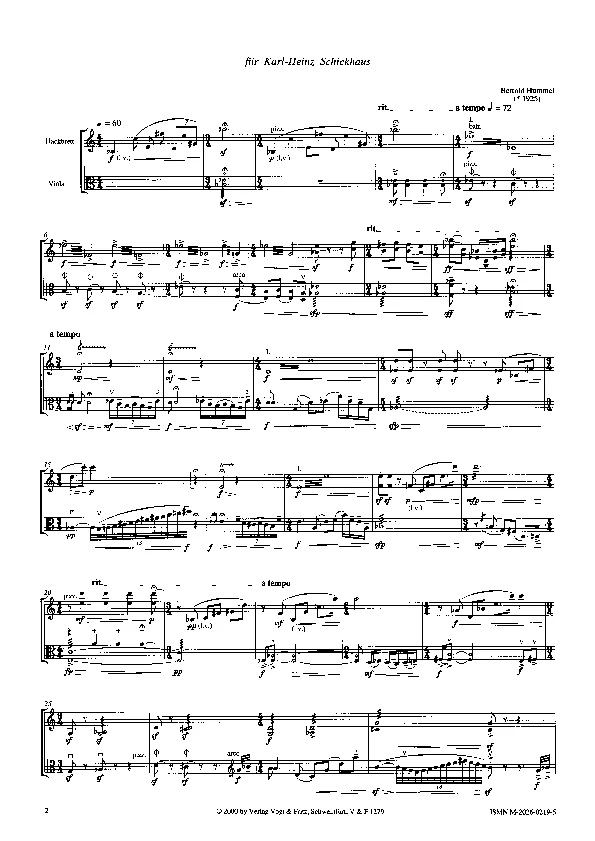
At the beginning three times in a row in bars 5/6, as well as in the next section bars 11/12 and four bars later moved up a major second.
At the end of the quasi cadenza, the "Schickhaus" theme plays around the cadential trill e flat, first twice in the dulcimer, then augmented and extended upwards by a sixth mixture in the viola.
Hummel also takes up the "Schickhaus" theme in the Allegro section. He presents it three times in succession in the same form, namely in a mixture with the upper fifth, increasing the dynamics from time to time.
He uses the theme one last time at the beginning of the coda.
In total, the "Schickhaus" theme appears 13 times within the Fantasia Poetica. So while the "Borchert" theme appears and is transformed constantly, especially in the second part and the passacaglia, so that the repetition of the theme can hardly be ignored, the name Schickhaus (without his first name, by the way) appears somewhat less frequently and in less prominent places. It is also used much less.
3 Moreover, as in most of his works, Hummel hides his own name as a kind of signature. He has it enclose the Fantasia Poetica like a parenthesis:
In the first bar, the first name B-E-R-T-O-L-D. The notes in between merely represent a resolved seventh mixture. The surname appears in the last two bars: H-U-M-M-E-L. Here, too, it is again in a resolved mixture, this time with a minor ninth.
Hummel also uses the whole-note "Bertold" theme, with which the piece begins, several more times. he first repeats it in bar 3/4 and then uses it mainly in the cadenza-like passages: first in bars 83/84, then in the quasi cadenza bars 157-160 and again in bars 186-191. this theme is only varied rhythmically, but not played around or set in a mixture. as a result, it always remains easily recognisable.
The individual sections of the Fantasia Poetica:
Part 1 (unmarked) - bars 1 to 98
Part 2 (unmarked) - bars 99 to 201
3rd part (passacaglia) - bars 202 to 268
4th part (coda) - bars 267 to 295)
(from Heidi Ilgenfritz's diploma thesis: Werkanalyse der "Fantasia Poetica" op. 101b für Hackbrett und Viola von Bertold Hummel, Richard-Strauss-Konservatorium, Munich 2002)