Four chansons after poems by Mascha Kaléko for three-part choir a cappella (1959)
Movement titles
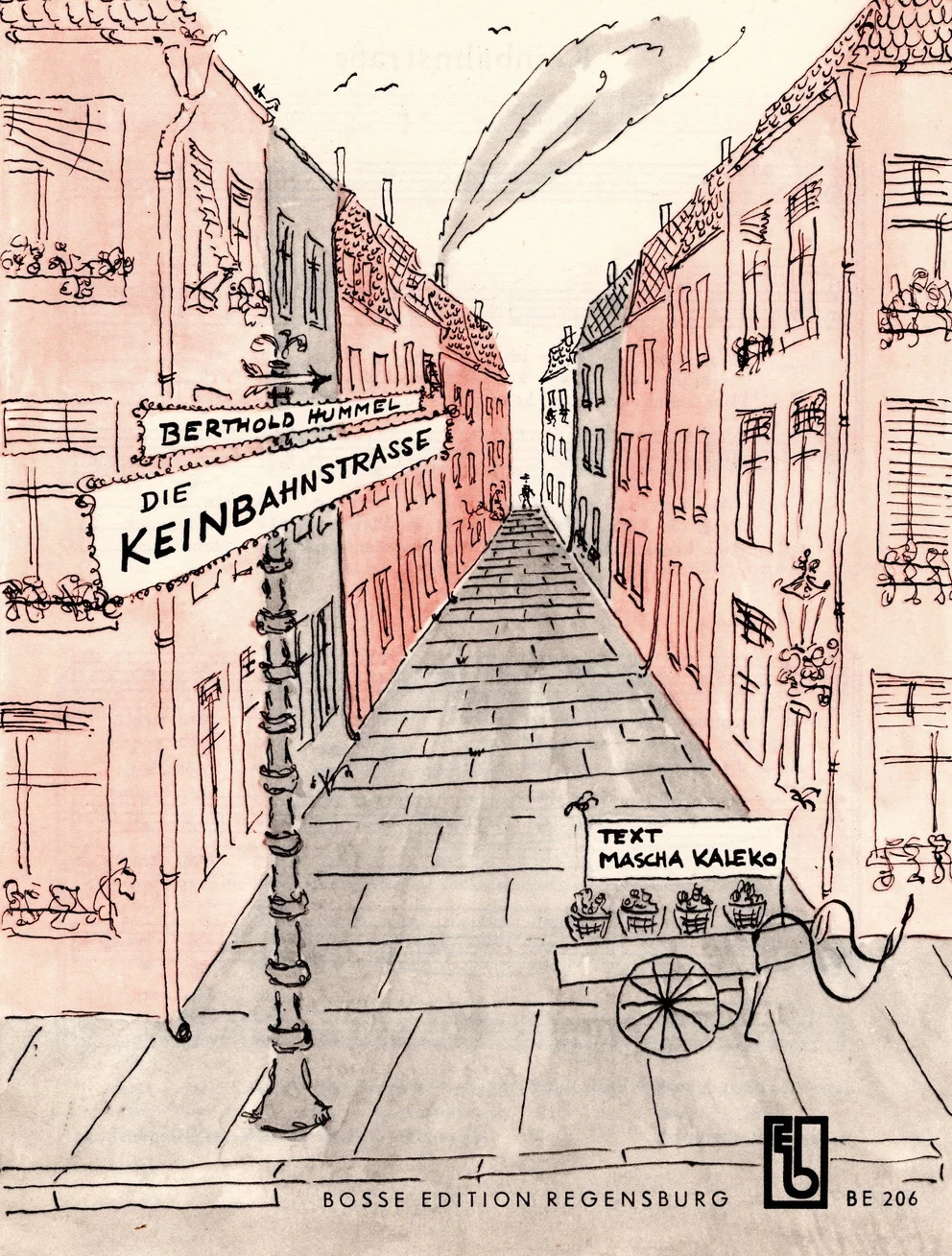
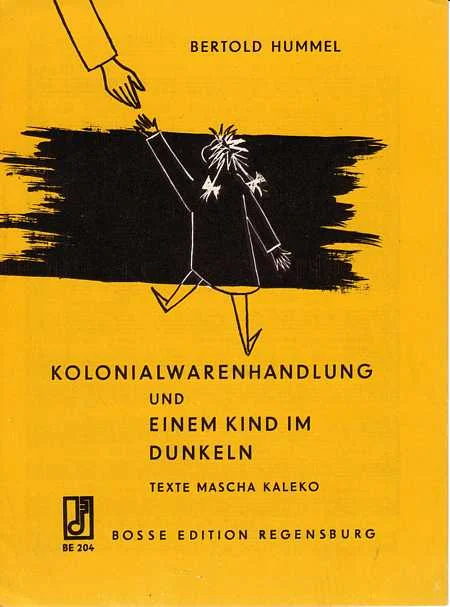
Kolonialwaren-Handlung, Keinbahnstraße, Einem Kind im Dunkeln, Schienen-Sehnsucht
Instrumentation
Three-part choir
Duration: 8 minutes
Publisher
Gustav Bosse Verlag Regensburg 1959/1960 (rights expired)
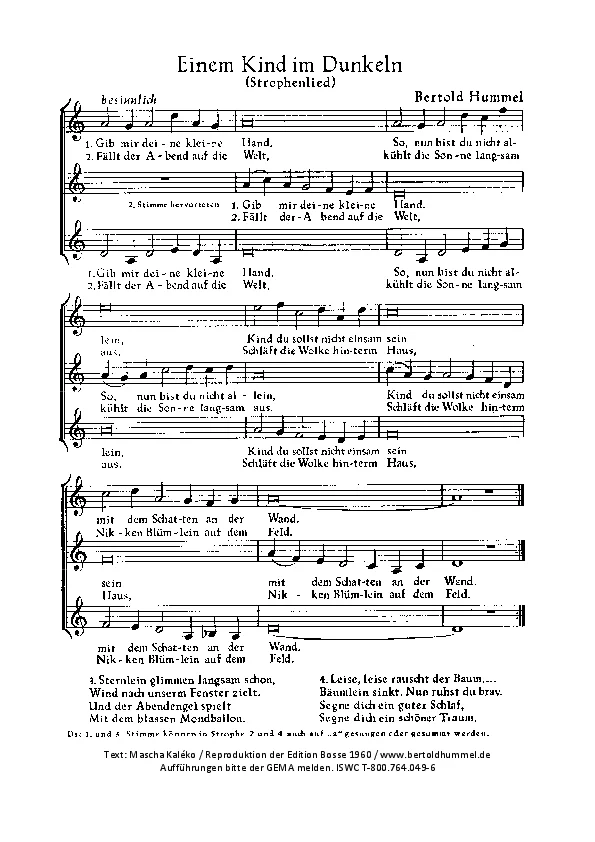
A child in the dark

A dead end
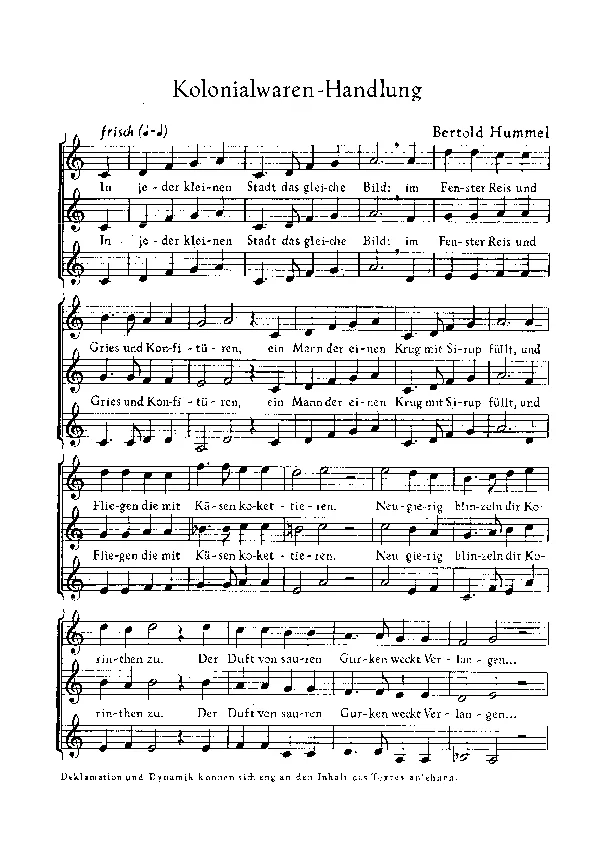
Grocery shop

Longing for the rails




On the advice of Harald Genzmer, the publisher Bernhard Bosse contacted Bertold Hummel in October 1958 and asked for his active co-operation for his new series of editions at Gustav Bosse Verlag Regensburg. The publisher's objective, formulated in a letter to Hummel dated 28 October 1958, is interesting from a music-historical perspective:
I would like to publish light music that is skilful in terms of the music and the text, that is really capable of appealing to the people of our time, especially to city dwellers and young people. The dance, the song and contemporary orchestral pieces for instrumentations such as those found in a school wind orchestra or in the countless small jazz combos and similar combinations should be made. combinations should be made. It should simply be "music for everyday use", for playing and entertainment, just as it was widespread and possible among the people until the end of the 18th century (e.g. Haydn, Mozart, Beethoven and Schubert wrote symphonies, operas, dance and light music with the "same" hand). The new "light music" should somehow grow out of the big city milieu, as I believe that today the big city is the living environment of the more musically active part of the population in Germany, but probably also in most other industrialised countries of the world. A type of "folk music" should therefore be created that corresponds to this circle.
In February 1956, Rowohlt Verlag published a new edition of Mascha Kaléko's Lyrisches Stenogrammheft, which had been so successful before the world war, thus heralding a renaissance of the Jewish poet's works in Germany. The popularity of the melancholy and cheerful verses of the "Berlin city lark" had not escaped the publisher Bernhard Bosse either, and in 1959 he commissioned Bertold Hummel to set some of these poems to music for his newly founded publishing series "Chanson, Lied und Song".
On 29 January 1959, he specified his ideas for these compositions as follows:
I would like you to set some of the texts I am sending you enclosed to music. They are all texts by Mascha Kaléko. They are to be worked into choruses for 3 equal voices, range g-f'' and arranged in such a way that the male voices can then be an octave lower G-f'. The choruses should be worked in such a way that they can be performed in the form of a small suite and that they can also be sung individually, without connection to the others.
The chanson Schienen-Sehnsucht was not included in the printing.
About the poem: Kolonialwarenhandlung:
After the poet had long been reluctant to come to Germany following the events of the Second World War, she nevertheless travelled to Berlin in January 1956 for a book edition and walked through the streets that were familiar to her at the time. In a letter to her husband in New York, she wrote: The neighbourhood " ... is glorious, thick with trees, which even now in the winter bleakness are of a mighty magic and remind me fiercely of old German fairy tales and "back then", and if I had time I would spend days just roaming the streets, seeking out shops exactly like those in my old poem Kolonialwarenhandlung."
To A Child in the Dark:
Mascha Kaléko wrote the poem Einem Kinde im Dunkeln in 1930 for her little sister Rachel.