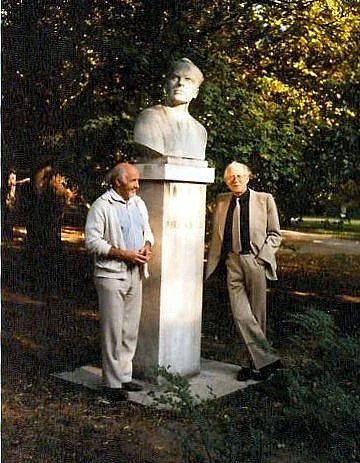
Siegfried Fink
8 February 1928 Zerbst - 3 May 2006 Würzburg
"My later friendship with Siegfried Fink and his students naturally inspired many works. I have learnt a lot from them, had a lot of things played to me and was able to develop my very own style of sound."
Bertold Hummel, January 1998
"Dear Bertold,
The concert of the percussion class at our institute is a welcome opportunity for me to say a few words to you. As your artistic and pedagogical work and your commitment have been honoured from so many sides on the occasion of your milestone birthday, I would like to make a few comments from the perspective of the "percussive instrumentalists".
I have always preached to my students that curiosity and imagination are the dominant criteria for our profession (our vocation?). I have learnt to know and appreciate both in such abundance with you. And I remember with great joy and pride the many hours we spent working and tinkering together on your numerous percussion compositions, based on the teaching of compositional technique and expression of content in the 20th century, two aspects of musical composition came to the fore: timbre and "timing" .... In my opinion, percussion instruments became the ideal instruments for new compositions as a consistent answer to the question of how to combine the new sound ideal with new rhythmic-metric formulas and unused sounds.
Composers of our generation have not been able to escape this fascination. But unfortunately not always with the necessary knowledge of the playing and stylistic criteria of percussion.
You, dear Bertold, as in all your works, took the only right path and engaged in long discussions with the performers of your compositions on the instrument. And this collaboration and your insights have resulted in compositions that, on the one hand, fully utilise the possibilities of the instruments.... but also always incorporate the "heart" of the instruments - and which were and are thus always realisable for the performers, despite the often very high technical demands, in accordance with the score.
Your profound knowledge of percussion instruments enabled you to realise the new and interesting soundscapes you created - and you also spared our instruments the garden hose and watering can.
I would like to take this opportunity to express my special thanks for your wonderful percussion compositions, no doubt on behalf of many performers.
Personally, however, I would also like to thank you for the 30 years of our professional and personal journey together."
Siegfried Fink (speech at a concert on 1 December 1995 to mark Bertold Hummel's 70th birthday at the Würzburg University of Music)
The "Pope of Percussion" died on 3 May 2006 at the age of 78
Siegfried Fink was born in Zerbst/Anhalt in 1928. His father was a violinist in the Königsberg Opera Orchestra, but was no longer able to practise his profession after an accident. After the end of the war, Fink began an apprenticeship as a bricklayer, which he completed with the journeyman's examination. At the same time, he secretly took the entrance examination for the Franz Liszt Academy of Music in Weimar at the beginning of 1948. There he studied timpani and percussion instruments with Alfred Wagner and composition with Prof Helmuth Riethmüller until 1951. This was followed by orchestral positions in Weimar and Magdeburg, his first teaching position at the Magdeburg Telemann Conservatory and his escape to the West in 1958 - because of his commitment to jazz, Fink was accused in the GDR of spreading decadent music with Western influences. The 30-year-old Fink initially came to Lübeck and was hired as a solo timpanist on the last day of the season by conductor Christoph von Dohnanyi for a performance of "The Flying Dutchman" without rehearsal. He was also appointed to the "Schleswig-Holstein Music Academy", where he led a jazz studio in addition to percussion. In Lübeck, Fink devoted himself in particular to 20th century music and soon made a name for himself as a soloist. This was followed by engagements at the "Tage der Neuen Musik in Hannover", the "Darmstädter Musiktage" and as a lecturer at the "International Summer Courses Schloß Weikersheim". Fink finally came to Würzburg in 1965 via a short diversions via the Hanover University of Theatre and Music. As a lecturer for timpani/percussion instruments and director of the "Studio for Percussion", he has made Würzburg a Mecca for percussionists from all over the world. Here - at the first chair for percussion in Germany - he was able to realise his ideas for the reorientation of percussion methodology and percussion music.
Siegfried Fink has received many awards for his artistic and music education achievements, including the Federal Cross of Merit, an honorary diploma from the Barcelona Academy of Music, an honorary doctorate from the Sofia State Academy of Music and the Cultural Prize of the City of Würzburg. Much more important to him, however, were his students, who were always among the winners of national and international competitions and are now internationally renowned solo percussionists, such as Peter Sadlo, Mark Glentworth, Wessela Kostowa, Andrea Schneider, Bernd Kremling, Thomas Keemss and Mark Andreas Giesecke. This list could be continued with many more names. Today, Fink's students are active in orchestras and as teachers at music schools and conservatories all over the world, and some of them are already professors themselves.
He has also written over 140 compositions for a wide variety of percussion instruments and ensembles with other instruments, with which he has set new standards in percussion literature. These include a suite for snare drum solo (ZM 21710), which, as a concert piece of 9 minutes (!) in length, was something absolutely unusual at the time of its composition. His Drumset Suite (ZM 21790) is one of the first notated works written for this instrument. As a multitude of different notation habits for the percussion instruments often make it unnecessarily difficult to grasp a part quickly, Siegfried Fink developed "Tabulatur 72" (later updated as "Tabulatur 2000"); a list according to which the symbols and notation can be standardised.
Just in time for his 75th birthday on 8 February 2003, news arrived from America. Siegfried Fink was the first non-American to receive the "Lifetime Achievement in Education Award" at a banquet during the last World Congress of the Percussive Arts Society (PAS). Siegfried Fink was the one who made percussion socially acceptable. He gave many important impulses to German percussion pedagogy. And anyone who has a name in the German and European percussion scene today will almost certainly have the name Siegfried Fink on their CV.
(Source: www.percussion-creativ.de)
Siegfried Fink : "Sound and Timing" - Bertold Hummel's works for percussion instruments (in Composers in Bavaria: BERTOLD HUMMEL )