Silent night (1974/1980)
3 variations and an epilogue from afar for speaker and mixed choir a cappella
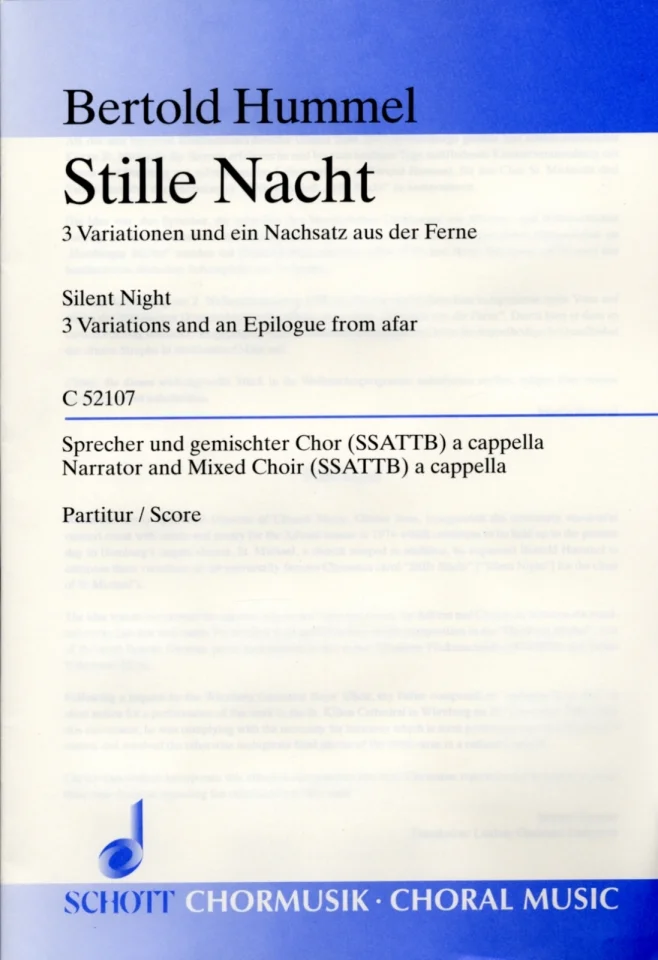
Speaker, mixed choir a cappella
Duration: 9 minutes
Elisabeth Flickenschildt (Speaker) | St Michaelis Choir | Günter Jena
Heinz Rühmann (narrator) | St Michael’s Choir | Günter Jena
Christiane Hörbiger (narrator) | St Michael’s Choir | Christoph Schoener
A/B:
Title: Stille Nacht / zu: Stille Nacht (Nachsatz aus der Ferne) - Length: 6 pages / 2 pages - Date: 23.11.74 / 1980 - Storage location:
Schott Music C 52107 / ISMN: 979-0-001-14409-4
Correction of printing errors:
bar 4: bass without ties | bar 5: bass: beat 1: without a | bar 6: soprano 2: beat 4: resolution sign missing
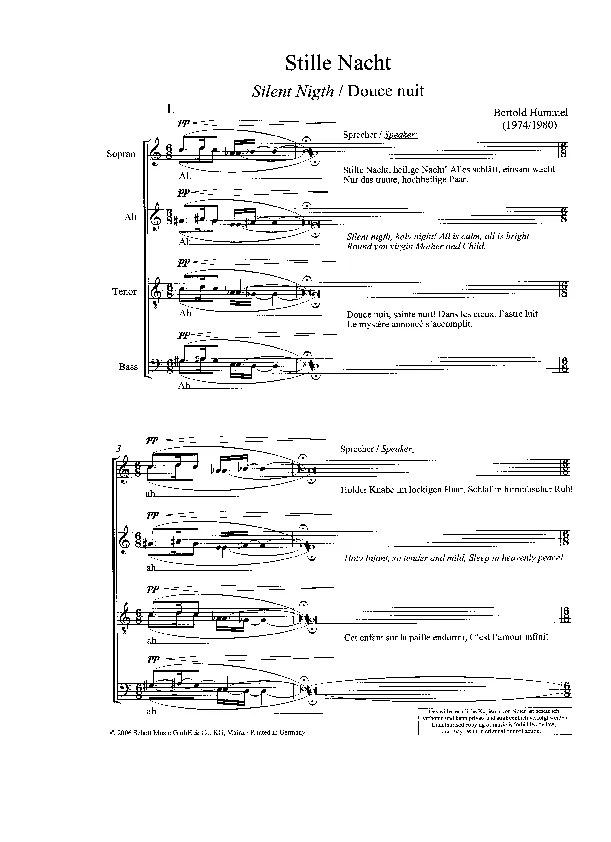
Bertold Hummel | Silent Night | Chamber Choir of the Würzburg University of Music
The piece, written for the choir of St Michael’s Church in Hamburg, incorporates a narrator in the first variation. Over a cluster that re-emerges three times from the first song motif, he (or she) recites the first verse. This completes the narrator’s part. In the second and third verses, the song’s melody is heard in its entirety and unchanged, first in the alto, then in parallel parts between the soprano and tenor. But what one hears from the other voices alongside this is, in the most beautiful sense, unheard of! No harmonic icing, no Christmas kitsch, no musical ‘Goldilocks’ moments. Just a perfectly logical motivic development, emerging from the pp of the second verse through an ever-increasing division of the voices into an ff in the third verse, in which the upper and lower choirs are sung in parallel. And it is precisely this logic that is so captivating; the chordal structure arising from the leading of the individual parts is so astonishingly new, and yet it feels as though it could not be any other way... The third verse ends with the cluster from the first; the‘epilogue from afar’ comprises an entire ‘verse’ consisting solely of tonal syllables, and leads the listener back ‘home’ to C major. The only fly in the ointment: even though the title page states otherwise, the choir is actually divided into all parts, with sopranos and tenors even split into three sections at key points; you need basses who can still sustain the low G, you need sopranos who can comfortably hold the high G for a long time at pp, and you need a truly large choir for this.
Stefan Rauh
Hummels’ four- to eight-part choral setting of Gruber’s world-famous melody ‘Silent Night, Holy Night’ (composed for Günther Jena’s Michaelischor in Hamburg) explores patterns in which expansive soundscapes (featuring clusters and glissandos) flow into a rocking and undulating motion. From all directions, angelic voices, as it were, resound as a foundation and overlay to the main melody, whilst subtle dissonant frictions strip the harmony of any seductive sweetness.
The artistic highlight of the concert was undoubtedly ‘Silent Night – 3 Variations and an Epilogue from Afar’ by the Würzburg composer Bertold Hummel. Kai Christian Moritz recited the familiar lyrics to the choir’s ethereal soundscapes, which oscillated between absolute harmony and atonal clusters of sound and soared upwards in the high-ceilinged Gothic hall. From all around, angelic voices, as it were, rang out as a foundation and overlay to the main melody, whilst subtle dissonant frictions stripped the harmony of any seductive sweetness. After what appeared to be the end of the piece – the choir had already withdrawn from the stage into the chancel – the crystal-clear, strictly harmonic coda suddenly resounded from the Rienecker Chapel into the church, which was as quiet as a mouse.




Foreword (Schott Music C 52107)
When the newly appointed Director of Church Music, Günter Jena, launched the highly successful concert series featuring music and poetry during Advent in 1974 at St Michael’s, Hamburg’s largest and most historic church – a series that continues to this day – he asked Bertold Hummel to compose three variations on the world-famous Christmas carol ‘Silent Night’ for the St Michael’s Choir.
The idea was to incorporate the narrator, who recited poems relating to Advent and Christmas between the musical pieces, into this song motet.
For the first three performances of this composition at the ‘Hamburger Michel’, two of Germany’s most famous actors, Elisabeth Flickenschildt (1974/1975) and Heinz Rühmann (1978), took part.
Following a performance on Boxing Day 1980 at St Kilian’s Cathedral in Würzburg, my father composed a further “Epilogue from Afar” at the request of the Würzburg Cathedral Boys’ Choir. In doing so, he responded to the particularly strong desire for harmony felt on that festive day and resolved the ambiguous closing phrase of the third verse into a radiant C major.
Choirs wishing to include this striking piece in their Christmas programme may decide for themselves how to conclude it.
Martin Hummel
Günther Jena formulates the commission as follows:
Dear Mr Hummel,
Please find the song enclosed. Naturally, it would need to be in a higher key for the choir. As Ms Flickenschildt will be present, the first verse could also be sung in a spoken voice over the choir – though I am not sure whether that would be appropriate, given that she is due to read Böll’s story immediately beforehand. In my opinion, the second and third verses should be rearranged to achieve a clearer (dynamic?) build-up. The number of voices could also be increased; there are 90–100 choristers.
The entire evening is accompanied by various lighting effects: it begins in an Advental atmosphere in the darkened church, then candles are introduced, and at the end of the evening the church should be festively illuminated amidst Christmas jubilation. During the third verse, a spotlight could be directed at a golden sun and the risen Christ in the altarpiece, thereby making the church noticeably brighter for the first time. Unfortunately, I’ve left Böll’s story at home, but perhaps you can imagine the atmosphere he captures in a main railway station on Christmas Eve: loneliness, desolation, darkness, despair.
With warmest regards,
Günter Jena
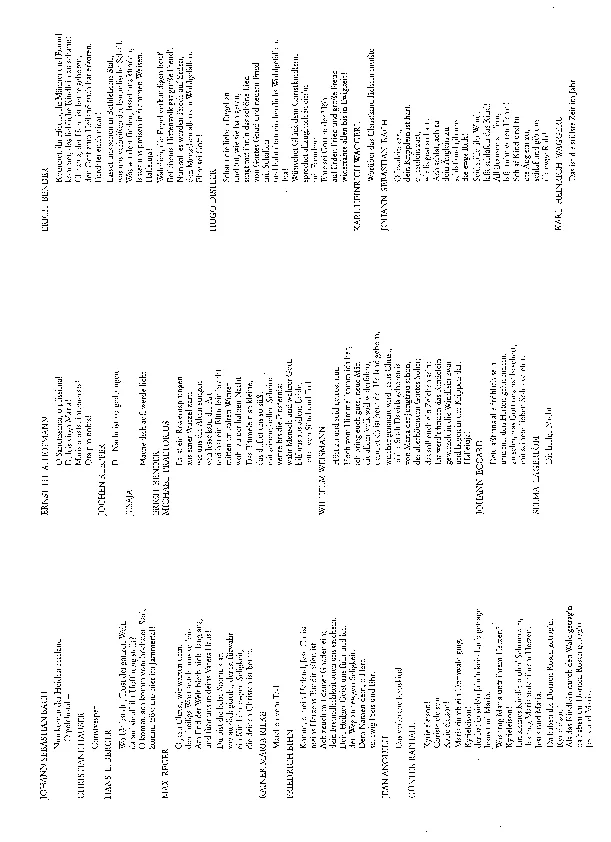
At the popular concert series ‘Music and Poetry for Advent’ at Hamburg’s St Michael’s Church, the following texts were read before the motet:
Heinrich Böll: ‘Christmas at the City Station’ (Elisabeth Flickenschildt, 1974) – followed by Jochen Klepper: ‘The Night Has Fallen’
Karl Heinrich Waggerl: ‘This Is the Quietest Time of the Year’ (Heinz Rühmann, 1978)
Selma Lagerlöf: *The Holy Night* (Christiane Hörbiger, 2015) – followed by Johannes Kuhn: *Do You Believe in Angels?*