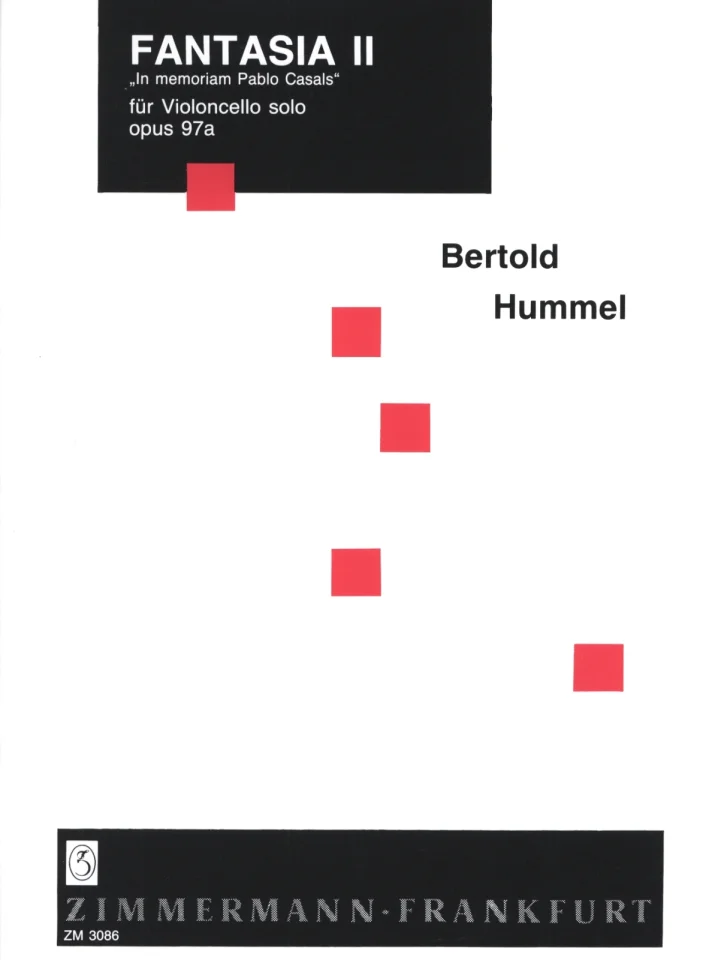
Fantasia II in memoriam Pablo Casals (op. 97a, 1993)
Dedication
for Julius Berger
Instrumentation
Violoncello
Duration: 8 minutes
Premiere
22 October 1993,
Kronberg, St Peter and St Paul's Church, Cello Festival "in memoriam Pablo Casals"
Julius Berger
Autograph
Title: FANTASIA II op. 97a - Length: 8 pages - Date: S.D.G. 4.Aug.93 - Location: Bayerische Staatsbibliothek Munich
Publisher
Zimmermann Musikverlag Frankfurt ZM 30860 / ISMN M-010-30860-9
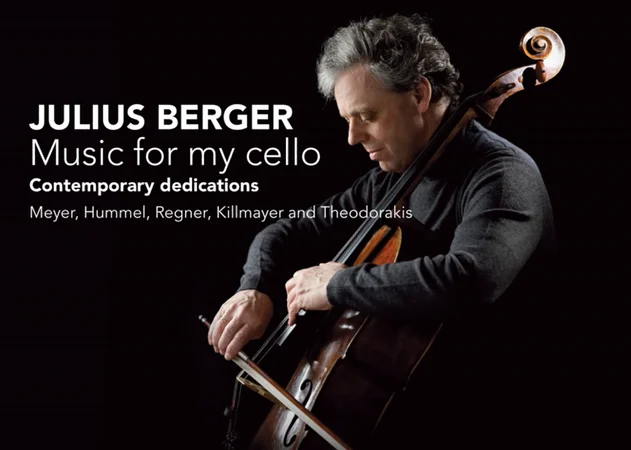
Augsburger Allgemeine, 13 August 2010
The second, the more opulent Fantasie, "in memorian Pablo Casals", mixes shimmering, luminous sound spaces, noisy magic, hard exploding passages and delicate webs. The material is organised in coherent scenes, making harmonious contact with one another - a kind of musical Paul Klee panorama, a celebration of Berger's virtuosity and creative mastery.




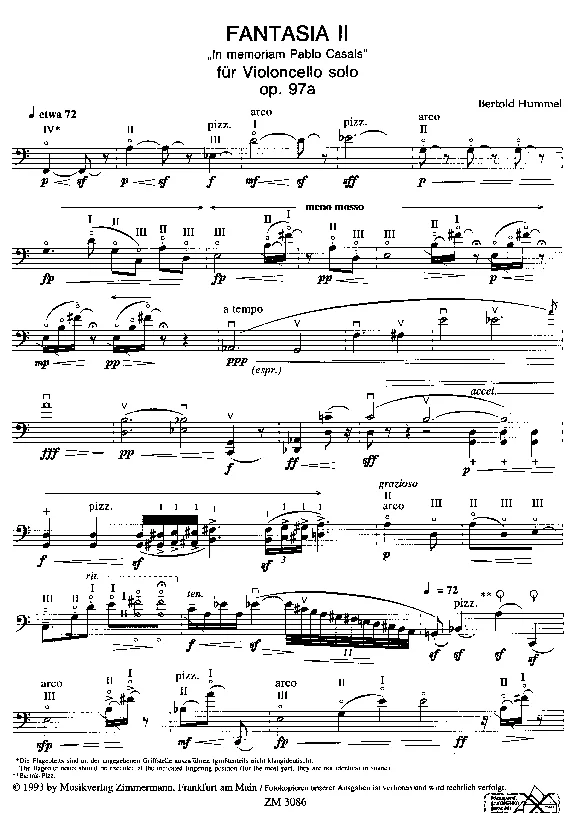
Fantasia II was written in the summer of 1993 at the suggestion of the cellist Julius Berger. In keeping with the occasion of the premiere, the Kronberg Casals Festival in the same year, I chose the letters of the name "CASA(L)S" that can be set to music, the 'B-A-C-H' tone sequence and the first line of the Gregorian "Te deum laudamus" as the source material. In addition, there are diatonic harmonics combinations and the use of the overtone series. The alternation between flageolet and ordinario, as well as arco, con sordino and pizzicato offers the opportunity to explore the tonal and tonal range of the instrument. The permanent variability of the metre is intended to enable "free speech".
The tone material is brought into very contrasting rhythmic and tonal situations in the form of a metamorphosis. The dance-like alternates with the chorale-like, the recitative-like with the arioso. The return of the beginning introduces the ever-slowing conclusion, which fades away in the extreme piano.
Bertold Hummel
Bertold Hummel conceived Fantasia II for violoncello solo op. 97a in the summer of 1993 at the suggestion of cellist Julius Berger. In keeping with the occasion of the premiere, the Kronberg Casals Festival in the same year, the composer chose the letters of the name "CASA(L)S", the 'B-A-C-H' tone sequence and the first line of the Gregorian "Te deum laudamus" as his source material. This early church hymn has its liturgical place on the morning of Easter Sunday. In Christ's resurrection, God has turned the deepest darknesses, sin and death, into the light of reconciliation and life. Coming from Easter and travelling towards the eternal Easter feast, the Christian and the congregation of believers proclaim the Easter faith all the days and nights of their pilgrim existence in praise and thanksgiving, in lament and petition: "God has raised Jesus".