Music for four saxophones (op. 88f, 1990)

Movement titles
I. Allegro vivace, II. Sostenuto, III. Burleske, IV. Finale
Instrumentation
Soprano, alto, tenor, baritone saxophone
Duration: 18 minutes
Premiere
3 May 1991,
Würzburg, St Stephen's Church
Normand DesChênes | Jürgen Faas | Matthias Köhler | Johannes Neuner
Autograph
Title: I. Allegro Vivace - Length: 35 pages - Date: I. 13.4.90 II. 28.3.90 III. - IV. 3 May 1990 - Location: Bayerische Staatsbibliothek, Munich
Publisher
Schott Music ADV 7626 / ISMN: 979-0-2063-0743-0 / ISBN: 978-3-89221-691-9 (score and parts)
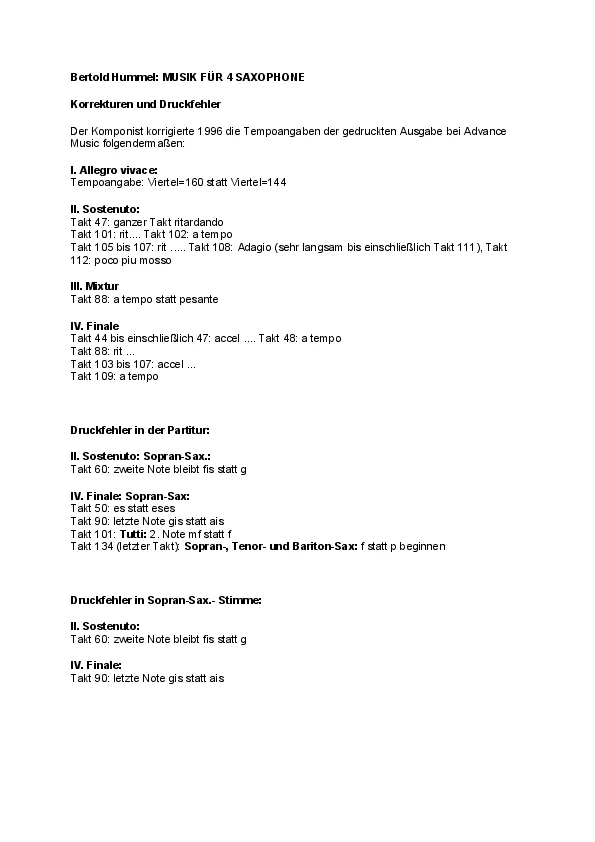
Op. 88f: Corrections and misprints
Fürther Nachrichten, 31 October 1993
The four saxophones were given a fascinating fullness and luminosity in the slow movement: an homage to the tuba landscape from Bruckner's 7th Symphony.




A tone sequence, which is played in unison at the beginning, forms the starting material for the first movement. The intervals minor third, fourth and fifth play a special role, both in the melody and in the chord formation. Strong differentiations in dynamics and articulation characterise this first part of the work, which is committed to classical sonata form.
The sostenuto - which repeatedly returns to the harmonic-hymnal gesture of a funeral march - is structured by recitative-like interjections and motivic continuations and leads to a fading chorale-like episode - a Brucknerian allusion.
The recorded mixture of two intertwined ninths defines the burlesque 3rd movement vertically. Horizontally, the interval sequence of minor thirds and fourths is predominant - a quasi resumption of the tonal material from the 1st movement. The formal structure is A B A, whereby B appears in the tempo of a Ländler.
The 4th movement begins with an arioso introduction, followed by an Allegro vivace with the character of a rondo. Throbbing rhythms, melodic phrases reminiscent of jazz and strong dynamic contrasts characterise it. The turbulent finale ends as if with a touch of resignation. The work was composed in 1990 at the suggestion of Normand DesChênes.
Bertold Hummel