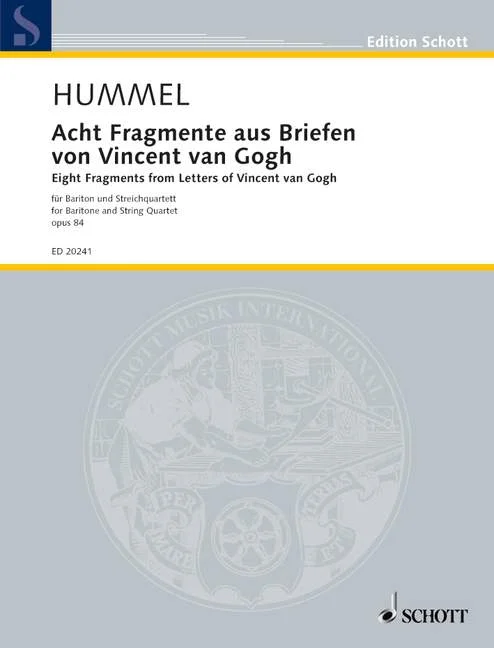
Eight fragments from letters by Vincent van Gogh for baritone and string quartet (op. 84, 1985)
I., II., III., IV., V., VI., VII., VIII.
Baritone, string quartet
Duration: 19 minutes
Martin Hummel | Seraphim-Quartett Stuttgart: Margret Hummel | Sonoko Imai | Florian Hummel | Matthias Neupert
Title: 8 FRAGMENTS FROM LETTERS BY VINCENT VAN GOGH for baritone and string quartet op. 84 - Length: 28 pages - Dated: I. 28.4.85 II. 2.May 85 III. 3.May 85 IV. 19.May 85 V. Whitsun 85 VI. 28 May 85 VII. 29 May 85 VIII. 30 May 85 - Location: Bavarian State Library, Munich
Schott Music ED 20241 / ISMN: M-001-14888-7
First edition: J. Schuberth & Co., Hamburg 1988
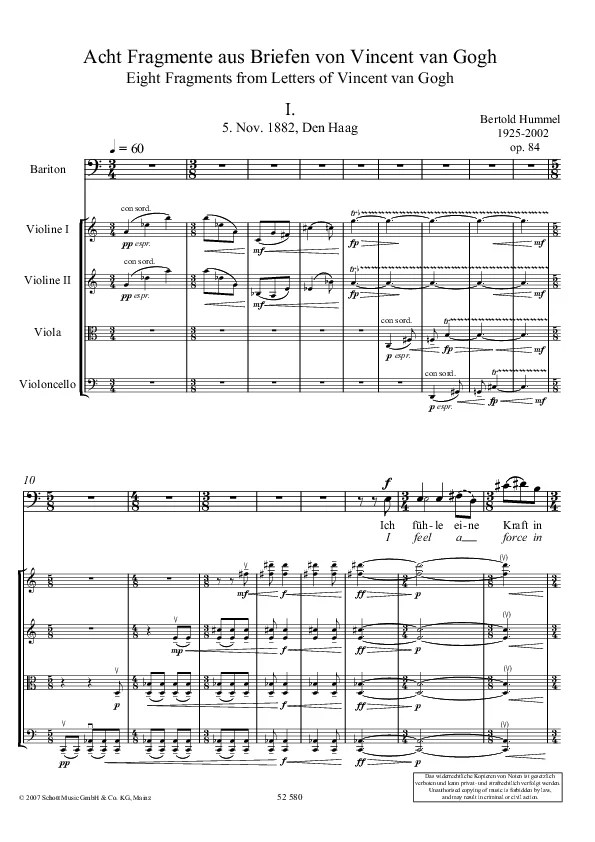
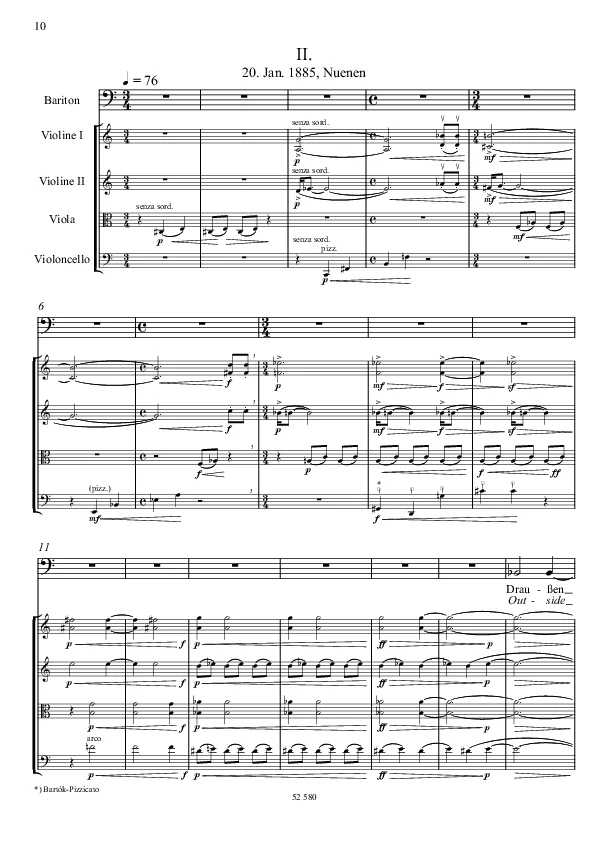
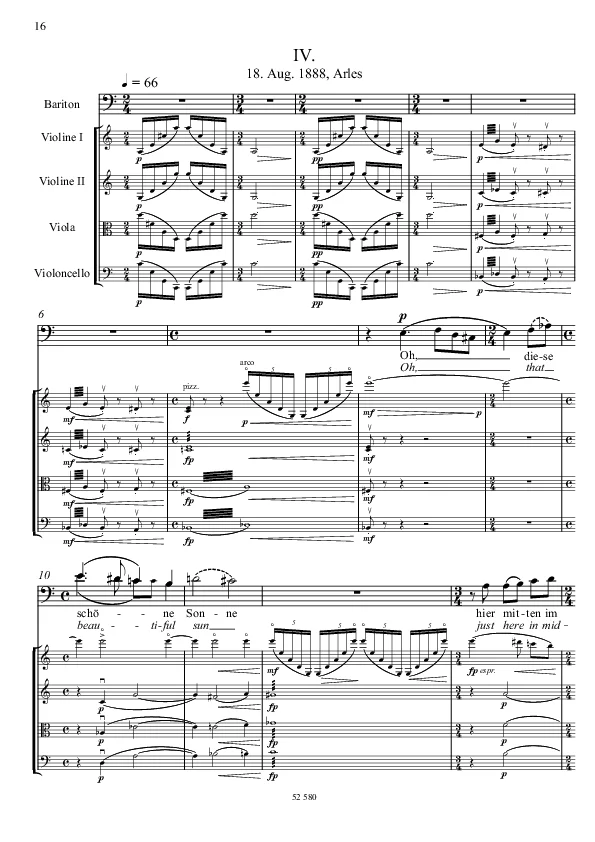
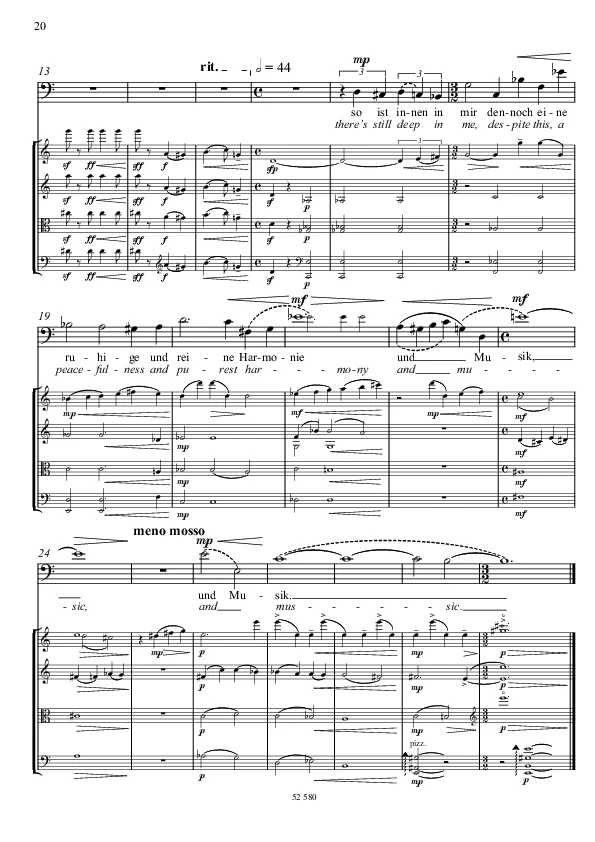
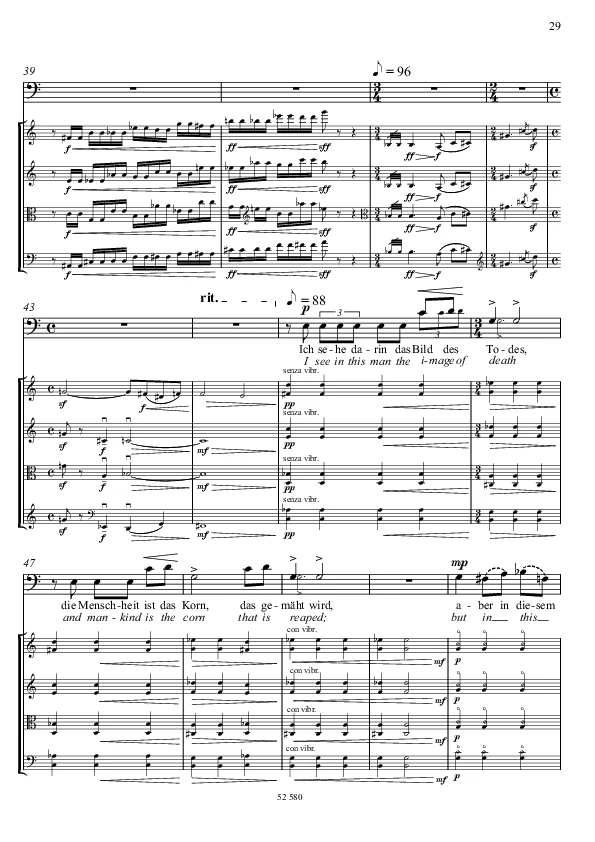

With the "Eight Fragments" , Bertold Hummel has indeed created a highly impressive work. These "dark grey songs" - to quote Ludwig Hirsch - unfold a sad, expressive, almost somnambulistic charm that is extremely atmospheric and text-related. These songs seem to have become Bertold Hummel's completely inward-looking"Winterreise", the epigram of a psychosis, full of hidden allusions and dark forebodings, but also always full of hope. The"sun" becomes the repeatedly invoked bearer of hope. The music is highly expressive, utilising the different ways of playing and bowing the string instruments, their nuancing possibilities, to the utmost, sometimes creating oppressive visions of sound. It is endangered music with an extremely unstable balance. There are also subtle musical allusions. Harmony and tonality are evoked with just one note following the word"music".
Reinhard Söll
A fervent, glowing setting, whose melodic style is cuddly to the prose-like text by the painter van Gogh and whose artistic message was so well suited to being presented as a credo to an audience that had rushed in out of personal sympathy and objective interest.
In addition to songs by Barber and Respighi, Christoph Sökler has included Bertold Hummel's "Eight fragments from letters by Vincent van Gogh" in his demanding programme in the Schlosskirche. He sings these fragments with a strong, also inwardly strong voice with a fine, bright timbre, completely secure within the string section, which is more oppressive than supportive. Radically explores violent intervallic tensions. Shocked by the sharpness, the drama, the seriousness of his performance and by the closeness to the word of every note. Makes the tale of woe of these epistolary passages palpable in a rending and yet never violent expression and has the strength and warmth to let the picturesque sun rise in this highly condensed music and let the splendour of the voice flow.




One of Bertold Hummel's main works is the Eight Fragments from Letters by Vincent van Gogh, set for baritone and string quartet in 1984. These are atmospherically dense, dark grey songs, above which the sun rises at times as van Gogh's symbol of hope. There has been talk of Bertold Hummel's "Winterreise", which is not at all far-fetched, because here too everything is turned inwards, here too the picture is one of total isolation with traits of psychosis, here too oppressive visions of sound are evoked, especially in the string writing, which utilises all the possibilities of nuance.
The eight letters date from the years 1880 to 1889, i.e. from the time when van Gogh first embarked on the path of a Methodist preacher and then gradually found his true destiny. The late letters were written in Arles, where he painted and lived in the much-publicised yellow house.
Van Gogh has rarely been associated with music. This makes it all the more exciting to see how his highly expressive letters - definitely side pieces to the paintings - are reflected in the sound world of an oversensitive composer of our time.
Karl Schumann 1990
Foreword (Schott Music)
"With the Eight Fragments , Bertold Hummel has indeed created a highly impressive work. These "dark grey songs" - to quote Ludwig Hirsch - unfold a sad, expressive, almost somnambulistic charm that is extremely atmospheric and text-related. These songs seem to have become Bertold Hummel's completely inward-looking Winterreise, the epigram of a psychosis, full of hidden allusions and dark forebodings, but also always full of hope. The sun becomes a constantly invoked beacon of hope. The music is highly expressive, utilising the various ways of playing and bowing the string instruments, their nuanced possibilities, to the utmost, sometimes creating oppressive visions of sound. It is endangered music with an extremely unstable balance. There are also subtle musical allusions. With just one note following the word"music", harmony and tonality are evoked."
Reinhard Söll