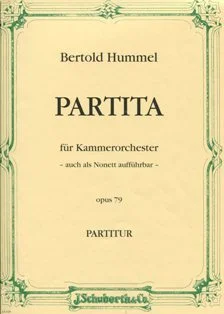
Partita for chamber orchestra or nonet (op. 79, 1982)
I. Prolog, II. Burleske, III. Tempo di Valse, IV. Finale Marciale
0.1.1.1 - 1.0.0.0 - strings
Duration: 20 minutes
Munich Nonet: Erich Keller | Karsten Heymann | Walter Stangl | Ulrich Bode | Herbert Duft | Kurt Kalmus | Karl-Heinz Hahn | Richard Popp | Gottfried Langenstein
Philharmonie Lublin | Piotr Wijatowski
Title: Partita for chamber orchestra also performable as a nonet op. 79 - Length: 31 pages - Dated: I. 16 Aug. 82 / II. 25 Aug. 82 / III. 11 Sept. 82 / IV. 19 Sept. 82 - Location: Bavarian State Library, Munich
Schott Music LS 5185-01
First edition: J. Schuberth & Co., Eisenach 1995
Later, Bertold Hummel's Partita for chamber orchestra is performed: a metropolitan sonata of expressionist escapes, shadows, passages, lively trills and unison shifts - stuttering waltzes, limping traffic marches, controlled escalation, harmony of the seconds. The space expands.
Composed in 1982, the work is bursting with ideas such as quotes from BACH, playing with stylistic breaks, grotesque and burlesque musical associations, all originally juxtaposed and combined in four movements. (...) Hummel's writing also captivates with its skilful handling of the instruments, which essentially comprise a string section and some additional wind instruments in virtuoso handling.
Wolfram Graf
Bertold Hummel's Nonet op. 79 (1982) appeared quite different, vital and witty, highly originally formulated and downright grateful in the solo parts, a lively, spirited, multi-coloured, iridescent fanning out of instrumental idiosyncrasies, burlesque and pleasantly pictorial.




The Partita op. 79 was written at the suggestion of the "Münchner Nonett". An entertaining "serene" composition was expected for a trip to East Asia. I tried to fulfil this requirement in 4 movements.
In the prologue, the four wind instruments (oboe, clarinet, bassoon and horn) are introduced as soloists, while the strings comment en bloc. A Schoenberg-style fourth motif is juxtaposed with the B-A-C-B sequence and the four-note motif of Wagner's Tristan. After many interweavings and metamorphoses, the movement ends with the clarinet's lowest note.
The Burleske thrives on the lively 16th-note movement, which is only briefly interrupted and comes to a standstill in the "golden section". Winds and strings often face each other in blocks in a concertante manner, resulting in quite amusing sound figures.
In the Tempo di Valse , the last sound of the burlesque is taken up again and extended by further triads to a 12-note total. After the slow introduction, a waltz beat is repeatedly attempted, which is rhythmically disrupted. Waltz and ländler gestures break through more and more until finally the opening sound is resumed, with which the movement ends.
The Finale marciale is characterised by march-like structures: first a funereal introduction, which is broken up by a grotesque march. The funereal mood appears once again before the grotesque march pushes towards the end and breaks off with a tonal climax. The ostinato coda ends with a surprising gesture.
Bertold Hummel