Fantasia I in G for cello solo (op. 77d1, 1952/1978)
for Cornelius
Cello
Duration: 6 minutes
Julius Berger
Title: "Fantasia in G" for violoncello solo (new version) - Length: 3 pages - Date: 78 - Location: Bayerische Staatsbibliothek Munich
N. Simrock Hamburg-London (Boosey & Hawkes) ISMN M-2211-0906-4
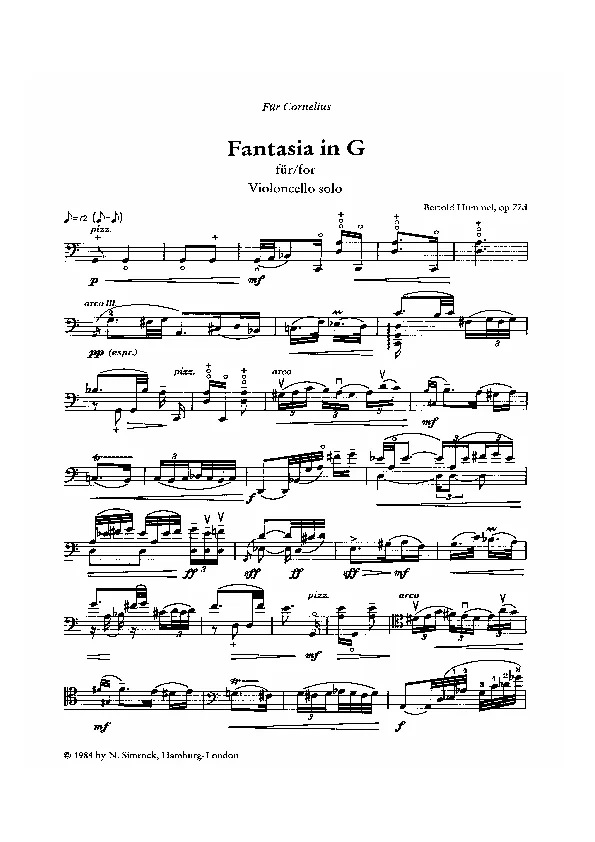
A short one-movement work for solo 'cello. As with most unaccompanied 'cello work technically demanding for the performer yet is a highly effective piece and well worth the time taken to master is various Complexities. The style is rhapsodic, almost improvisatory, with great rhythmic fluidity and bars of constantly varying length. Although tonally quite free, there are landmarks for the listener in the form of repeated motives and the overall structure is clear with obvious recapitulation of the opening material in the last section. This work is well-written for the instrument and is recommended as a useful addition to a performer's repertoire.
Literature list of the German Music Council for the competition "Jugend musiziert":
Level of difficulty 3 / moderately difficult (intermediate level I)




Formally, the Fantasia I in G op. 77d is quite clearly structured. After the pizzicato introduction, an arioso section begins, which is repeated in the 5th line (bar 2) somewhat modified in the fifth, albeit with a different ending. Page 2 (bar 2, line 2) begins a kind of development as a middle section. Page 3 (2nd line) begins the recapitulation. The arioso theme is now repeated in the mirror image = inversion (line 4, bar 2). The coda begins with the meno mosso in the third-last line and ends with the pizzicato of the beginning, which can be taken very slowly.
Bertold Hummel
The name "Fantasia" indicates that the tempo can be handled somewhat more freely than in motorised movements (so the designation quaver = 72 could also mean quaver = 60-80). The change between arco and pizzicato can also be treated accordingly. You just have to make sure that the piece does not "fall apart", i.e. the listener must be able to sense a meaningful connection.
Formally, the fantasia is quite clearly structured: after the pizzicato introduction, an arioso section begins, which is repeated in the 5th line (bar 2) slightly modified a fifth higher - albeit with a different ending. Page 2 (bar 2, line 2) begins a kind of development as a middle section. Page 3 (line 2) begins the recapitulation. The repetition of the arioso section now begins in the mirror image = inversion (line 4, bar 2). The coda begins with the meno mosso in the last line and ends with the pizz. of the beginning, which can be taken very slowly.
Bertold Hummel to Katharina Stein (12 February 1999)