Fantasia for flute solo (from the ballet "The Last Flower") (op. 55d, 1975)

Flute
Duration: 5 minutes
N. Simrock Berlin (Boosey & Hawkes) EE 2978 / ISMN M-2211-0896-8 - Critically corrected new edition by Henrik Wiese, 2014
First edition: N. Simrock Hamburg-London 1984
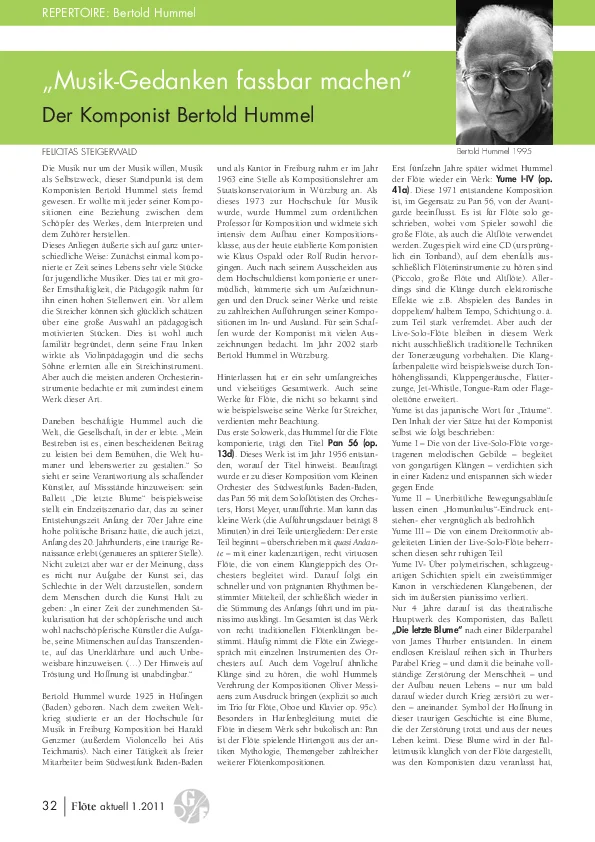
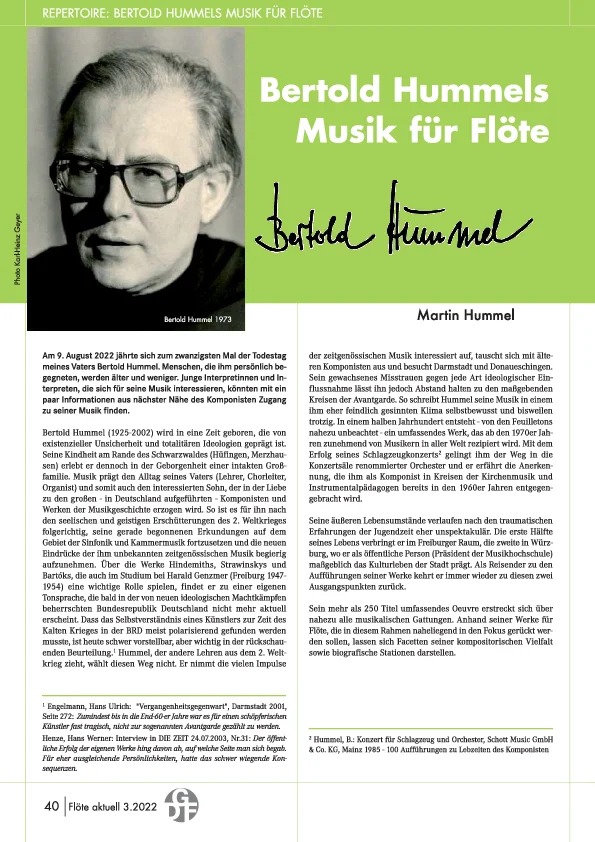
Bertold Hummel has summarised and rounded off two solo flute episodes, which are played behind the scene in the aforementioned ballet, into one piece in a formally convincing manner. Although the musical substance is certainly understood in the context of the ballet plot, the Fantasia also appears meaningful and essential on its own as an autonomous musical statement. Listeners, players and readers will be able to recognise the architecture of the piece in its memorable intervallic patterns; they will notice how the circle rounds out towards the end; they will not miss the intervallic inversion of characteristic rhythmic-melodic figures and an espressivo cantilena, which creates a clear structure. Many more details in this direction could be mentioned, in short: the great advantage of the piece is its clarity or "comprehensibility" (as it was called in the Viennese school), without it having lost any of its originality, spontaneity and genuine emotionality.
Heino Schwarting
Bertold Hummel's Fantasia op. 55d from the Ballet "The Last Flower" is a lively and well written piece, uses flourishes, trills and runs in unorthodox ways and could test the players to the limits of their abilities.




The ballet "The Last Flower" after J. Thurber describes power, abuse of power, war, destruction and hope in repetitive alternation. The flute solo depicts the futile attempt of the "last flower" to spread hope, which dies in the descending atomic rain.
Bertold Hummel
Preface (Critically corrected new edition Simrock 2014)
The title of the ballet Die letzte Blume inevitably triggers associations with the song "The last rose of summer", to which both Ludwig van Beethoven (op. 105, no. 4) and Friedrich Kuhlau (also op. 105) composed variations for flute and piano. However, the similarity in the title is deceptive: The last flower and "The last rose of summer" have nothing to do with each other in terms of content or music.
The last flower by Bertold Hummel is based on the parable The last flower (1939) by James Thurber. In it, war and peace are depicted as two states of a cycle caused by civilisation, which will one day lead to the complete destruction of life and love if man does not learn from history. In this parable, the last flower is a symbol of nature, without which mankind cannot survive. If the last flower dies, man dies too.
Hummel transports Thurber's parable to the 1970s by linking it to the Cold War and the nuclear threat in his ballet The Last Flower op. 55a. After a murderous war, "a flower blossoms alone in the devastation and fully unfolds its beauty. As it is not recognised by anyone, it tries to make itself noticed. It tries in vain to cast a spell over the figures cowering petrified on the ground. Finally, she manages to catch the eye of a young girl. Touched by the beauty of the flower, the girl's senses awaken, her will to live is awakened and her initial amazement turns into joy and enthusiasm (dance: girl + flower). Now she wants to share her discovery with other people. After various attempts, she succeeds in drawing the attention of a young man to the flower. He too is touched by the beauty of the blooming flower and feels a new zest for life. At the same time, love for the young girl awakens in him" (from Hummel's synopsis). From this love of life, a civilisation gradually develops again. It leads once again to war, the last war. In a world destroyed by nuclear weapons, "the 'last flower' timidly blossoms once more, but finds no resonance and fades away" (from Hummel's synopsis).
Hummel's Fantasia op. 55d is made up of three parts of this ballet. The first section describes the first blossoming and the desire for attention (to m. 1 from the score: Dance of the Flower). In the ballet, this is a flute cadenza behind the scene. This is followed by the girl's discovery of the flower (to m. 31 from the score: "Das Mädchen erblickt die Blume"). In the ballet version, a vibraphone joins the flute here. This second section of the Fantasia is somewhat shortened compared to the ballet. The third section (from m. 63) is taken from the end of the ballet and - like the other two sections - is played backstage. It describes the final blossoming and dying (to m. 83 from the score: "At last the flower dies in the deadly atomic rain").
The ballet Die letzte Blume op. 55a was premiered on 4 May 1975 at the Stadttheater Würzburg under the musical direction of Max Kink. The solo flute player that evening was Hubert Scholtes. The Fantasia for flute solo from the ballet "Die letzte Blume" op. 55d was published by Simrock in Hamburg in 1984. Unfortunately, this first edition (source E) lacks important tempo markings. In addition, the performance markings are very carelessly placed and the bar divisions are clumsy, which must have been due to the use of a music typewriter for the notation. This made a new edition of this work necessary for reasons of both content and aesthetics. Unfortunately, the model for the first edition is unknown. Instead, however, the autograph of the ballet version (source A) has survived. It is characterised by its good legibility and clarity. Valuable additional information was also provided by the written-out flute part of the ballet version (source M).
The musical text of the present new edition follows source E in its musical substance (pitches and rhythm), whereas source A was favoured as the authoritative source for the performance markings (dynamics and tempo). The few missing performance markings in the autograph, which can be found in the first edition, have been tacitly adopted. Further additions by the editor are placed in square brackets [ ]. This also applies to additions from source M.
Henrik Wiese
Munich, autumn 2013