The last flower - Ballet (op. 55a, 1974)
based on an idea by James Thurber
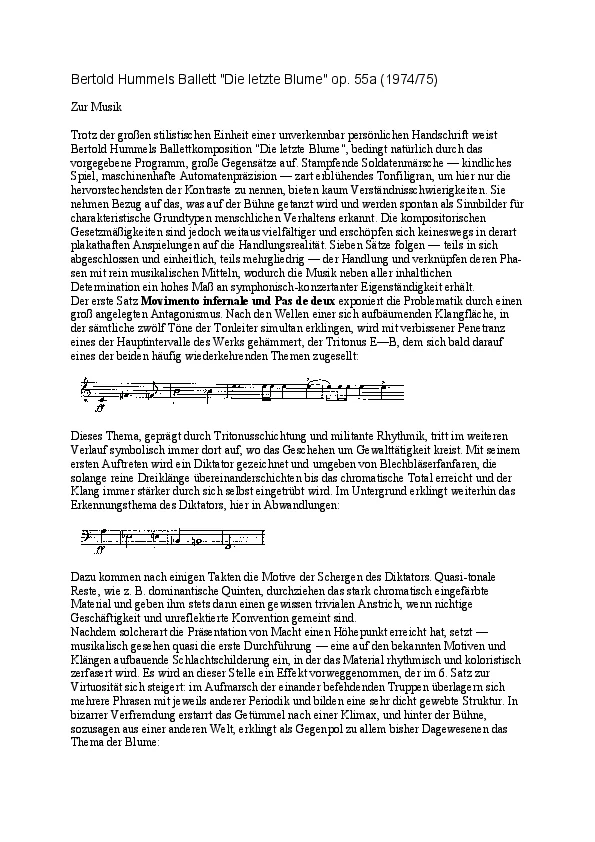
I. Movimento infernale and pas de deux
Once again, a dictator appears with his henchmen. They show themselves to be violent - and start a war.
People's works are destroyed and no one wants to live - except for one flower.
This flower reawakens the joy of life in the girl and the man.
II Scherzo
Children play again.
III. Notturno
Young girls and boys dream again.
IV. Danza
People are working and rebuilding their houses.
V. Intermezzo meccanico
Inventors and scientists experiment again and find new ways to split atoms.
VI Mascherata
Jugglers amuse the people. They meet in the marketplace.
The dictator and his henchmen appear against the democrat.
VII Finale
They showed how powerful they were. And started the war.
This time everything was destroyed. In the end, the flower dies.
3.3.3.3 - 4.3.3.1 - timpani, percussion, harp, strings
Duration: 55 minutes
Würzburg Municipal Philharmonic Orchestra | Max Kink
Ballet ensemble of the Würzburg City Theatre | Choreography: Klaus Meyer
Location: Bavarian State Library Munich
N. Simrock Hamburg-London (Boosey & Hawkes)
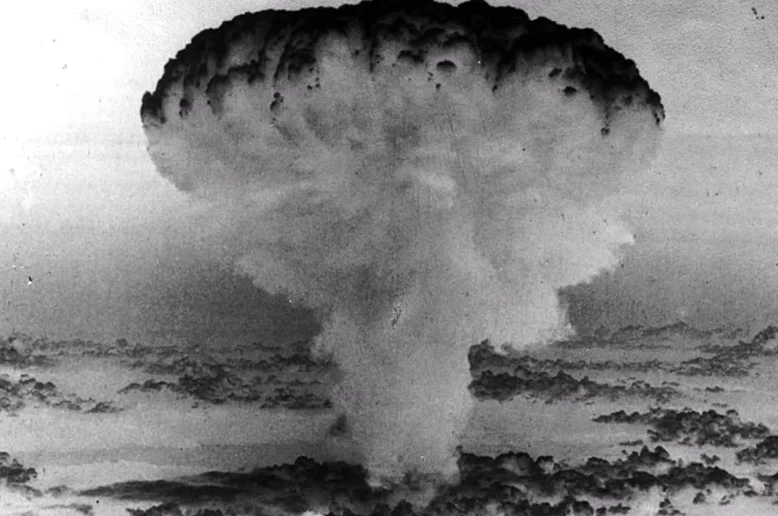


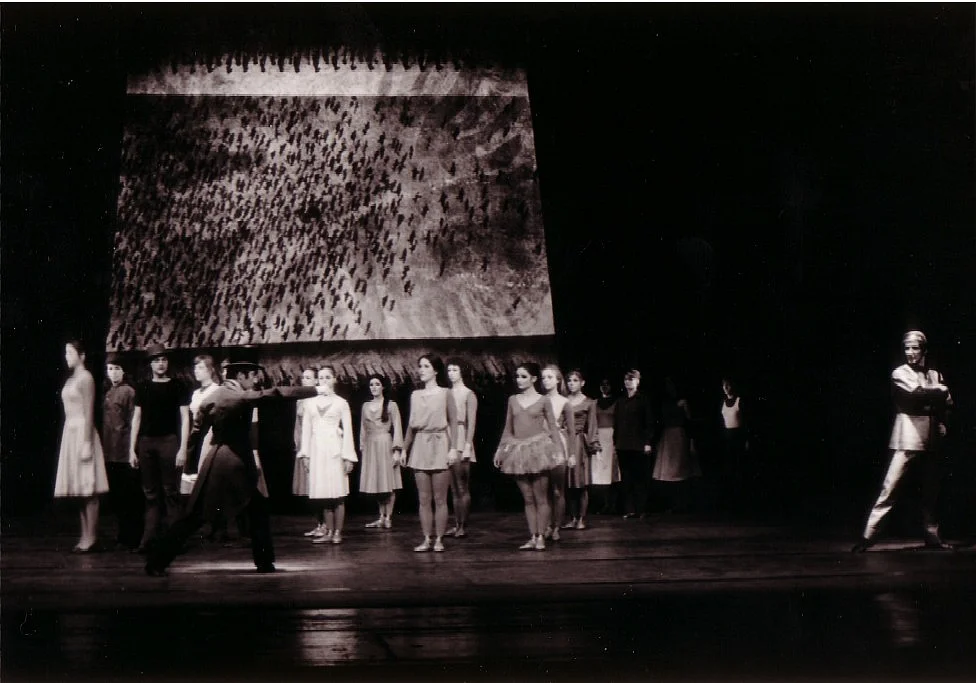


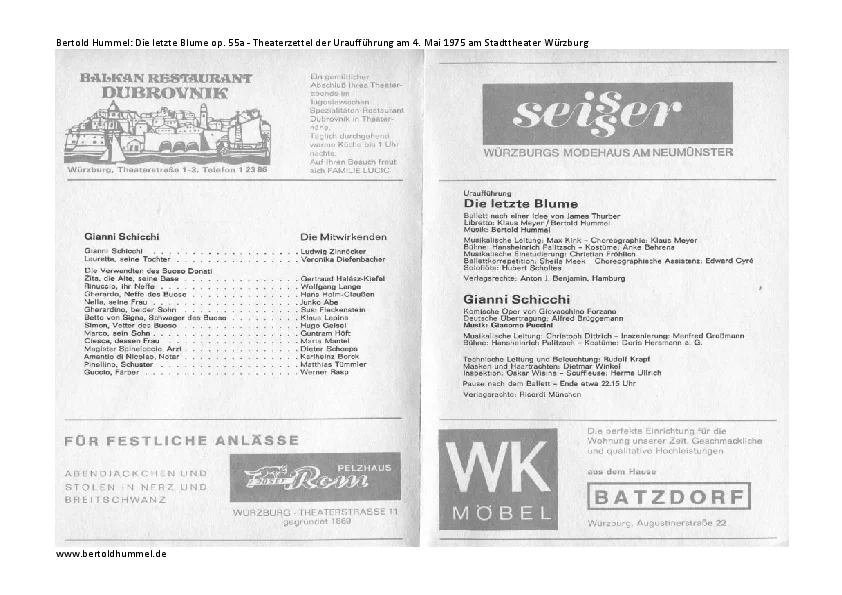
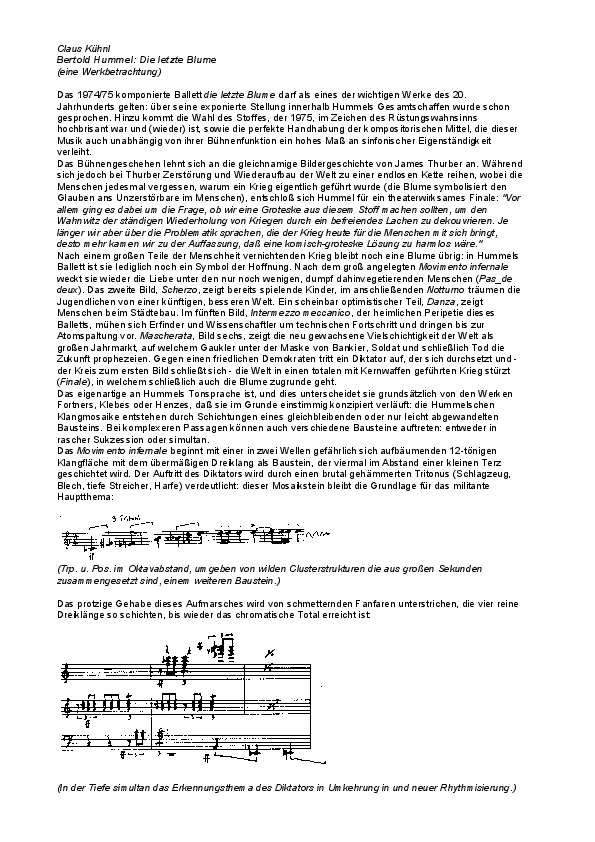
In his ballet "The Last Flower" (based on an idea by James Thurber), Bertold Hummel tells a succinct, memorable and stirring story, demonstrating an unusual talent for vivid, stage-appropriate design - from the detailed dramatic dance gestures to the contrastingly accentuated tonal background of various scenes. Ballet director Erich Payer found the ideal basis here for his effective choreography, with which he translated these favourable conditions into striking movement: a dictator obsessed with power destroys everything in a devastating war. The "last flower" rises again delicately and fragile; its shy grace encourages a pair of lovers, children begin to play again, houses are built, boys and girls dream of happiness, the work of inventors begins again, artists warn in vain. A scientist makes a discovery: she inserts a "T" into the letters "A-O-M" (symbolising the Far Eastern invocation of God) and creates the ATOM. Suspecting its misuse, she carries the "T" away with her like a cross, but the dictator snatches it from her and uses it for a war of annihilation that no one survives. Against the backdrop of a mushroom cloud, the last flower also dies - disfigured and distorted. The Augsburg audience fully appreciated the outstanding performances of all those involved in this remarkable evening. A roar of applause and shouts of bravo were the spontaneous, heartfelt thanks.
"The Last Flower" was an exciting reminder on a subject that usually leads to platitudes.
Hummel's music, entirely dedicated to the action on stage, is colourful, effective, striking, powerful in the true sense of the word. Five percussionists sit in the orchestra to give the annihilation attack on humanity between war (at the beginning) and nuclear war (at the end) the necessary explosiveness. Electronic sounds are also incorporated. When it comes to showing the monotony of work as well as the hectic pace, he resorts to serial technology.
The "Scherzo " of the playing children, who - a charming idea in the following "Notturno" - quickly transform into dreaming girls, offers a nice contrast. More comical than frightening, a scientist fights for her atom before a dictator wrests it from her.
"The Last Flower" with Hummel's extremely impressive music was very well received by the audience.
Bertold Hummel's composition is modern in the best sense of the word, it is not content with harmonies, it also shows the turmoil of the modern world within a rich palette of sounds. This powerful, expressive music has substance.
The catchy music can be credited with wonderfully strong colours, especially in the highly illustrative, dramatic scenes.
... a success that is all the more remarkable as it comes from an audience that was previously unaccustomed to new music. This is probably not least due to the musical composition, which has a high degree of persuasive power even without concessions in the musical means. It is difficult to categorise Hummel's work stylistically, as it follows several mutually exclusive directions. However, the fact that there is a special intention behind it becomes obvious if one is prepared to think about the social relevance of the means. To name just a few examples, dodecaphony is used and artistically perfected where coldly calculating calculation is personified in the material by a researcher who has just succeeded in inventing a new, all-destroying wonder weapon. Trivial material thinking with poster-like tonic-dominant relationships and rousing rhythms, on the other hand, is located where it is a matter of the masses' lack of criticism and unfounded optimism.
The work, which was spontaneously convincing at its premiere - there was no audience member who would have resisted the seriousness of the message and the aesthetic appeal of the performance - must now make its way across the stages to prove its stability. It has the prerequisites for this.




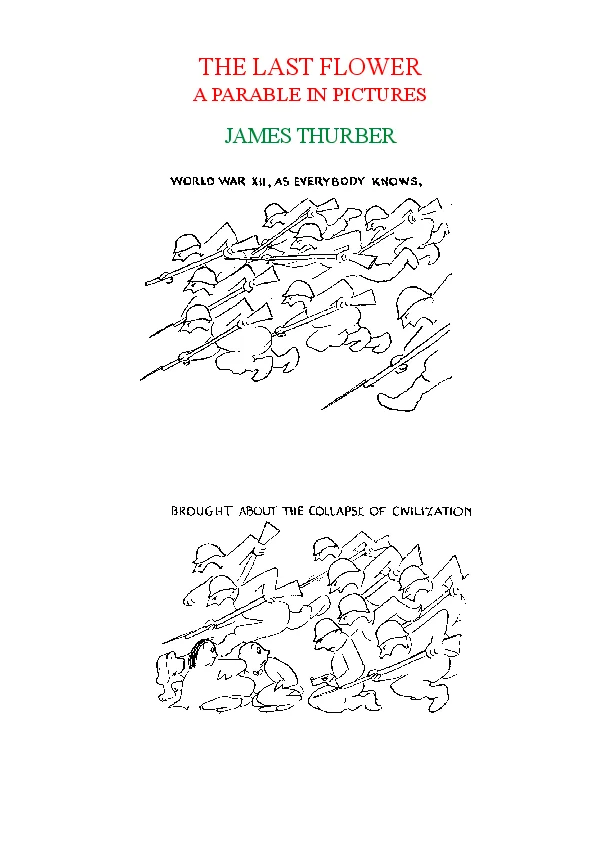
In 1974, I was commissioned by the municipal theatre in Würzburg to write a ballet score for James Thurber's picture parable "The Last Flower" .
James Thurber (1894-1961) enjoys a similar reputation in the USA as Wilhelm Busch does here. Kurt Kusenberg has aptly described the content of the parable as follows:
"The Last Flower is a melancholy parable of the futility of history. Destruction and reconstruction are strung together in an endless chain, and why a war was actually fought is forgotten afterwards. The picture book begins with a catastrophe, it shows the people who "got away with it once more", miserable, naked, apathetic creatures who no longer know anything about love, beauty and hope; it shows the reawakening joy of life, the new beginning, the reconstruction - and it ends with the next, even more thorough catastrophe. One could take the parable for the deepest pessimism, but it harbours an optimistic core: the belief in the indestructible, in the flower. The last people of yesterday are also the first people of tomorrow. The only flower that escapes total destruction becomes the mother of a new flora on earth. In this picture story, Thurber, consciously or unconsciously, makes a self-confession: his faith in man is a little, decisive bit greater than his despair over his folly.
In my version, however, faith in man has dwindled to a minimum and has given way to despair over his folly. It signals the end of the round dance and serves as a warning in our time, which is incomparably threatened by nuclear self-destruction.
Bertold Hummel
Description of the plot by the composer for the premiere in 1974
Ia
The dictator embodies power and violence. (Solo) His helpers reinforce him. (Pas de quatre) Armament and the development of military power inevitably lead to the use of power and finally to a murderous world war, which results in the almost complete destruction of mankind, animals and vegetation. The remaining, decimated humanity has no will to live and is completely apathetic. (Corps de ballet)
Ib
In a state of complete emptiness, a flower blossoms alone and unfolds its full beauty. (Solo) As it is not recognised by anyone, it tries to make itself noticed. It tries in vain to cast a spell over the figures crouching petrified on the ground. Finally, she manages to catch the eye of a young girl. Touched by the beauty of the flower, the girl's senses awaken, her will to live is awakened and her initial amazement turns into joy and enthusiasm (dance: girl + flower ). Now she wants to share her discovery with other people. After various attempts, she succeeds in drawing the attention of a young man to the flower. He too is touched by the beauty of the blooming flower and feels a new lust for life. At the same time, his love for the young girl awakens. This love comes to full fruition in a large-scale pas de deux. (The flower repeatedly appears in the background as a source of new will to live).
II
Children dance naively and happily into a hopeful future. (Corps de ballet)
III
Young people experience the magic of a moonlit night. (Pas de quatre)
IV
Different classes optimistically build a new, peaceful world. (Corps de ballet with soli)
V
The scientist lives only for research and progress. (Solo)
VIa
The arts (minstrels, acrobats, jugglers) celebrate happy holidays. (solos, etc.)
VIb
A fair - the epitome of peaceful joie de vivre - unites all groups in a cheerful celebration. (Tutti)
Two fairground criers appear, initially advertising their wares. The people are interested in both of them. The opponents appear in ever new guises and change the nature of their offers. Finally, they appear as political party speakers - one as a liberalist, the other as a radical. The masses side with the radical politician, while his political opponent loses supporters. Finally, the liberal is massacred and assassinated on the orders of the "dictator".
VII
The dictator enjoys his power (as at the beginning) and spreads violence, again leading to armed conflict. Murderous destruction, this time so complete that humans and animals have no chance of survival. Under the most unfavourable living conditions, the "last flower" timidly blossoms once again, but finds no resonance and dies.
A year's work
"The Last Flower" by James Thurber, a satirical story in pictures about the eternal recurrence of the same human stupidity, has interested ballet master Klaus Meyer for many years as the basis for a ballet. A first attempt was made over two years ago to have this material composed for the Würzburg ballet company. In May last year, Prof Bertold Hummel was won over for the work. In long meetings, the ballet master and composer, together with the stage designer and the dramaturge, discussed the subject and its feasibility for the theatre.
The main question was whether we should make a grotesque out of this material in order to decouple the absurdity of the constant repetition of wars with a liberating laugh. But the longer we talked about the problems that war means for people today, the more we came to the conclusion that a comic-grotesque solution would be too harmless. After this fundamental decision, a number of individual questions had to be solved. Thurber's original was extraordinarily rich in characters and would have resulted in a ballet lasting two and a half hours. As we were planning to perform the ballet together with an opera, it should not last longer than 60 minutes. So everything that seemed superfluous was left out and the story was reduced to its actual core. A reduction that is very conducive to telling a story through dance and movement. As a consequence of all these changes to the original libretto, our ballet ends with the total destruction of life instead of depicting the unchanged return of the same thing over and over again.
Once the basics of the libretto had been established, the composer and choreographer met many times and agreed on the details that had to be finalised before the music could be written.
Most of the music was then composed in the summer of 1974. The ballet troupe had been working on the rehearsals since around mid-October, alongside all the daily tasks involved in opera and operetta.
(in: Blätter des Stadttheaters Würzburg, 1974/75 season - issue 19)
"The Last Flower" by James Thurber is the basis of the ballet. It is a satirical story in pictures that vividly demonstrates that humanity has not learnt anything from its experiences and has learned nothing from history. It cannot break the cycle of war, new hope, reconstruction and war again. This work demonstrates how power works, with its dangerous independence. The next destruction could be the last.
Programme preview 1983/84 of the Städtische Bühnen Augsburg