Pentafonia for percussion and strings (op. 53a, 1974)
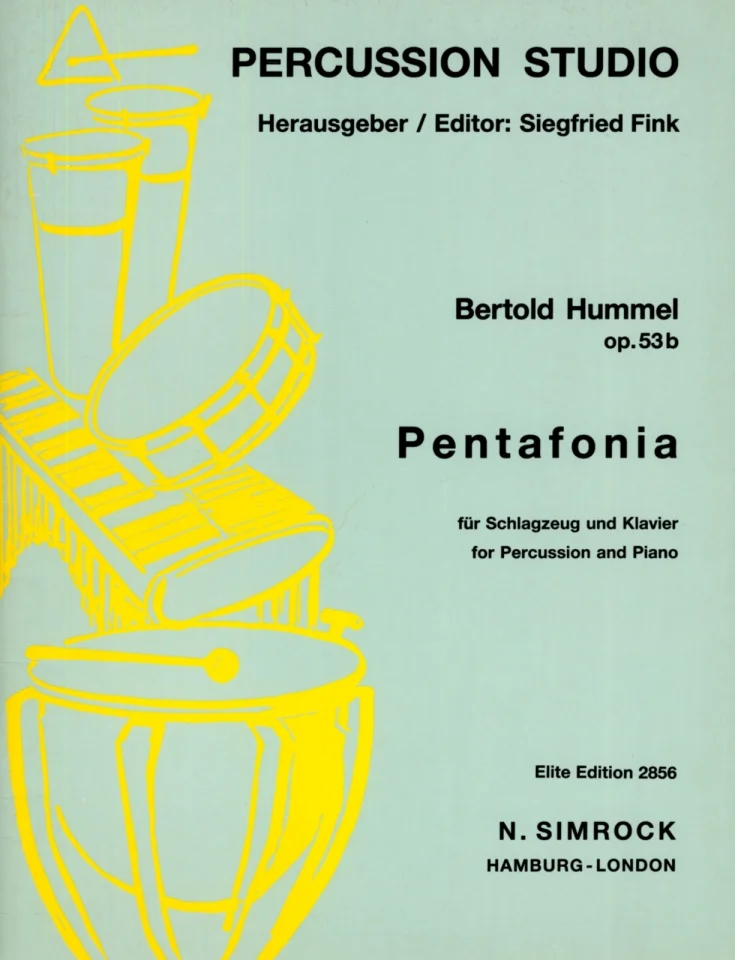
I. Fantasia, II. Allegro ritmico, III. Nocturne, IV. Intermezzo, V. Conclusion
gong (50 cm), vibraphone, cymbals (50-45-40-35 cm), cymbal 45 cm (sizzle) 20 cm (bell), 2 tom-toms, snare drum, 2 bongos, 5 temple blocks, 2 woodblocks, strings
Duration: 26 minutes
Hermann Gschwendtner | Munich Chamber Orchestra | Hans Stadlmair
Siegfried Fink | The Cairo Conservatoire Orchestra | Ernst Schelle
Title: - - Length: 48 pages - Date: I. 5.1.73 II. 21.1.73 III. 5.2.73 IV. 13.3.73 V. 6 Jan. 74 - Storage location: unknown
N. Simrock Hamburg-London (Boosey & Hawkes) Piano reduction: ISMN M-2211-0810-4

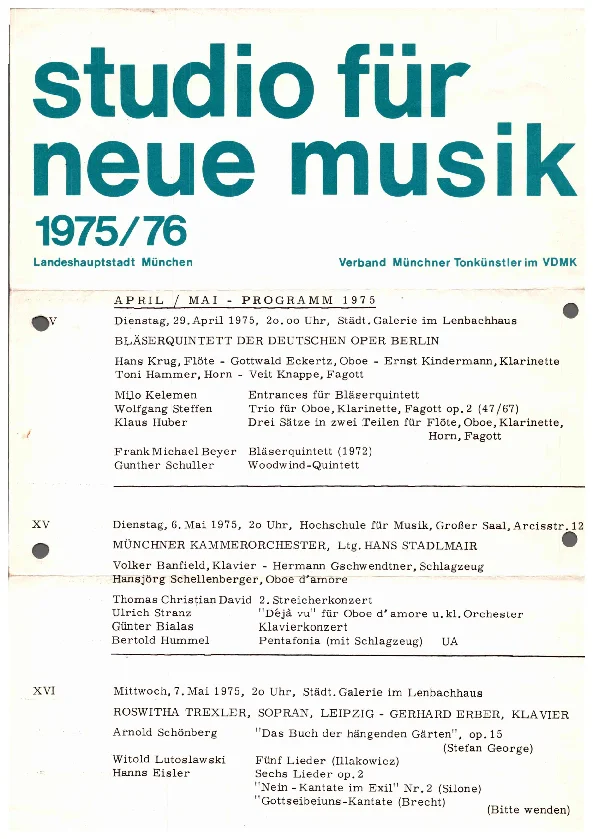
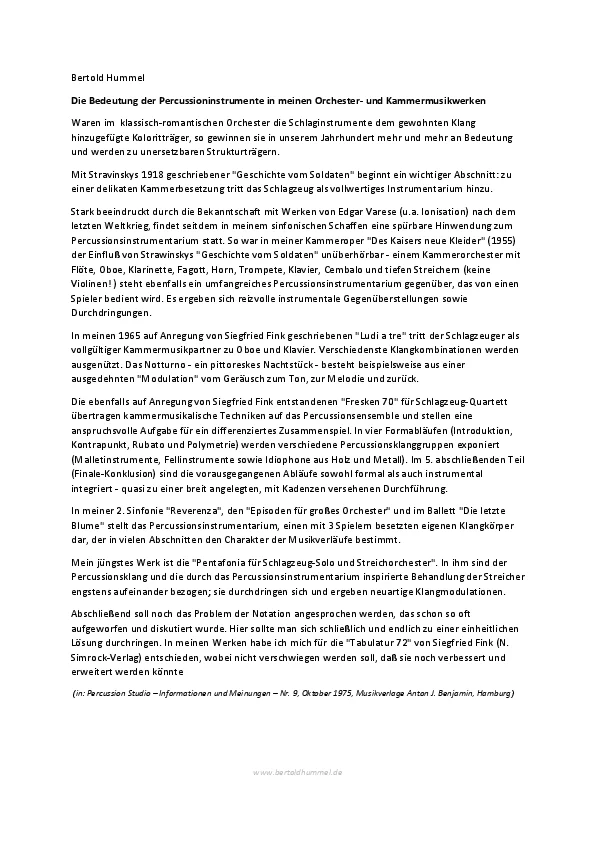
This work derives its name from its five movements and was conceived by the composer in 1973/74. The number of percussion effects included in this piece is astonishing. Hummel's convincing compositional achievement, however, is to integrate these impulses, which emanate from the percussion, into the string sound; he has succeeded in doing so in a convincing manner.
This work, composed in 1974 for the justified wishes of percussionists, draws its charm from the relatively small percussion instruments, which are juxtaposed with a sure sense of intimate floating sounds, but also rhythmically elementary effects, against the string section, which is worked with a lot of tremolo and layered sounds.
Hummel's Pentafonia proved to be an interesting sound study between the percussion, which included drums, temple blocks, cymbals, tam-tam and vibraphone, and the 12-piece string ensemble. But anyone who thought this was going to be a rapid thunder of sound was mistaken. Instead, the emphasis was on magical, mysterious string filigree, naturally with a contemporary colouring. Soloist Wolfgang Schneider contrasted this with sometimes spherical sounds, sometimes virtuosic, sparkling climaxes. The young solo percussionist mastered even the most intricate rhythmic figures.
The Pentafonia for percussion and strings is a highly interesting and successful sound experiment, which can be heard even without a linear theme, a real composition that shows what beautiful musical instruments percussion instruments can be.




The solo percussion with its diverse tonal possibilities is at the centre of the work.
In the first movement Fantasia, tonal surfaces, mainly produced by the vibraphone and various cymbals, are juxtaposed with striking short motifs. The percussion sounds are extended by the strings and vice versa, interpenetrating each other and resulting in attractive sound modulations.
The second movement, Allegro ritmico, is dominated by the concertante principle, the juxtaposition of two bodies of sound. The string ensemble is predominantly contrasted with skin and wood percussion instruments.
In the 3rd movement Notturno, a chorale-like episode takes centre stage, which appears 4 times in different versions; in between, the vibraphone plays recitative-like cadenzas.
In the 4th movement Intermezzo, fur and metal instruments are again used in a concertante manner. A short cadenza for the soloist, which recalls what has just been heard, is played shortly before the end of the movement.
In the broadly conceived final movement (5th), the possibilities already shown are summarised and formally reorganised, so that the procedures shown in movements 1-4 come together in an overarching bracket as a kind of development.
The work concludes with a coda in the outermost pp.
Bertold Hummel