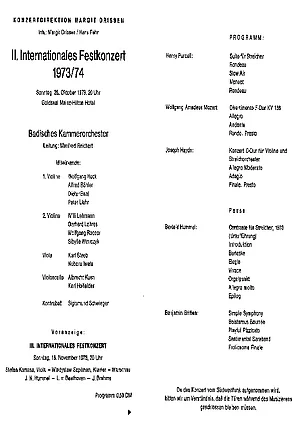
Contrasts for strings (op. 50, 1973)
I. Introduction, II. Burlesque, III. Elegy, IV. Vivace, V. Organ point, VI. Allegro molto, VII. Epilogue
8 violins, 2 violas, 2 celli, 1 double bass
Duration: 14 minutes
Badisches Kammerorchester | Manfred Reichert
Title: "Contraste für 13 Streicher" (1973) - Length: 26 pages - Dated: I. 9.Aug.73 / II. 11.Aug.73 / III. - IV. 14.Aug.73 / V. 22.Aug.73 / VI. 24.Aug.73 / VII. 25.Aug.73 - Location:
N. Simrock Hamburg-London (Boosey & Hawkes) (loan material)

In seven individual movements of very contrasting, yet well-balanced expression, a charming sound world of easily audible transparency is captured here, which was immediately convincing at the première. Burlesque and Elegy are the end points of a whole scale of different areas of experience, which are framed by a meditative introduction and a restrained, melancholy epilogue. Vivace and Allegro molto polarise the sound magic of an impressive organ point. A comparison with the string quartet genre comes to mind. Hummel has resorted to a correspondingly versatile apparatus, which is often enough frayed into thirteen soloistic individual strings. From this body of sound, he brings out the most delicate sound fabrics, comic effects and gripping power. A fusion of clear form and a wealth of personal expressive values seems to have occurred here. However, the composer keeps the work free of any excessive pathos and is able to convey far more through sparing gestures than through unbridled espressivo.
Klaus H. Stahmer
Heinz Zeebe had chosen an effective piece, Contrasts for Thirteen Strings (1973) by Bertold Hummel, as the overture for the evening. These seven individual movements are written freitonally in conventional notation and are characterised by a differentiated richness of colour. The pieces, which culminate in a delicately fading epilogue, were played excellently and with a sense of sound by the strings.
Alongside Britten's"Simple Symphony", which is hardly missing from any string orchestra repertoire today and was also played at the end in Mainz, these new orchestral miniatures proved to be outstanding. They promise to become genuine repertoire pieces alongside Hummel's"Klangfiguren".
Hummel's work is moderately modern, a feast of tonal nuances for the ear, an almost "pleasant" opus that delights rather than shocks. Subtle webs of strange harmonies appear over normal triad chords. The floating, buzzing dominates, with flagolet, glissando and trill effects, with precious organ points. It is a sophisticated colouristic event arranged for the refinements of the string art, which occasionally conjure up an oboe or bassoon effect.
Of the chamber orchestra works, the Contrasts for thirteen strings by Bertold Hummel was a beautiful-sounding and effective piece, music of a free-tonal quasi-impressionism that should be a pleasant change for chamber orchestras that are primarily focussed on baroque music.
What develops from a prelude-like violin cadenza is a moving piece rich in fantasy and figures. Hummel lets fashions be fashions, making it clear that he is after the sonorous full sound of the string section. This is a very listenable work by someone who can do a lot, who understands a varied orchestral writing and who has an unbroken relationship to tangible effects.




My friend D. v. B has asked me to say a few things about my work.
As a matter of fact, I am very much inclined to the opinion of I. Stravinsky, who once said: The only permissible means for a composer - to convince his audience - is the score and its sonorous result.
Despite this judgement, I don't want to disappoint you completely and would like to tell you something about my piece.
The contrasts - 7 in number - have one thing in common: the 13-part, solo string scoring. (8 Viol. 2Br. 2Celli. 1 Kontrab.) The most contrasting sound events are extracted from this instrumentation:
From the unison sound to multi-tonal chord glissandi, trill chains, harmonics and a fanned-out 13-part sound. - From solo to fully composed pedal effects (borrowed from piano technique) to the organ point in a wide variety of tone colours. In short: the possibilities of the 13 string instruments are utilised in a variety of ways - and you can certainly tell from the work that its author has a special relationship of trust with this instrumental genre.
This Tredezimett was inspired in the spring of 1973 by the concertmaster Wolfg. Hock (we know each other from our time together in Freiburg.) It was composed in August 73 and premièred in Mainz in October. The Bad. K-O, to whom the work is dedicated - played as this evening under the direction of Mr Reichert. May I now wish my contrasts a good reception here in Kirchzarten - and thank you already now for listening with an open mind.
Bertold Hummel (Speech manuscript for the introduction to the work, Kirchzarten October 1974)
Bertold Hummel's 'KONTRASTE FÜR STREICHER' op.50 (1972) is divided into seven formal sections. The string orchestra is divided into thirteen parts. Traditional categories such as melody, harmony and polyphony are audible, but follow independent principles of organisation. The tonal material is derived from a 12-note row, which appears complete in linear form in the third section (Elegy). All melodic-linear forms emerge from permutations of the original form of the row and from working with segments of it. For the vertical layers of sound (harmony), Hummel favours the two transpositions of the whole-tone row, but also third-quaver sound complexes. We encounter a specifically polyphonic contrapuntal arrangement in part VI (Allegro molto). Three structures are combined here (repetitive rhythm - glissando - linear). Part V (Orgelpunkt) also follows a similar principle (regular quaver pulsation - melodic expansion). In part II (burlesque), complementary rhythms are linked to sound complexes in different pitch ranges (pizzicati).
In Part IV, a 'contrast' results from the interweaving of a moving continuum (semiquaver) with 'spread' sound surfaces and strikingly rhythmicised unison attacks. The title 'Contrasts' refers both to the work as a whole (structurally different parts) and to the internal structure within each individual part.
Alfred Thomas Müller
13 solo strings come together in the contrasts to form highly varied sound sequences that draw their profile from an intensely experienced emotional world. After an introduction, the mood turns abruptly to the grotesque of a burlesque, followed by the plaintive song of an elegy. A playful Vivace leads to one of the most original ideas: The fifth movement has the note F sharp constantly sounding in some instrument, but constantly changing its colour and position. Glassy harmonics, muffled trills or octaves send the note on a journey through the labyrinth of strange tones in its surroundings. The sixth movement is characterised by glissando effects, and an epilogue captures the moods of the introductory movement.
Klaus H. Stahmer (from: Portrait of the composer Bertold Hummel, Bayerischer Rundfunk 1974)
In May 1981, Bertold Hummel wrote to his friend and conductor Günther Wich that he could also imagine his Contrasts op. 50 in a choreographed interpretation.