Symphony for strings (op. 20, 1959)
I. Andante maestoso, II. Vivace
String orchestra
Duration: 18 minutes
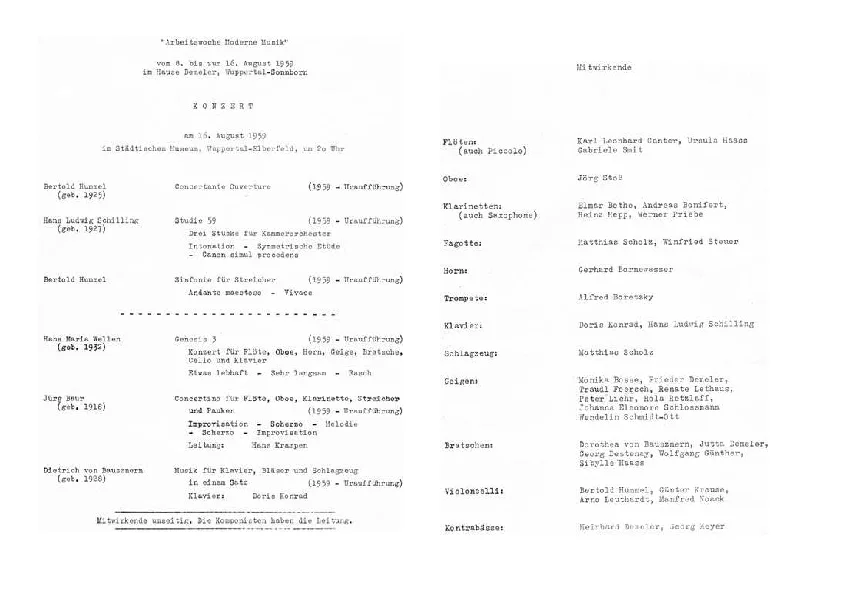
Orchestra of the Working Week Modern Music | Bertold Hummel
Title: Symphony for Strings 1959 - Length: 43 pages with numerous handwritten corrections - Date: Reduced version 10 Sept. 64 / final version 1971 (May) after performance in Caen - Location: Bayerische Staatsbibliothek, Munich
N. Simrock Hamburg-London (Boosey & Hawkes) study score, parts (loan material)
The substantially dense work, which for all its vital expressivity displays a high degree of spirituality and is characterised by esoteric seriousness - far removed from anything playful - seemed to suit the orchestra in its entirety. The alternation of austere sensuality of sound, sinewy ardour and tautness of the lines (one was reminded of Samuel Barber from time to time) with glassy fragility in the Andante maestoso was not reproduced without noblesse. The same applies to the tracing of the harsh bizzarrias of the Vivace. It was all well worked out, had profile and captivated the attentive listener.
An interesting work from the very point of view of its exposition, the creation and enrichment of the repertoire. It respects logic to the end, but it is a logic of surprises, the motivic changes do not give the impression of compulsion and yet they are compelling, they come unexpectedly and are always clear. The Andante maestoso, for example, does not assume the gesture of solemnity; its austere composure is full of shades. The Vivace is a prime example of how stylistic purity can be cultivated and yet produce elementary effects when the sense for the evolutionary possibilities of the material, for its potential, is sharpened.
Erich Riede gave a precise interpretation with the Municipal Philharmonic Orchestra, he did not take the Andante too broadly and sensed a captivating restlessness in the second movement, which is not only explained by the time scale. Edmund Link played the solo cello part of the Andante, a cadenza of masculine power, flawlessly and beautifully.
Otto Schmitt




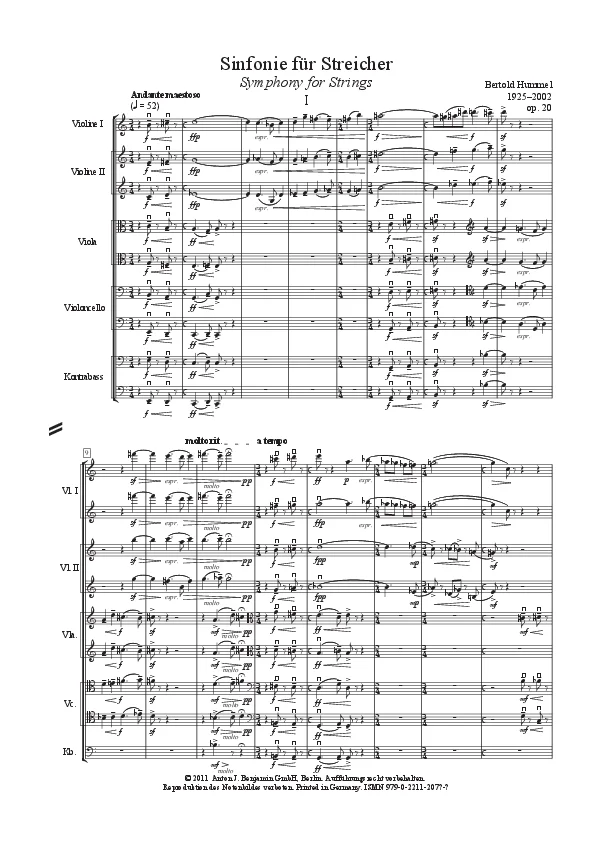
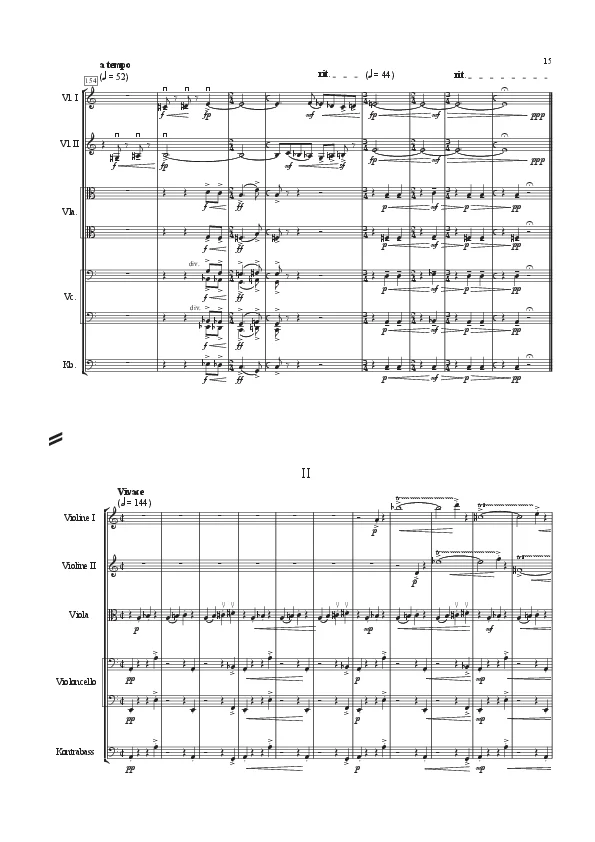
In my two-movement symphony for strings, I by no means dispense with a tried and tested symphonic gesture. However, there is no polar theme, but the motivic material derived from a six-note cell is constantly subject to rhythmic and figurative modification. The expressive Andante maestoso, written out in rubato style, which is intercepted at its climax by a broad cadenza in the solo violoncello - counterpointed by the tutti playing with mutes - is contrasted by the Vivace movement, which is energised by motoric energies. The tone sequences developed in the first movement are given a completely different light. A march-like insertion - executed in a variety of canon techniques - leads into a whirling final section that summarises the various elements of the symphony once again.
Bertold Hummel
Concert introduction to the 1st Symphony op. 20
First of all, I would like to express my delight that - as far as I know for the first time - one of my orchestral works is being performed here in Trier.
The situation in the years after the Second World War was quite confusing for young composers (at that time I was still one of them). The creations of the 20th century that had been suppressed during the "3rd Reich" were now accessible again. The works of Bartok, Hindemith and Stravinsky conquered the concert halls. A little later, a lasting "come back" of the so-called 2nd Viennese School began: Schönberg, Webern and Alban Berg.
In these years, there were a number of young composers who were more influenced in their work by the works of the former and a group who were more the successors of the Viennese School.
To anticipate this: I belonged to the group that was inspired by Hindemith, Bartok and Stravinsky etc. The 1st Symphony for Strings on tonight's programme certainly documents this.
Nevertheless, I believe that there is still enough of my own that points to my later work. The two-movement form, which I later took up again in my Visions op. 73 (but also in chamber music works), should enable the listener to comprehend the strongly contrasting episodes of the work. I am now hoping for a pleasant re-encounter with my 1st Symphony.
Bertold Hummel (Trier 13. 11. 1986)
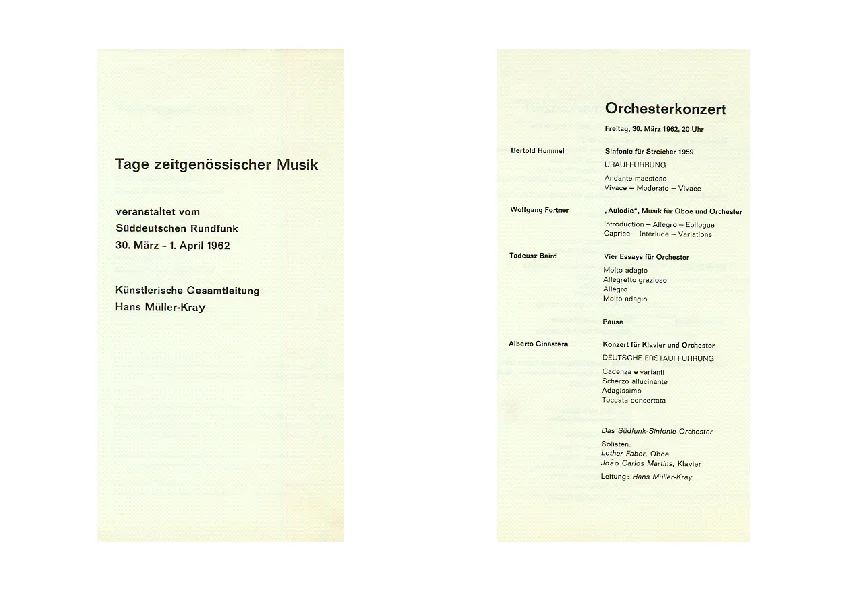
In April 1960, Bertold Hummel received the City of Stuttgart's sponsorship award for young composers of serious music for his string symphony. The official premiere of the work took place in Stuttgart on 30 March 1962.
Thoughts on the performance of B. Hummel's "Symphony for Strings" on 13 November 1986 in Trier
Bertold Hummel's Symphony for Strings was composed in 1959, when the composer was in his thirty-fourth year. If you follow the development of his compositional output closely, you will realise that it progressed very slowly but steadily. This does not mean that he wrote very little: In this respect, Hummel always held with Max Reger, who coined the phrase that an artist should "write freely".
Over the course of many works - Hummel's oeuvre encompasses all genres of music - his style developed, which by the 1970s at the latest had congealed into an unmistakable signature. I say this explicitly: no German composer of his generation, not even Henze, developed a style that would immediately identify a work as typical after the first few bars. Something similar could only be said of the old Messiaen in New Music. Hummel's key works in this context would be the 2nd Symphony (1966), the ballet "The Last Flower" (1975), then the masterpieces from more recent times: "Visions" for orchestra and the Concerto for Percussion and Orchestra.
An important work from the earlier phase is the string symphony you hear today. Many of the germ cells of the mature style can be found in this piece, even if here and there its role models can still be heard: Bartok, for example, in the virtuoso turning figures in the second movement, or Genzmer, with whom Hummel studied. In return, this piece offers a remarkable - almost youthful - freshness. A virtue that is rarely found in other German authors of the 50s and 60s.
The first thing to emphasise about the piece is its two-movement structure: the espressivo and the powerful gesture are followed by ludus, the play. It is a great moment, for example, when the action in the first movement breaks off and the note E remains in the basses above a long cello solo, to which the solo violins and violas respond, join forces with the cello, move towards a climax, break off; the violoncello (Hummel is a cellist!) fantasises alone for another four bars, only to die away together with the low E. A relatively short coda concludes the piece. A relatively short coda concludes the movement in a contemplative gesture.
The second movement with the centre note A is in a pure fifth relationship to the first (E-A). Very musical, interspersed with dramatic blocks, this movement gives free rein to the playfulness and lends the entire symphony a classicistic attitude.
The constants of Hummel's tonal language, which are already apparent in this work, are: a very eloquent gesture (declamation), a sense of the dramatic, which is evident in the shaping, a harmony which results from the layering of small building blocks and consequently often works with real mixture, a melody which preferably works with twelve-tone fields, and finally, in the rhythmic area, a preference for ostinati.
Claus Kühnl