3rd Symphony "Jeremiah" (op. 100, 1994)
S.D.G.
I. Moderato (Anathot), II. Presto (Babylon), III. Adagio (Lamentationes Jeremiae), IV. Moderato (Hymnus-Lakén)
Piccolo (also 3rd flute), 2 flutes, 2 oboes, English horn in F, 2 clarinets in B flat, bass clarinet in B flat, 2 bassoons, contrabassoon - 4 horns in F, 3 trumpets in C, 3 trombones, 1 tuba - timpani (1 player) percussion (3 players), harp, - strings (large ensemble)
Percussion instrumentation:
Vibraphone, marimba, xylophone, glockenspiel, tubular bells, timpani (4), snare drum, shuffle drum, bass drum, bongos (2), tom-toms (2), tambourine, temple blocks (5), wooden drums (2), African slit drum (4), claves (2), quiro, vibraslap, ratchet, cymbals (4), rivet cymbal (1), pair of cymbals, triangle, gong, tam-tam, glissando gong (Chinese opera gong), anvil or iron rail with iron hammer, chains, rain stick.
Duration: 45 minutes
Moscow Symphony Orchestra | Alexei Kornienko
Title: 3rd Symphony op. 100 - Length: 157 pages - Dated: I. Wü 1 Sept.94 II. 29.10 - 15.12.96 III. 24.08.96 IV. 25.10.96 S.D.G. - Location: Bavarian State Library Munich
Schott Music
Op. 100, 2nd movement
Op. 100, 4th movement
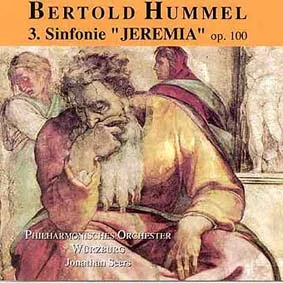


Coming from the Hindemith-Genzmer school and citing Olivier Messiaen as a compositional role model is no contradiction for the Würzburg composer Bertold Hummel, born in 1925. He combines Hindemith's claim to musical transcendence, as expressed in the Keppler opera and symphony of the same name "The Harmony of the World", with Messiaen's modally characterised, creed-like music to create a pluralistic, chorale-infused composition. In almost every one of his multi-genre works, Hummel attempts to make the "meaning of the world audible in the praise of God". However, he does not write sacred music for everyday use, which would have to legitimise its contemporaneity in a sacred manner. Although there are often biblical references, stylistically, technically and, above all, tonally, his works have a firm place in contemporary composition, even without spiritual support. His third symphony "Jeremiah", which premiered two years ago, has been recorded amazingly brilliantly by the well-attuned Würzburg Philharmonic Orchestra under the energetic direction of Jonathan Seers. The protracted calling of the young priest's son Jeremiah to be a prophet is interpreted in musical circles ranging from simple rhythmic models to multi-layered superimpositions. With a varied and colourful percussion apparatus, Hummel found a gesturally expansive, but not bold tonal language for the famous lamentations about the impending fate of the city of Babylon. With Hummel, tonal movement is directly physical expression, so that dark moods promise disaster and bright tone colours promise good. Jeremiah's self-doubt is portrayed with a pastel mixture of extremes. Above all, Hummel's virtuosic, concertante handling of the instruments makes the work worth hearing.
Hummel's tonal language is based on small motif cells, is archaically austere and serious, paints the moods of fear, threat and gloom very vividly, but repeatedly refers to conciliatory visions and ambivalent feelings beyond fear and horror.
The world premiere of Bertold Hummel's confessional third symphony "Jeremiah" with its rebellious gestures was almost apotheotic.
Hummel exhausts the possibilities of combining and transforming the thematic cells, achieves an impressively diverse orchestral sound and once again proves himself to be a master in dealing with a huge range of instruments.
Hummel's orchestration skills provided for varied events, shimmering string sounds, colourfully graded wood and representative brass interjections contrasted with rhythmically accentuated passages, forced by all kinds of percussion. The lamentation movement was particularly impressive with its intense tonal language; the final movement brought a somewhat longer passage of intensification, which faded away quietly after archaising pathos.




The third symphony Jeremiah op. 100 was composed in 1994-96. The inspiration for the composition was the reading of the novel "Jeremiah" by Franz Werfel. The 4 movements of the symphony are assigned to important stages of the prophet's life. In the 1st movement , the calling of the youthful Jeremiah in his native Anathoth, to which he returned again and again throughout his life, plays a special role. The relentlessness of the 2nd movement is reminiscent of the Babylonian captivity of the people of Israel. The famous lamentations over Jerusalem find their musical expression in the 3rd movement. The final movement expresses the "nevertheless" (Lakén) that the long-suffering proclaimer of God has repeatedly set against his personal defeats and hardships. The tonal language of the symphony is expressive and unorthodox. Old Testament numerical symbolism plays just as important a role as modal procedures, including twelve-tone fields.
Bertold Hummel
His third symphony op. 100, 'Jeremiah' (inspired by Franz Werfel's novel), was premiered in 1997. Hummel gave me the immediately released CD with the remark so characteristic in its lack of insistence: 'Well, perhaps you have time to listen to it. I was accordingly unprepared for the force and depth of the sounds of this great, important work. What colours in the harmonies and orchestra! What density of form and, at the same time, what clarity and distinctness of sound!
Thomas Daniel Schlee (in "Guardini-Stiftung e.V. - Annual Report 2002, Berlin")
In my opinion, the effect of the work is based less on the developmental principle of late 19th century symphonic music than on the magic of sound projections in the various dimensions (horizontal, vertical, dynamic increases and decreases).
Fascinating sound spaces are opened up. Although a programmatic idea is given (the legend of Jeremiah), the symphony does not contain the "drama" of this material.
With Mahler, for example, who is regarded as an absolute musician par excellence, the drama is strangely always latent in the symphony (at least until the 6th Symphony).
Nietzsche made a very apt comment about content that is conveyed in different ways through the medium of music. He speaks of the "artistic powers", the Apollonian on the one hand and the Dionysian on the other. ("The birth of tragedy from the spirit of music")
The "Apollonian" musician, as I would like to call Bertold Hummel, has a parable-like dream image as his primal inspiration.
The musical figures come into play immediately as finished products. The binding nature of the sound material applies to the entire work.
The substance of the material cells remains untouched. This creates unification and logical coherence.
I see the work as a great musical ritual, divided into four clearly distinct parts. Within the four parts - rich contrasts and variety. A great experience for the listener!
Alfred Thomas Müller (composer, Halle/Saale)