14 Dances from the Black Forest for 2 clarinets in Bb, trumpet in Bb, 2 violins and double bass (1957)
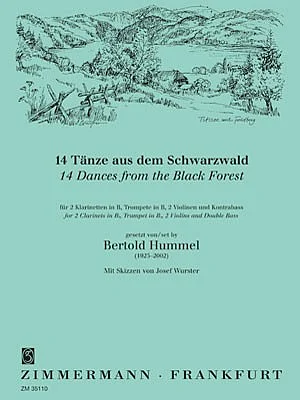
1. Simonswälder Bauernwalzer, 2. Schonacher Oberab, 3. Schottisch, 4. Jörgli-Polka, 5. Bernauer-Polka, 6. Rheinländer, 7. "Der rote Hans" Polka, 8. Heuberger, 9. Glaser-Schottisch, 10. Triberger Hippentanz, 11. Kilbi-Tanz, 12. Heissa Kathreinerle, 13. Walzer aus Siegelau, 14. "Lorenz"
2 clarinets in Bb, trumpet in Bb, 2 violins and double bass
Zimmermann Musikverlag Frankfurt ZM 35110 / ISMN M-010-35110-0
Printing error: No.3: 2nd violin: bars 19 and 23 e instead of e sharp/ No.5: 1st clarinet: final bar: 3 times b instead of g/ No.11: trp: bars 27 and 31: e instead of e sharp, 2nd clarinet: bar 29: 3rd c quarter instead of d
A cheerful surprise was provided by the Black Forest peasant music, which played for the dance at this traditional costume meeting in Freiburg. The young Freiburg music student Hummel, a son of the teacher and conductor Hummel, who lived in Merzhausen and came from Hüfingen, had set this music to old dance and folk tunes in the original instrumentation with two violins, a bass violin, a trumpet and two clarinets. With wild enthusiasm, the old and young peasants with their heavy red-lined roast skirts and the traditional maidens with their wide pleated skirts turned round again. They all felt that, despite the occasional borrowing of modern styles, something beautiful and authentic had been recreated.
There is hardly any real folk music left in this country. Music that is not trampled on every Saturday evening by unscrupulous television editors, permanently grinning high priests of bad taste and a compliant audience in wild orgies of clapping along. Anyone who talks about the Musikantenstadl and the spring, summer, autumn, Advent and Christmas festivals of folk music is referring to the decline of our musical culture that has long since taken place. Where two generations ago the National Socialists were up to mischief, the protagonists of folk music have long since served their new pop idol - the quick money they pull out of the pockets of members of the cultural underclass. No - let's talk about real folk music. The kind of music that is still played today in some forgotten corners of our country and which forms the foundation of our musical culture. Let's talk about music that is not stupid and simple-minded like the noise we have learnt to despise under the name of "folk hits". We have integrated Balinese ritual dances and Irish ballads into our culture just as much as Bartók's "Romanian folk tunes" and the singing of Provençal monks - so why not our own music? So let's talk about small rural dances with cosy names like "Heuberger" or "Triberger Hippentanz", which delight us with their charming alternation of duple and triple time. Let us learn to listen to the subtle richness of the "Jörgli-Polka" or the "Schonacher Oberab" and remember that there was also a flourishing folk music landscape outside the Black Forest, whose treasures can once again be unearthed. Bertold Hummel did this almost 50 years ago - on behalf of Südwestfunk radio, he reconstructed original instrumentations from worn-out part books and old recordings. This collection offers everything the musician needs - curiosity is enough!
Manuel Rösler
Who would have thought it: Bertold Hummel, highly decorated contemporary composer and long-time director of the Studio for New Music, as an arranger of traditional dance music from the 19th century! It is thanks to Südwestfunk Baden-Baden that, as a young composer in the 1950s, he went in search of traditional dance melodies in his native Black Forest and arranged this suite of 14 dances. The melodies were only available to him as a clarinet part for one voice, and he arranged them for a traditional original instrumentation of two clarinets, trumpet, two violins and string bass. In the arrangements, the winds alternate with the violins in the melodic line.
Overall, Hummel opted for a more chamber music concept. The second half, so indispensable for the dance music function, is often missing. In the original, the violins were certainly responsible for this almost throughout. The result is a variety of very interestingly arranged performance pieces with the most diverse dance melodies. ... Friends of traditional folk music will enjoy this previously unpublished sheet music edition and will certainly be well received as cleverly arranged performance music with a chamber music concept.
Uwe Rachuth
In this form, Glaser-Schottisch and Bernauer Polka or Heuberger- and Hippentänze should interest amateurs and advanced students as well as specialists and are also suitable for multiple instrumentation of the individual parts or new instrumentations.
Bertold Hummel, himself born in the Black Forest, arranged these fourteen dances according to old traditions, i.e. genuine folk music from the Black Forest.
The delicious humour of the Black Forest people, musicianship and the joy of music are the characteristics of this edition. Sepp Wurster has contributed landscape pictures. This gives this edition a special Black Forest flavour. Very playable for amateur music groups, music schools, etc. Everyone will enjoy playing these pieces.
Frank Klüger
viewed by the expert advisors for the VdM
As a counterpart to the alpine "Stubenmusi" (with the possible instrumentation of violins, dulcimer, accordion, clarinets and double bass) we also encounter real folk music in the dances from the Black Forest in the instrumentation of 2 clarinets, trumpet and string trio. The dance tunes, collected and set by none other than Bertold Hummel (1925-2002) on behalf of SWR, exude pure cheerfulness and humour. Of course, the music of the Alpine region does not lack these attributes, but its frequently tritone-like twists and turns convey a certain abysmal quality, which also has an effect on the art music of Schubert, Mahler and Alban Berg (Violin Concerto 1935 - including the "Kärntner Weise"), for example. Instrumental parts richly illustrated with landscape motifs of the Black Forest appear alongside the score. It should not be concealed that the wind instruments predominantly play "first fiddle". A successful contribution to folk music in the narrower sense of the word, i.e. not to "folk" music.
Werner Merkle
Foreword (Zimmermann Musikverlag Frankfurt)
In the stories of the famous Black Forest chronicler Heinrich Hansjakob (1837-1916), we read about folk musicians, Schnurranten, wedding fiddlers, pipers and trumpeters, to whose music the people of the Black Forest celebrated and danced. In a centuries-old tradition, original folk tunes were passed down from generation to generation, mostly orally, and only a few of them have been preserved on sheet music.
In 1957, the young composer Bertold Hummel, himself born and raised in the Black Forest, was commissioned by Südwestfunk Baden-Baden to go on a search and he arranged 14 dances from the Black Forest for the traditional original instrumentation of 2 clarinets, trumpet, violins and string bass. Sometimes only a clarinet part found by chance (from Siegelau 1883) was the source material for these dances, among which the so-called Heuberger or Hippentänze with their alternating duple, triple and quadruple metres are special.
This edition will be a real enrichment for friends of original folk and dance music. The previously unpublished notes bear witness to the delicious humour of the Black Forest inhabitants and inspire with their freshness and cheerfulness. The landscape pictures by Sepp Wurster, to whom my father felt a lifelong friendship and who was able to capture the beauty of this region again and again on countless hikes, give this volume its unmistakable Black Forest face.
August 2004
Martin Hummel
Explanations of the titles:
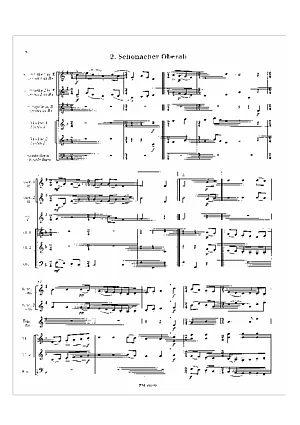
2: Oberab does not mean a dance down from a higher landscape level, but originally meant "dances authorised by a higher level of government." Not all Oberab melodies are dances, but also songs. There is a collection of texts from the Black Forest without sheet music.
3: Schottisch is probably derived from the ecossaise (Scottish waltz). It is similar to the polka and is related to the Rhinelander.
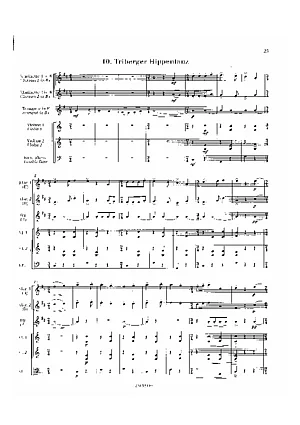
10: Hippe was a form of dress in the 17th-18th centuries, not only in the Black Forest.
11: Kilbi is the Alemannic name for a church festival.
14: Lorenz is the name given to the night watchman's call in the Black Forest.