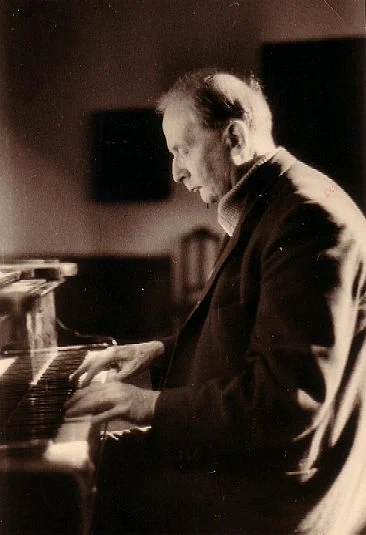
Julius Weismann
26 December 1879 Freiburg/Brsg. - 22 December 1950 Singen am Hohentwiel
... apprenticed to the late Romantic composer Julius Weismann, he soon developed a compositional streak that initially swelled to late Romanticism but then gave way to a new objectivity. 8 November 1964 ... theory lessons from the late Romantic composer Julius Weismann at a very young age, to whom I have many personal memories. 8 November 1964
... I took my first compositional steps with the late romantic Julius Weismann during my school days. 1974
... What fascinated me about my teacher Julius Weismann was the impressionistic sound fantasy as well as the harmonic richness and formal variety. 12 July 1981
Bertold Hummel
Dedication: "In memory of the Julius Weismann memorial evening on 23 February 1951" On the back of this photo, the Weismann family thanks Bertold Hummel for his participation as a cellist at the Freiburg concert. Weismann's String Quartet in A minor op. 133 and the "Tagore-Lieder" for alto and piano trio, op. 67, were among the works performed.
Julius Weismann - His life
Julius Weismann was born in Freiburg on 26 December 1879, the son of the famous zoologist and genetics researcher August Weismann, professor at the University of Freiburg and founder of Neo-Darwinism. As he was ill for a long time in his youth, he received his education from private tutors and from his father. As an eleven-year-old, Julius Weismann received composition and counterpoint lessons from 1891-92 from Joseph Rheinberger in Munich, who was considered conservative. From 1893 to 1895, he took piano lessons from the Liszt pupil Hermann Dimmler in Freiburg, followed by language studies in Lausanne (1896-98), and for one semester (1898/99) he studied in Berlin - however, the "musically arrogant, academically framed - and framed - atmosphere" (Weismann) with Friedrich Stumpf and Leopold von Herzogenberg repelled him. The following three years with Ludwig Thuille, Rheinberger's successor in Munich, brought Weismann further in his development, but they also show his pronounced solitary nature: "It is strange that I so often came closer to those people with whom I came into contact through my love of the mountains - music, on the other hand, usually acted as something separating, and I avoided those circles more often than I sought them out. If I had not found such a warm welcome in the family of my future wife, I would probably have been very lonely. In the Thuille circle there was only one supreme god, that was Richard Wagner - and two living gods: Max von Schillings and Ludwig Thuille! What was I 'classicist' person supposed to do with that! Despite my honest enthusiasm for Thuille's opera 'Lobetanz' and his wind sextet, I soon felt a chasm opening up that would separate me from the 'Munich School'. Nevertheless, I worked eagerly with Thuille. For many later critics of my music, I seemed to belong to the Munich School. A great mistake! Certainly, after a while, my music was influenced by it - but much more by the supreme god Richard Wagner than by the sub-gods!"
In 1902, Weismann married the concert singer Anna Hecker and settled in Munich as a freelance composer - perhaps one of the reasons why he wrote so many solo songs with piano accompaniment in his first creative phase. In 1906, he returned to his home town of Freiburg and also worked as a pianist and conductor. The twenties became the most productive period in Weismann's life: Five of his six operas were written within ten years. His breakthrough was achieved. In 1929 he became a member of the Prussian Academy of Arts and received its Beethoven Prize a year later. In 1930, Weismann founded the Freiburg Music Seminar with Erich Doflein, from which the Freiburg University of Music emerged after the Second World War. There he taught composition and led the piano masterclass. In 1939, he was made an honorary citizen of Freiburg and received the Leipzig Bach Prize. However, in the same year he moved to Nussdorf (near Überlingen) on Lake Constance and gave up teaching two years later. Weismann, already a rather shy loner, albeit cordial towards friends, gradually withdrew from public life. The last years of Weismann's life were characterised by uncomplainingly endured illness, scepticism, but also diligent composing and numerous house concerts with his closest circle of friends until 1950, the year of his death. Julius Weismann died in Singen am Hohentwiel on 22 December 1950, shortly before his 71st birthday.
Stylistic position
Julius Weismann's oeuvre is as extensive as it is multi-layered: it goes up to opus number 157a (although there are numerous works without opus numbers), and (apart from sacred music) it encompasses almost every musical genre - from operas, theatre music, choral works, songs, symphonies, concertos, piano pieces of all kinds to chamber music, which occupies a central place in his oeuvre and from which the entire oeuvre can be understood. A catalogue of his works can be obtained from the Julius Weismann Archive in Duisburg.
There are two reasons for Weismann's impressive and continuous productivity: Until 1930 and from 1941 onwards, he was able to concentrate on his work largely unhindered by official duties, as he was active as a freelance composer, pianist, conductor and song accompanist. His sketchbooks, which he took with him on every hike, show that Weismann fluently wrote down the ideas he had in the great outdoors. He composed without a piano, with an obviously excellent inner conception of sound and a ready-made inner conception.
The richness and diversity of the work also brings with it the problem of categorising it stylistically. The pianist Franzpeter Goebels has attempted to categorise Weismann's piano works: Up to op. 68 (1917), he sees a "romantic" or "naive" phase, influenced by Schumann. From op. 76 (1918/20) to op. 87 (1923), "the influence of Debussy is noticeable" through the differentiation and concentration of the harmony and the means. From op. 93 (1926) to op. 109 (1931), according to Goebels, "constructive features tighten the form", he sees "a kind of new music dawning" and the "polyphony becomes harder". He allows Weismann's late style, which is particularly characterised by contrapuntal thinking and a turn towards Bach, to begin from op. 114 (1933/34), but adds: "However, one is reluctant to periodise such a complex work in this sense. The transitions are fluid and each individual work needs to be heard and understood from its centre." Attempts to categorise Weismann's work can be found at all times. As early as 1907, Thomas-San-Galli wrote (about the Symphony in B minor op. 19): "If we were to cite historical similarities, we would be able to find echoes of Schumann here and there. Now and then Brahms also wanders past in indistinct outlines. But Weismann's real affinity is with Franz Schubert." Alexander Berrsche, the classic Munich music critic, emphasised Weismann's "gift of a rich, carefree imagination" and "the ease with which he always commanded it". Adolf Weißmann, one of the most important Berlin music writers of his time, also mentions Julius Weismann in his book Musik in der Weltkrise (1922): "And now we could list a long list of those who sought solutions in various ways, some off the beaten track of modern art. ... Julius Weismann is lively at work, seeking a style between the Brahmsian and the modern, but in any case unity ... He is not a subversive, rather a maverick who professes a reserved nature, especially in chamber music works." (S. 232)
Richard Wagner's grandson Wieland Wagner, who took intensive care of Weismann towards the end of his life, saw Weismann's music "... at home in the realms of the meta-physical, he perceived himself only as the mediator of a gift that he received in a gifted hour. The most modern harmony, wandering in the border areas of tonality, is organically combined with the relentless rigour and faithful humility of the musical conception."
After the Second World War, the interest in the latest musical developments was so great that composers in Germany who did not follow the directions of Hindemith, Stravinsky, Schoenberg and Webern were pushed aside as "conservative". There was little room for individualists like Julius Weismann. In addition, when the first catalogue raisonné was published in 1955, his work was scattered across 20 different publishers and a large proportion of his compositions were only available in manuscript. However, the time has long since come to rediscover Weismann's music. In 1954, the Julius Weismann Archive was founded in Duisburg at the instigation of Wieland Wagner. Weismann's manuscripts, sketchbooks and other archive materials were given to the Duisburg City Library on permanent loan in 1981. And from Duisburg, the archive's office is committed to the dissemination of Weismann's work.
Gerd Rataj (Published with the kind permission of the MDG label www.mdg.de)