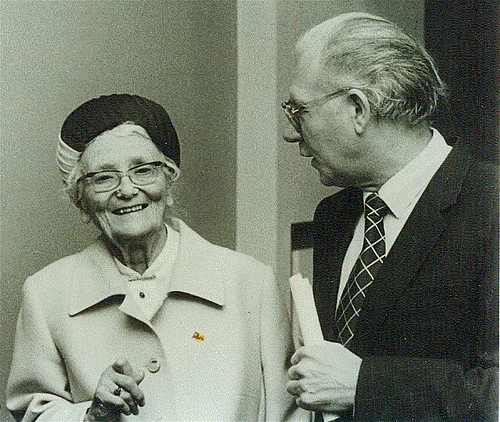
Lotte Kliebert
Lotte Kliebert 15 October 1987 Würzburg - 27 November 1991 Würzburg
Full of curiosity for the as yet unknown
One of the special highlights of Lotte Kliebert's long musical life was undoubtedly her interest in contemporary music. This interest is probably one of the reasons for her youthfulness into old age. Her curiosity for the as yet unknown was certainly awakened by her father, Court Councillor Karl Kliebert, who was closely associated with the creative musicians of his time such as Richard Wagner, Franz Liszt, Peter Cornelius, Friedrich Smetana, Richard Strauss, Joseph Rheinberger and Hans von Bülow. Active as a composer himself, he took it for granted that the "new music" of the time was strongly promoted at the royal music school he directed.
In February 1963, when I had just been appointed as a composition teacher in Würzburg and was to succeed Rochus Gebhardt as director of the Studio for New Music, I had the honour of meeting Lotte Kliebert for the first time. She had already affiliated the studio to the Tonkünstler-Verband Würzburg as a newly founded organisation in 1958.
Since then, a series of concerts has been organised in an attempt to introduce the broad range of 20th century music to the people of Würzburg. Naturally, I was attracted by the studio management offered to me, especially as it was offered to me by such a clever, humorous, uniquely energetic and charming lady, who outlined the Würzburg music scene of the past and present to me in succinct strokes. So that long first evening at Sterenstraße 38, where the Franconian wine also came into its own, was the beginning of almost 25 years of friendly, unclouded co-operation in the promotion of contemporary music. Lotte Kliebert has helped organise well over 100 studio concerts. There was hardly a concert that she missed, and her apt and knowledgeable comments on the works performed were always a special treat for me. In our joint endeavours to alleviate the studio's permanent financial difficulties, I was always amazed at her imaginative powers. There is much to tell about her selfless way of helping others. Time and time again, she has unobtrusively but sustainably supported young artists. All in all, this wonderful woman was and is a stroke of luck for our city.
As head of the Studio for New Music at the Tonkünstler-Verband Würzburg, I greet Mrs Lotte Kliebert with gratitude on her day of honour. I salute her as a shining example and role model for us all.
Bertold Hummel (in: "Seek the true, love the beautiful, do the good! - Lotte Kliebert on her 100th birthday - 15 October 1987", published by the Tonkünstlerverband Würzburg e.V. 1987)
Bertold Hummel dedicated the Andantino for harp op. 77e to Lotte Kliebert.
The true, the good, the beautiful
Honouring 100 years of life in our city. Mrs Lotte Kliebert on 15 October 1987.
(...) On 15 October 1887, a daughter was born to the director of the "Königliche Musikschule" in Würzburg in his flat in Franziskanergasse and christened Lotte Louise (nickname: Lotte). She had a very close relationship with her highly talented brother Hans (born in 1882). He became a scholarship holder of the Maximilianeum in Munich, studied law and entered a higher career in the civil service. When he was killed in action outside Ypres in 1917, he suffered a life wound that never completely healed. Lotte Kliebert's sister Käthe (born 1889) became a harpist and lived until 1963.
"You can't be too careful when choosing your parents" - Lotte Kliebert obviously took this mischievous and true-to-life saying from her mother very, very seriously: On her father's side, she comes from Sommerach am Main - they were her great-great-grandparents. They emigrated to Flöhau near Saaz in the Sudetenland. Their grandson Johann worked as a highly respected notary in Prague; he was awarded honorary citizenship of the city of Prague for his services to the unification of Czechs and Germans. His grandson, Karl Kliebert, who had already become a double orphan as a child, grew up with him and his sisters in the house "Zu den zwei goldenen Bären". Like his grandfather, he studied law in Vienna, where he obtained his doctorate. At the same time, he studied music (with Hanslick and Bruckner, among others) and later in Munich, where he was particularly encouraged by Hans v. Bülow (conducting) and Josef Rheinberger (composition, piano). On Hans v. Bülow's initiative, he was appointed director of the "Königliche Musikschule" in Würzburg in 1875. As reorganiser of the institute, which he developed into an exemplary orchestral school, as a composer, conductor and promoter of contemporary music, he gained an extraordinary reputation. His friends included such important musicians as Friedrich Smetana and Hans v. Bülow, and his admirers included Richard Strauss, Eugen d'Albert and Richard Wagner ("the best music school in Germany"). He died of apoplexy at the age of 58, probably as a result of his restless commitment and constant overwork.
Lotte Kliebert's mother came from a family of pastors and scholars from the university town of Greifswald, the "pearl of Pomerania". Her grandfather, Prof. Karl Ludwig von Urlichs, professor of classical philology and archaeology, made a name for himself by, among other things, donating the so-called. FEOLI collection (480 Greek vases) to Würzburg (Martin-von-Wagner-Museum). The grandparents, who ran a stately home in Sanderstraße, provided the children with additional favourable conditions for their development: Open-mindedness and family warmth, a rich library with many first editions of German classics, a large number of valuable heirlooms, including a series of paintings by the then still unrecognised C. D. Friedrich; they were encouraged to read great literature, especially by their grandmother, as well as to draw from models and from nature and to recognise beauty, for example in the old facades of the many Petrini and Neumann buildings in Neubau and Sanderstrasse. This laid the foundation for Lotte Kliebert's comprehensive education. Lotte Kliebert received her first piano lessons at the age of six and was given a great deal of understanding and encouragement at the Protestant primary schools in Münzgasse (1894-1901) by her father's pupils, teachers Kuch and Fuß, while a third teacher, who did not recognise her eye condition, considered her to be untalented. At the age of 13, she entered the Royal School of Music and studied piano with the outstanding organist and pianist Leo Gloetzner, a pupil of Rheinberger.
As the annual reports show, she played Robert Schumann's Fantasiestücke op. 12 on 3 November 1907, Schumann's Piano Concerto op. 54 on 18 June 1909 and the Piano Concerto in F sharp minor by H. Bronsart (1830-1913), a subtle pianist from the circle around Franz Liszt, Hans v. Bülow and Felix Draeseke from Coburg, in the rather demanding concerts known as "student productions". Lotte Kliebert's wide-ranging educational interests are documented in her annual reports for the years 1907-1909, where she studied Italian and art history in addition to her compulsory subjects. In 1908, one year after the death of her revered, loving father, she passed the private music teacher's examination with a grade A. She continued to study piano, but decided not to take the "artistic maturity" exam, as she was completely captivated by her work as a music teacher.
In 1901, she became a pupil at the private Sophienschule, the only girls' secondary school in Würzburg at the time, passed the regular examination in 1904 and entered the postgraduate level known as "SELECTA"; after two years (1906), she passed the examination with the qualification of a private language teacher in English (grade 1) and was therefore also allowed to teach at public and public schools. This initially took place at the Sophienschule, later at its successor institution, the "Mozartschule", and only ended when she reached the age limit. She set up a private music teaching practice (1908) and met Professor Albrecht Mendelssohn-Bartholdy, grandson of Felix Mendelssohn-Bartholdy, professor of law at the University of Würzburg and an excellent pianist. She performs with him, but also as a soloist and in a chamber music ensemble, at the "Volkskonzerte" he founded. Two trips to England serve to deepen an old friendship, but also to broaden her experiences and improve her language skills. She learnt about the movement of women's rights activists in England, who were campaigning for universal equality for women. All these stimuli, together with her concern about the "fate" of female private tutors and her determination to intervene to help and alleviate their plight, ultimately led to the founding of the Private Tutors' Association (1911) (together with the language and singing teacher Gusti Kirchdorffer, a niece of the painter Wilhelm Leibl). Both Gusti Kirchdorffer (1st chairwoman) and Lotte Kliebert (2nd chairwoman and leader of the group of private music teachers) work with great vigour to solve the tasks they set themselves and come closer to the goals they had set themselves: Further training of members, clarification of professional and social issues (such as setting an appropriate hourly fee, social security by joining the employee insurance scheme, arranging lessons, counselling young female colleagues), introduction of music lessons for pupils, setting up a specialist library (sheet music and specialist literature), lectures by first-class experts (e.g. by Munich musicologists), and the establishment of an association of private music teachers.These were very popular concerts by "accomplished musicians" with the aim of promoting enjoyment and understanding of valuable music through exemplary interpretations and explanatory introductions penned by Lotte Kliebert. At Prof Mendelssohn's invitation, she also gave lectures of the same content at the adult education centre. Lotte Kliebert's many talents, her wide-ranging interest in education, the many encouraging stimuli at home and in her grandparents' house, her careful education and her eminently social attitude resulted in a tireless, fruitful "activity" in Goethe's sense, especially during the hardships of the First World War and the years of inflation.
When, on the advice of the 1st Chairman of the Landesverband Bayerischer Tonkünstler, Prof. Hermann Wolfgang Freiherr von Waltershausen (Munich), Prof. Dr. b.c. Hermann Zilcher, the director of the Bavarian State Conservatory of Music, founded the Würzburg chapter of the "Reichsverband deutscher Tonkünstler und Musiklehrer" in 1926, Lotte Kliebert and the group of female private music teachers joined the Private Teachers' Association. She herself becomes treasurer and takes on the "lion's share" of the work involved. The varied and helpful activities from the time of the Private Teachers' Association are taken over, intensified and expanded; the trusting, even cordial relationship between the members is also maintained.
In 1935, the "Reichsverband deutscher Musiklehrer und Tonkünstler" is dissolved altogether. After strict qualification checks, members are automatically transferred to the local chapter of the "Reich Chamber of Music". Lotte Kliebert works, undisturbed by party ideologies and worse, on the further education and training of the members, especially at the fortnightly training weeks with first-class lecturers such as Dr Wilhelm Twittenhoff, Prof Fritz Jöde, Prof Felix Oberborbeck and Dr Herbert Just. Lotte Kliebert is also a permanent lecturer. The aim of these courses is theoretical and practical improvement and, just as importantly, opening up to new developments such as youth music, the singing movement, the turn towards early music and its instruments (such as recorder, lute, viola da gamba, fiddle, harpsichord) and folk song as a basis for vocal and instrumental learning and music-making in general. Further areas of work in these training weeks are: the cultivation of old and new choral music, the development and tonal realisation of new music, the introduction to rhythmic gymnastics and a particularly thorough cultivation of old and new chamber music. The foundation of an ideologically-led municipal youth music school (motto: "Youth leads youth") is forestalled by the foundation of a professionally-led youth music school in 1942 in order to - as she puts it - "keep the colleagues' bread and butter".
On the night of the bombing on 16 March 1945, the "Sunday city" of Würzburg suffered the most terrible catastrophe in its history. The following post-war years are a period of indescribable hardship and incomprehensible misery. Even Lotte Kliebert had nothing left. Everything she had once built up and lived for no longer existed. With the gradual improvement of conditions in the fifties and with the support of a "loyal circle of undaunted people", she began to rebuild: On 30 October 1955, the Würzburg chapter of the Bavarian Tonkünstler-Verband was founded on Lotte Kliebert's initiative. She herself initially becomes 2nd chairwoman, 15 months later 1st chairwoman. In 1956, the series of school music lessons is resumed and - "a cultural deed" for our city - the first concert series of supra-regional importance in post-war Würzburg is established with the "Subscription Concerts of the Tonkünstler-Verband". The second "great deed" was the founding of the "Studio for New Music", an institution so lively and of such high quality that it would do honour to many a far larger city. The proud series of 155 events, artistically directed by Professors B. Hummel and Dr Kl. H. Stahmer from the Hochschule für Musik and otherwise supervised by the Tonkünstler-Verband, speaks for itself. With unwavering loyalty, Lotte Kliebert fulfils the many internal tasks of the association, from advising members, recommending young music teachers and supporting colleagues in need, to the daily tasks that we casually refer to as "paperwork". Despite her eye condition from birth, she wrote letters and publications in a style characterised by great sensitivity and nobility, reflecting the essence of her personality: eminent education, personal charm, devotion to duty and a daily commitment to those values which, according to Plato, are the goals of man: the true, the good, the beautiful.
At the age of 97, Lotte Kliebert steps down as director of the Tonkünstler-Verband Würzburg. She remains tirelessly active, as is her nature: writing, advising, participating in concert life and in the intellectual and cultural life of our city, stimulating, mediating, helping wherever possible: the example of an all-round successful 100-year existence for others, and at the same time open to the beautiful sides of life: be it at concerts, at festivals and celebrations or in a circle of friends, preferably with a glass of exquisite Franconian wine.
Lotte Kliebert has received many prestigious awards and honours, including
the Ring of Honour of the City of Würzburg, the Federal Cross of Merit 1st Class, Honorary Citizen of the University of Music, Honorary Member of the Bavarian State Association of Musicians, Honorary Chairwoman of the Würzburg Association of Musicians, Honorary Member of the Friends of the Hermann Zilcher Conservatory.
Two honorary titles say even more: to the people of Würzburg she is the "Grande Dame de musique", to her friends and colleagues she has remained the "soul of the association" to this day.
It is the wish of all those who have travelled a greater or lesser part of her life with her that Lotte Kliebert may remain as healthy, as spiritually fresh, as inspiring and as active for a long time to come in this city and for all those who know and admire her.
Dear Mrs Kliebert,
I have probably not listed all your activities, initiatives and achievements because I wanted to show your origins, your life's journey and the unusual aspects of your personality. I know that your modesty makes you wonder whether all this - honours, celebrations and reports - is not too much; but you know yourself how many people are looking forward to celebrating your 100th birthday with you. But you also know how important, indeed how necessary, it is to point out examples of fulfilled lives, especially in our difficult, complex and - it seems to me - often so disorientated times. With all my heartfelt sympathy, yours
Stephan Werner (in: "Seek the true, love the beautiful, do the good! - Lotte Kliebert on her 100th birthday - 15 October 1987", published by the Tonkünstlerverband Würzburg e.V. 1987)