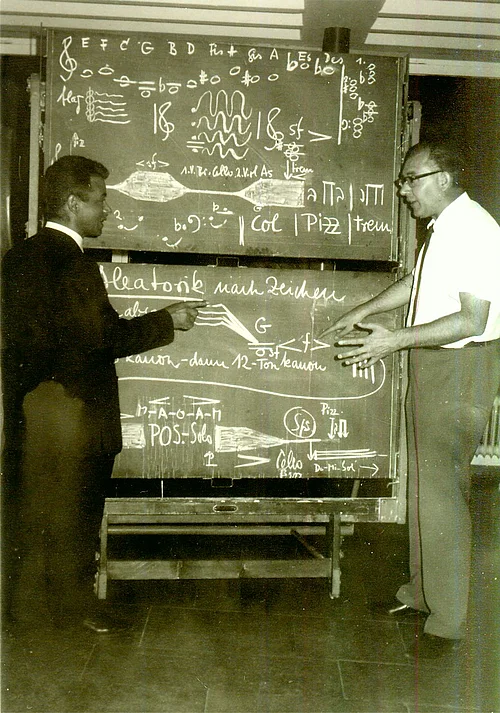
Walther Gaemperle
1934 Zuzwil - 17. July 2010 Bronschhofen
Bertold Hummel met the Steyl missionary Walther Gaemperle at the various choir and orchestra weeks organised by the Werkgemeinschaft Musik e.V. (Düsseldorf) at the Landvolkshochschule Wies/Steingaden. In 1962, 1967, 1969, 1971, 1981 and 1983, they worked there together with the course participants, Hummel as orchestra director, Gaemperle as spiritual counsellor. They quickly developed a very friendly relationship. Gaemperle, very interested and productive in literature, wrote the two motet texts Lord, how numerous are your works (Psalm 104) and Praise the Lord (Daniel 3) for Hummel in 1983. At the beginning of the 1970s, they considered joint opera projects. It was also at this time that the Süd-West-Funk Baden-Baden (Hans-Peter Haller) commissioned Bertold Hummel to compose a piece for the church service on 22 October 1972 in the castle church in Donaueschingen as part of the Donaueschingen Music Days. The composer asked his friend Walther Gaemperle for the text for the Kyrie, interlude and offertory for schola, precentor, percussion and stereo band, who finally sent it from Fribourg (CH) on 22 May 1972 with the following explanation:
Dear Bertold,
I marvel at your patience. Or is it simply a bit of resignation?
To be honest, I imagined the whole thing would be easier. After all, many different things are possible. But then comes the hard part: you have to make a commitment. Well, I did. I don't know whether it corresponds to your ideas and wishes. But you know one thing: the texts are neither holy nor sacred. So you can do anything with them. Even send them back indignantly.
I even had a few things in mind when I was "making" them. Perhaps something like this: I become aware of the problems of the world, of life (e.g. how some of what we do and think is contrary to what we profess...). The refrain summarises this briefly. "Lord, Lord are you" is a confession, a question, a criticism of our actions at the same time. The two lines should be a translation of the Kyrie.
In the "interlude" I would try: Does the message give us an answer, does it give meaning, a way, life. The hymn of sacrifice should become a song of confession that we believe in the transformability of the world, of human beings. For communion, I would like to meditate on the sign that one gives oneself for others.
So the text would certainly become calmer, I say this because it was pointed out to me that the first movement is wild.
The main text in I is the refrain. The other is interpretation, the background from which the refrain wants to be said. So it would probably have to be repeated more often, in whole or in part.... The quatrains should be treated accordingly. Of course, this is not a guide for your work. But I could imagine that the text would be easier to understand if I told you how I played with the lyrics. You'll soon see if you can do something with the text. I would be happy if you would tell me soon. I could then continue. (...)
I
From the depths I call to you.
Lord, Lord art thou.
The thousand names we gave You:
The purple of our vanities.
We believed Thee near in progress -
War masks itself thus and violence.
From the depths I call You.
Lord, Lord art thou.
We pray to the power you do not have:
Hunger compels us and the next payday.
We love God and we love money,
We have prayerfully made a rhyme for many things,
From the depths I call You.
Lord, Lord are you.
The sun sometimes still falls in our dreams,
By day our prosperity is up to our necks.
We wait for your effective sign,
Which you will not give without us.
II (interlude)
I search for meaning
In the finely spun web of our sentences
Lurks the deadly spider of meaninglessness
Speak sense to us in your word
You are the truth - Alleluia
I seek the way
The words of faith that confess you
Become directionless on our tongues
Show us possibilities through your word
You are the way - Alleluia
I seek life
The dead stones that centuries have laid for you
we try in vain to re-curse
Call us to life through your word
You are the life - Alleluia
III (For the offering)
And again and again the bread that we break
To feed the many who are full and hungry
one gives himself
we proclaim the death of the Lord.
And again and again the wine we share
to strengthen the many who live and die
one gives himself
we praise your resurrection.
No one likes to die and no one wants to be lost
yet
one gives himself
that we may change
when we change
one gives himself.
Walther Gaemperle (1972)
For unknown reasons, this joint project is not completed.
The caller in the "desert" has fallen silent
Walther Gaemperle, although a pilgrimage chaplain in Dreibrunnen, was also a missionary for the cause of God in his last place of work.
With the unexpected death of missionary Walther Gämperle, who was most recently a pilgrimage chaplain in Dreibrunnen, a pastoral personality whose work was always able to surprise has fallen silent. What Walther Gämperle could not achieve in physical stature, the Steyl missionary repeatedly made up for with his strong voice. He was a born missionary, so to speak, to win people over to the power of God.
The son of Mesmers from Zuzwil, in memory of his first Mass in his home parish in 1961, was never forgotten by us young people. On this, his special day and many more, Walther Gämperle was able to utilise the services of his father directly at the altar. At that time, experiencing a first mass or receiving the first blessing from an ordained priest was something special. The power of this blessing was emphasised at the time by the fact that you had to travel a day's journey to receive a first blessing.
Walther Gämperle's deep faith earned him a great deal of attention, but he also had his critics, including in his home parish, when he called certain things by name at lecture evenings. He was a man who was not afraid to remind even the authorities of their duty from the pulpit. But Walther Gämperle was also a humorous person who was able to crack jokes in social gatherings.
For those familiar with his strong personality, it was a matter of course that he was later interested in the post of student chaplain at the University of St. Gallen and was successful. Over the years, student chaplaincy had taken its toll on Walther Gämperle's strength, but not on his profound thinking and pastoral power.
His retreat to the pilgrimage site of Dreibrunnen near Wil was by no means a retirement. During his years in Dreibrunnen, the numerous worshippers were still able to experience his multifaceted commitment. As in his early years, he was able to inspire people to listen actively in his sermons. When he wanted to emphasise his words, he often raised his voice dramatically to rouse even the last listener from their silence.
A week ago, his voice finally fell silent with his surprising return to his creator. On Friday, the farewell service took place at his last place of work in the Dreibrunnen pilgrimage church. Those who experienced Walther Gämperle will probably remember his profound work for a long time to come. He will probably remain alive in many hearts for a long time to come.
Niklaus Jung
In his farewell speech in Maria Dreibrunnen, the parish priest of Wil, Roman Giger, aptly characterised the Steyl missionary: "Walther never shied away from relentlessly addressing, discussing and occasionally condemning grievances and undesirable developments in the church. Yet, despite all his criticism and healthy distance from the institution, he always retained a great love for the church. He was never someone who simply tore things down, but someone who also rebuilt. We have learnt a lot from Walther's well thought-out and long-reflected theology and his concise, catchy formulations."
These qualities have accompanied Father Walther Gaemperle throughout his life.
He was born and grew up in Zuzwil SG. He was ordained a priest in 1961 in the chapel of the Marienburg grammar school in Rheineck. This was followed by teaching at the Marienburg grammar school in Rheineck and studying German language and literature and art history at the University of Fribourg. The St Gallen native then worked as editor of the Order's own family magazine "Stadt Gottes" from 1971 to 1982. It was a task that he fulfilled with "passion". During these years, he decisively shaped and developed "Stadt Gottes". After retiring as editor, Father Walther remained on the editorial team for several years. He also worked on the Steyl picture calendar until 2006. He selected the pictures and wrote meditation texts for them. In the 1970s, he was also active as a director with the Steinhausen theatre company. A hobby that he loved very much.
From 1982 to 2000, the Steyler was highly committed to the Catholic chaplaincy at the University of St. Gallen. "Contact with the church through me should be positive" was the motto for Father Walther Gaemperle's work...both at the university and in his numerous other tasks. In addition to his work at the university, he also helped out in the city parishes, preached Lenten sermons in the cathedral and, from 1987 onwards, he was also drawn to the Alpstein on many Sundays as a Seealpsee "priest".
Father Gaemperle's work was much appreciated. At the "Dies academicus 2000", the student body honoured him with the Mentor Prize. In the laudation, it was said that he had always been particularly committed to the interests of the students. People were also at the centre of his last activity as a pilgrimage chaplain. Roman Giger put it in a nutshell: "He was a passionate and people-loving chaplain. And: a deeply creative and open thinker."
www.kathwil.ch (12.11.2010)