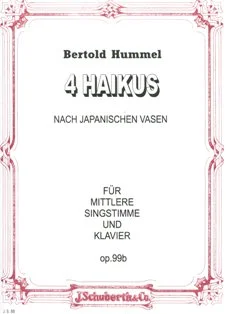
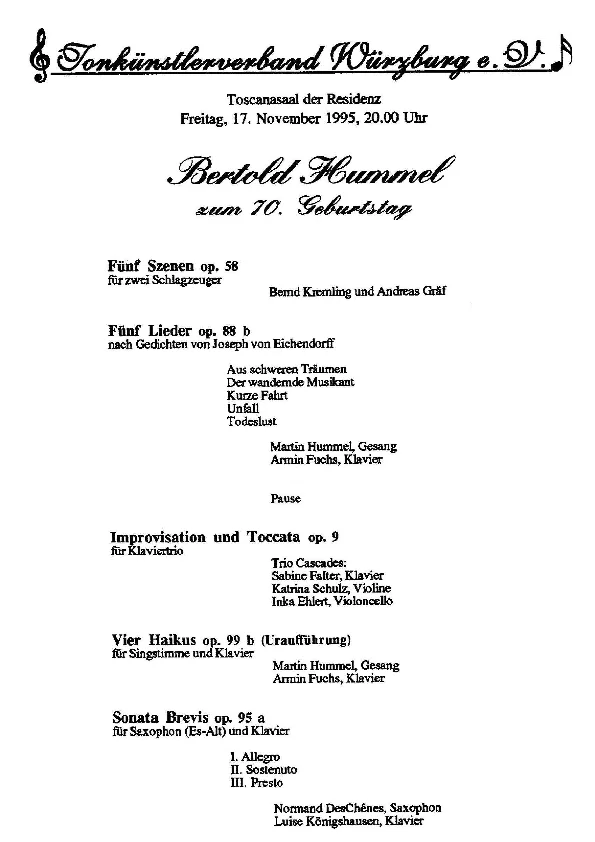
Four haiku for voice and piano (op. 99b, 1995)
Movement titles
I., II., III., IV.
Instrumentation
Voice, piano
Duration: 5 minutes
Premiere
17 November 1995,
Würzburg, Toscana Hall of the Residence
Martin Hummel | Armin Fuchs
Autograph
Title: 4 HAIKU - Length: 8 pages - Date: I. 28.8.95 / II. 29.8.95 / III. - / IV. 5.Sept.95 - Location:
Publisher
Schott Music ED 20285 / ISMN: M-001-14990-7
First edition: J. Schuberth & Co., Eisenach 2000
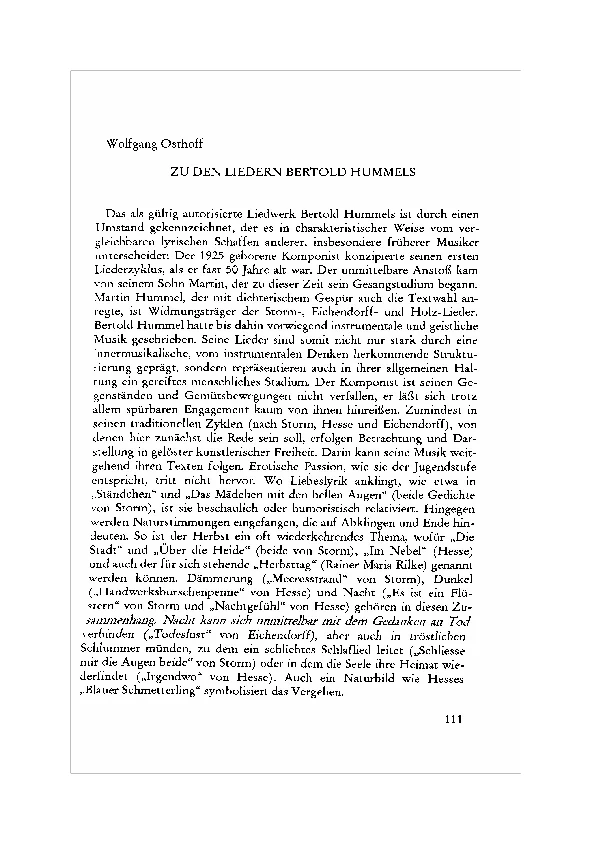
Wolfgang Osthoff (1988): On Bertold Hummel’s songs




Hummel's last piano song cycle to date (autumn 1995) occupies a special position: his 4 Haiku op. 99b. In this Japanese poetry genre, Marie-Louise Stangl writes here - completely true to form (3 verses with a total of 17 syllables). The dense brevity of the model also leads to a concentration on the essentials of the structure in the music. Thus - in the first piece - a blurred twelve-tone total, formed from four triads layered one on top of the other, is followed by fulfilled days in a pure or only slightly "enriched" major, only to plunge painlessly back into the quiet sea of sound at the end. In the same form, this "sea of sound" swells to fortissimo in the fourth piece after "Song of Creation". Despite its brevity, a haiku contains the most comprehensive image, feeling or wisdom possible. Hummel's singing voice reflects this - moulded in three parts - perhaps most happily in the third piece. Far Eastern colouring can only be found in a few whole tone passages, for example in the second piece, where the whole tone scale on E flat is used for one bar to the word silence, and the whole tone scale on D a bar later.
Wolgang Osthoff ( in "Zu den Liedern Bertold Hummels", Tutzing 1998)
Bertold Hummel already explored the concise form of haiku in 1973 in his work 11 Haiku for mixed choir and vibraphone op. 41b. The present composition was written in 1995. In the last years of his life, he enjoyed inventing his own haiku within the given rules of this poetic form.
Martin Hummel