11 Haiku for mixed choir and vibraphone (op. 41b, 1973)
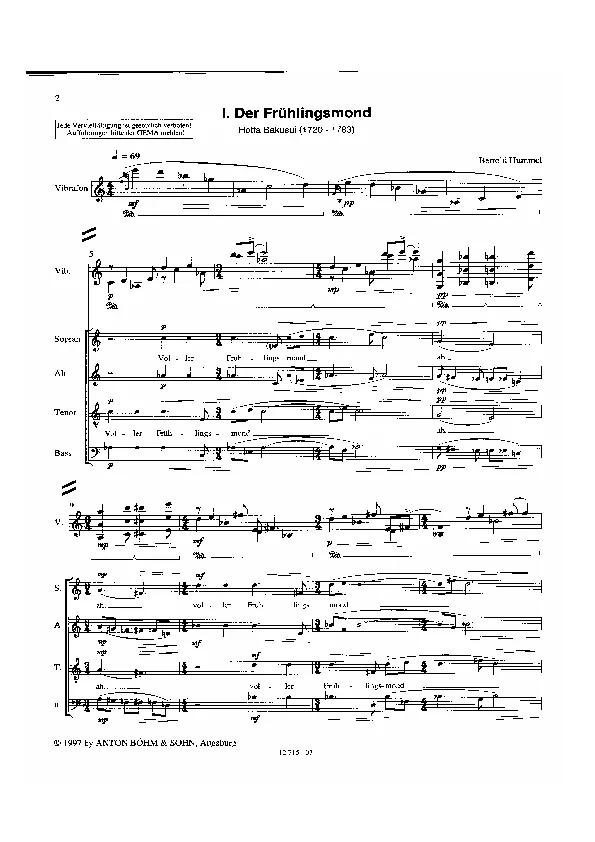
1. the spring moon (Hotta Bakusui 1720-1783), 2. the butterfly (Taniguchi Buson 1715-1783), 3. plum blossom branch (Sumi Taigi 1709-1772), 4. the trapped nightingale (Sumi Taigi 1709-1772), 5. the lost child (Yoshida Ryusui), 6. A Cloudy Day (Kusakabe Kyohaku d. 1698), 7. Little Mosquitoes (Matsuo Basho 1643-1694), 8. Mount Fuji in the Rain (Matsuo Basho 1643-1694), 9. Autumn Storm I (Toyoma Rogetsu 1666-1751), 10. Autumn Storm II (Morikawa Kyoroku 1652-1715), 11. Death Verse (Mrs Chine)
Four-part mixed choir, vibraphone
Duration: 15 minutes
Chamber Choir of the University of Music Würzburg | Juan Chavez | Josef Trompke
Schott Music SKR 20068 / ISMN: 979-0-001-17869-3
First edition: Anton Böhm & Sohn, Augsburg 1997
Taniguchi Buson 1715-1783
Midday sunlight,
on the temple bell sleeps
a butterfly gently sleeps.
The butterfly
Resting upon the temple bell,
Asleep.
Sumi Taigi 1709-1772
"That's not allowed."
he said and plucked me
a sprig of blossom.
"Don't break it off!"
And breaking off a branch of the plum,
He gave me it.
Sumi Taigi 1709-1772
Loudly, as if she could not see her
cage bars, the nightingale sings
the nightingale sings.
Yoshida Ryusui
The lost child cries
and cries and cries and cries
a glowworm after all.
The lost child,
Crying, crying, but still
catching the fire-flies.
Kusakabe Kyohaku died 1698
A cloudy day,
instead of the sun
today only cherry blossoms.Italic: Traduction from the Original Japanese Haiku by R.H. Blyth (Tokyo 1947)
Matsuo Basho 1643-1694
In the hermitage mine
the gnats are small and silent,
I have nothing else.
At my hut,
All that I have to offer you,
Is that the mosquitoes are small.
Matsuo Basho 1643-1694
Even on days when rain mist
the mountain remains
beautiful.
Toyoma Rogetsu 1666-1751
How the autumn storm roars!
but high in the sky are clouds
motionless.
The autumn tempest rages,
But high in the sky
The clouds are motionless.
Morikawa Kyoroku 1652-1715
Oh, first of all
the autumn storm
Just blew down the scarecrow.
The first thing
To be blown down by the tempest,
The scarecrow.
(Mrs Chine)
How quickly it glows
How it quickly goes out again,
Fire beetle light.
How easily it glows,
How easily it goes out,
The fire-fly.
The translations from the Japanese into German are by Gerolf Coudenhove
It was striking how well the Würzburg composer knows how to develop modern structures on the basis of traditional forms without having to swing the atonal sledgehammer, especially in these short pictures that require a highly concentrated style of writing. Every single statement "sits" in mood painting and expression when Hummel's sound world, for example, recreates a restrained lyric such as"Das Kind weint und weint, und hascht einen Glühwurm doch".
New scores revised by Max Nyffeler
Style, general character: Varied choral miniatures on traditional haiku poems, most of them from the 17th/18th century.
Form, structure: In extended tonality, predominantly syllabic with polyphonic elements. The vibraphone plays around and supports the vocal part.
Notation, duration, difficulty: traditional notation, approx. 15 minutes, rather easy
Comment: The unusual combination of choir plus vibraphone creates a light, floating atmosphere.




The haiku - three lines of 17 syllables (5-7-5) - the shortest form of world poetry originating from China, is the pinnacle of Japanese poetry. Starting from the playful, it finds its way to mythaphysical depth, which is usually only hinted at. Poems translated into images provided the impetus for the composition of the 11 haiku for mixed choir and vibraphone. The brevity and conciseness of the poems demand a high degree of compositional concentration. The trinity of time - place - meaning, which the haiku conveys, should not be translated into thought, but - as Helwig says - the poem should be"silenced".
Bertold Hummel
I was interested in Japanese haiku poetry long before composing my op. 41b. The poetic brevity and conciseness of the images in these 17-syllable word sequences fascinated me enormously. Finally, in 1973, I found an adequate translation of the haiku texts, which I initially set for choir a capella. On the occasion of the Japanese Week in Würzburg in 1988, the 11 haiku were given their final form and version for mixed choir and vibraphone.
Bertold Hummel (31 March 1993)