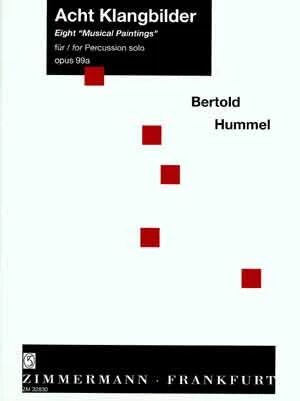
Eight pictures in sound for percussion solo (op. 99a, 1995)
I. Ezekiel 37, II. Passion I, III. Passion II, IV. Passion III, V. Triangle, VI. Circle, VII. Square, VIII. Ludi
Vibraphone, 2 tom-toms, standing tom-tom (size 18''/22''), bongos, snare drum, bass drum, 5 temple blocks, 3 crotales, 4 cymbals, rivet cymbal, small glissando gong, 2 gongs (medium size), tam-tam (32 inches), Log drum, vibraslap, chimes (metal), flexatone, 2 stones, 2 tubular bells, 2 bottles, ocean drum, rain stick, guiro, cowbells, 2 chains (heavy/light), dobaci (can be replaced by vibraphone) triangle.
Duration: 21 minutes
Stefan Eblenkamp
Title: I Ezekiel 37 - Length: 20 pages - Date: I. 8.8.95 II. 9.8.95 III. 10.Aug.95 IV. 11.8.95 V. 14.8.95 VI. 15.8.95 VII. 16.8.95 VIII. 20.8.95 - Location: Bavarian State Library Munich
Zimmermann Musikverlag Frankfurt ZM 32830 / ISMN: M-010-32830-0
The pictures by Andreas Felger are available as prints, slides and also digitally on CD from Andreas Felger Kulturstiftung, www.af-kulturstiftung.de
Hummel's music for percussion radiates a peculiar calm with great inner tension. The development of the volumes and the use of the various percussion instruments and sounds is extraordinarily subtle and sensitive. A master has written percussion music for which the impression of Felger's picture inspired musical thoughts of great intensity, which he did not want to present as his own screaming sentiment, but rather as a cautious interpretation.
Very demanding, sometimes difficult contemporary solo performance pieces for an extensive percussion arsenal. Very varied in terms of rhythm and tone colours. Recommended for advanced high school students, also suitable for university entrance examinations. The vibraphone is usually at the centre of the pieces. The following unusual instruments are required: 1 log drum, crotales, various gongs, chimes, sound stones, tubular bells, ocean drum, rain stick, friction gongs (singing bowls).
Ulrich Moritz
This multiple-percussion solo is subtitled "Eight Musical Paintings," each of which is inspired by a painting by Andreas Felger. Included with the music are the eight paintings for inspirational purposes. It is suggested that slides of the paintings be shown to the audience during the performance. (The slides may be ordered from an address given in the score.) This composition is the collaboration of three individuals: artist Andreas Felger, composer Bertold Hummel, and percussionist Stefan Eblenkamp, who first performed the work.
Twenty-seven percussion instruments are required to perform the work, ranging from snare drums to vibraphone to stones. Each musical painting is different from the other, but the vibraphone provides a continuous music color. The pieces are not necessarily filled with technical demands but musical demands. It would take a mature performer to realize the full potential of the eight "paintings."
John Beck




Question: You composed your work for percussion op. 99a to eight watercolours by Andreas Felger. I know that Mr Felger often paints to music. There is an exchange between artists here. How did you get to know Andreas Felger?
Hummel: The percussionist Stefan Eblenkamp asked me if I would like to write music to paintings by Mr Felger. During a visit to Felger's studio, I worked with the painter to select the objects that I thought were suitable for a musical interpretation.
Question: Have you already composed music to paintings by other artists?
Hummel: Yes, there is a symphonic poem for large orchestra "Die Stille vor dem Sturm" (The Silence before the Storm) based on a painting by Hans Thoma.
Question: Would you like to say something about the process that takes place in you when you compose to a painting? (Anyone who looks closely at a Felger painting and listens to your music can sense something of your feelings, I think).
Hummel: I looked at Felger's pictures in the original for a long time and had them in front of my eyes in reproductions when I was composing. The realisation of my feelings then takes place in purely musical categories and is very subjective. If the listener can empathise with this - all the better.
"Schwarzwälder Bote", 14 March 1997
Preface to the sheet music edition (Musikverlag Zimmermann, Frankfurt)
The artistic connections between music and painting are manifold. Many artists, especially at the end of the century, have sought mutual co-operation or have been inspired by corresponding guidelines.
I had my first musical encounter with the connection between the two arts as a child. Back then, I played a piece by the American percussionist Al Payson entitled "The twittering machine " after the painting of the same name by Paul Klee. Since then, the fascinating combination of the two arts has repeatedly inspired me as an interpreter. In my view, the enormous possibilities of musical colour predestine percussion instruments for this task.
I have followed Andreas Felger's artistic work with great enthusiasm for many years. So I was very pleased to be able to help him with his wish to set some of his works to music.
In Bertold Hummel, we were able to find a composer for this project who has masterfully translated the content, formal and colour relationships of the chosen pictures into eight concise musical statements.
I am delighted to have been involved in the creation, première and the first concerts with the "Klangbilder". For further performances, I recommend the projection of the accompanying images by slide, as the full artistic power of the "Klangbilder" is only conveyed in the direct, simultaneous connection of both levels.
Stefan Eblenkamp, April 1998
Bertold Hummel composed the 8 movements inspired by the pictures by Andreas Felger and at the suggestion of percussionist Stefan Eblenkamp. The individual pictures and their corresponding musical movements bear the titles: Ezekiel 37, Passion I-III, Triangle, Circle, Square and Ludi. The 4-colour reproductions replace corresponding commentaries on the pieces and lend an additional dimension to the overall impression. We recommend a performance with simultaneous projection of the pictures as slides, which can be obtained directly from the artist