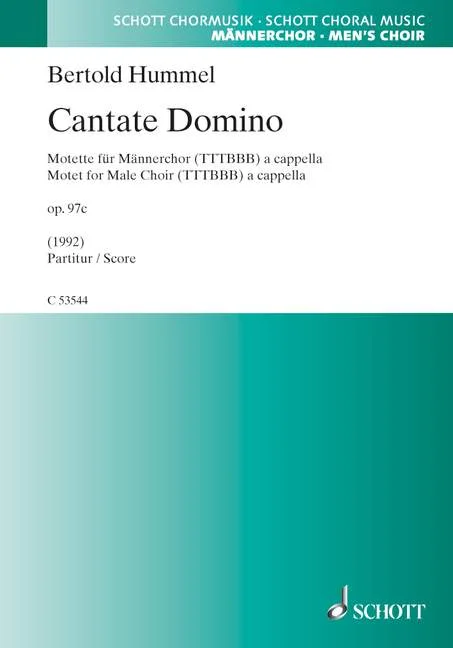
Cantate domino (op. 97c, 1992)
Motet for male choir a cappella
Dedicated to Hubert Velten and his vocal ensemble
Male choir (TTTBBB) a cappella
Duration: 3 minutes
cantARTE | Hubert Velten
cantARTE | Hubert Velten
Title: Cantate Domino for male choir - Length: 4 pages - Date: Regensburg 9.7.92 - Location: Bayerische Staatsbibliothek Munich
Schott Music C 53544 / ISMN: 979-0-001-16950-9
First edition: Feuchtinger & Gleichauf, Regensburg
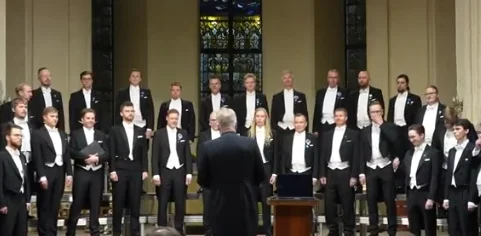
The genesis of Hummel's beautiful motet is typical of the nature and work of the renowned composer. Asked by Hubert Velten on the occasion of a meeting for a work for his recently founded vocal ensemble, Velten received the motet just one day later, based on the text of the first two sections of the 98th Psalm, the verses that are sung in Latin as the introit on the Sunday of the 5th week of Easter in both Protestant and Catholic services. The three-minute work takes up the formal criteria of the genre, but gives them a contemporary sound with the colourful harmonies typical of Hummel. An appealing task for ambitious male choirs.
Barbara Stühlmeyer




Preface (Schott C 53544)
When I was director of the Fachakademie für Katholische Kirchenmusik in Regensburg from 1988 to 2000, Bertold Hummel acted as state examiner. On this occasion, I once asked him to write a motet for my still young vocal ensemble. I was more than surprised when he presented me with the score of this beautiful "Cantate Domino" the following day.
Hummel chose the first two sections of the 98th Psalm as the text. The somewhat rearranged psalm verses were already added to the Gregorian version around 800, which is sung in the Protestant and Catholic liturgy of the Mass as the introit on the 4th Sunday after Easter (5th week of Easter).
I have often sung this motet with my ensemble cantARTE, e.g. in Portugal (Sé Catedral do Porto), Chicago (Cathedral of the Holy Name), Rome (Sant'Ignazio) and many other places. Always with great success! I always felt on friendly terms with Bertold Hummel and I am still grateful to this day that I was able to get to know him.
Hubert Velten, 2009