Music for saxophone (E flat/alto) and orchestra (op. 96b, 1993)
für Andrzej Rzymkowski
2.2.2.2 - 3.3.2.1 - timpani, percussion <2>, strings
Duration: 20 minutes
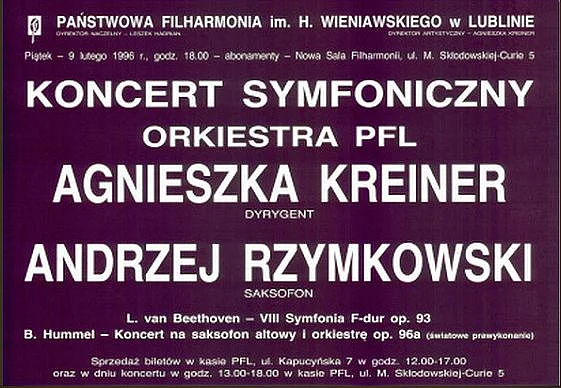
Andrzej Rzymkowski | Philharmonisches Orchester Lublin | Agnieszka Kreiner
Title: Music for saxophone (E flat/alto) and orchestra op. 96 - Length: 78 pages - Date: 1.10.93 - Location: Bavarian State Library Munich
N. Simrock Hamburg-London (Boosey & Hawkes)
Piano reduction: EE 5307 / ISMN: 979-0-2211-2097-7

Gregorian chant on the saxophone
Next Friday, Bertold Hummel's "Music for Saxophone and Orchestra" will receive its German premiere in a concert by the Göttingen Symphony Orchestra. Tageblatt editor Michael Schäfer spoke to the composer, who lives in Würzburg.
Tageblatt: The saxophone appears frequently in your catalogue of works from Opus 68 onwards. Is there a particular reason for this?
Hummel: Indeed. Because at that time I got to know an excellent saxophonist from Canada, Normand DesChenes. His playing removed my earlier scepticism towards this instrument. He later made several CD recordings of my pieces.
Tageblatt: There was previously a version of your "Music for Saxophone" for horn and orchestra. What prompted you to rework it?
Hummel: I got to know the saxophonist Andrzej Rzymkowski, who champions my saxophone pieces in his native Poland. I arranged the piece for him. The saxophone version is quite different from the horn version, it is much more virtuosic and has a completely new cadenza. Andrzej Rzymkowski was also the soloist at the premiere, which took place in Lublin on 9 February 1996.
Tageblatt: In the middle section of your piece, as you mention in your introduction, you quote a Gregorian hymn. Gregorian chant and saxophone - how does that fit together?
Hummel: The sound of the saxophone, especially in the low register, is similar to the human voice. In this respect, I can also sing a Gregorian hymn with the saxophone. Incidentally, Richard Wagner also originally wanted to use the saxophone in the "Ring of the Nibelung" - it reinforces the middle register in the orchestra in a special way.
Tageblatt: Do you think that listeners from the Protestant North can identify such melodies today?
Hummel: It is certainly not as easy for them as it is for the Poles, who I was almost surprised that they did not sing along with the hymn at the premiere in Lublin. But even if you don't know these original melodies, their special character comes across. Gregorian chant has been a part of Western music for centuries - underground, as it were.
Tageblatt: Do you think first and foremost about your audience when you compose, or is the musical structure the primary thing for you? Specifically: Would you sacrifice an idea for a more pleasant sound?
Hummel: I wouldn't do that. But for me, the triangle of composer - performer - listener remains a constant challenge. I have a slightly different opinion than my L'art-pour-l'art friends, who obviously haven't understood their social categorisation as composers.
Tageblatt: Do you see an opportunity to narrow the gap between composers and today's audiences?
Hummel: Composers must realise the role they have to play.
Tageblatt: A personal question: You have six sons. Are there any musicians among them?
Hummel: Five have become professional musicians, one a theologian. And there are two composers among the musicians. One of them writes very avant-garde music. Compared to him, Helmut Lachenmann is an old master.
Hummel's emotional music is very effective. Some of the effects seem somewhat theatrical, but they are always dramaturgically well prepared. And all saxophonists can be grateful to Hummel that he has given this instrument, often unjustly criticised as a means of light music, such an expressive concerto in the "serious" realm. At last, saxophonists can play something other than Glazunov in a symphony concerto.
The centrepiece of the evening was the Saxophone Concerto op. 96b by Bertold Hummel (1995), which is appreciated not only for its choice of solo instrument, but also for its compositional content and treatment. Hummel wrote a wide variety of modern music for the end of the 20th century, which, with its sounds and harmonies, stands firmly in its time, but has the rare quality of not frightening listeners, but skilfully inviting them to open up to new sounds. The saxophone concerto does not have the usual division into movements. It has seven sections that merge into one another and resembles an instrumental ballad. The saxophone narrates. The orchestra takes up the impressions and processes them in a variety of ways.
In the third section, the saxophone, together with the piccolo, quotes the famous Gregorian hymn "Pange, lingua, gloriosi". After an extensive cadenza, the chorale theme is altered in a jazzy manner, and towards the end the tone sequence B-A-C-H, which has been hinted at several times before, is even heard.
The Baden-Baden Philharmonic, with its wide-ranging percussion section, brought this work to life with great commitment and precision. The soloist Anton Hollich shone with his technique and colourful, graduated tone
Ulrich Eißler




Music for saxophone (E flat/alto) and orchestra" op. 96b (1993/95) has the character of an instrumental ballad with rhapsodic elements, in which the soloist functions as a narrator, so to speak. The one-movement work is divided into seven sections with contrasting dynamic and rhythmic structures.
The piece opens with a fanning out eight-part sound, which is repeatedly used to structure the piece. A diatonic, lyrical theme in the solo instrument develops into an initial climax. The second section is an allegro over throbbing basses, which leads into an orchestral tutti. The Gregorian hymn "Pange, lingua, gloriosi" is quoted in the third section, only to be linked with the throbbing allegro of the second section in the fourth.
The entire material of the work is worked through in the following formal section - the beginning of which is characterised by the abrupt interruption of a climax - in short orchestral and soloistic episodes. A final climax leads to the soloist's expansive cadenza, which forms the penultimate section. In the coda, the chorale motif is altered in a jazzy manner; a 16-part sound is then built up, from which the saxophone makes its last musical statement - with a B-A-C-H motif that had already been heard several times before. A restrained E major sound with a fading upward glissando ends the work in extreme pianissimo.
Bertold Hummel
My Music for saxophone (E flat/alto) and orchestra op. 96b has the character of an instrumental ballad with rhapsodic elements. The narrative, single-movement work can be formally divided into 7 sections, which have very contrasting dynamic and rhythmic structures, with the soloist acting as a kind of "narrator". Lyrical elements are juxtaposed with dramatic episodes.
1) The quiet opening bars fan out an 8-part sound, which is repeatedly used to structure the piece. A diatonic, lyrical theme in the solo instrument - faded over by a moving insertion - develops into a first climax, which is followed by the return of the beginning with a fading swan song.
2) An allegro section rises above throbbing basses in various sequencing waves, leading into an orchestral tutti. This section calms down after a brief concertante imitation exchange between solo and orchestra.
3) The Gregorian hymn "Pange, lingua, gloriosi ..." is quoted, embedded in a mixed sound of the strings. In the following course of the piece, this chorale is omnipresent and undergoes many metamorphoses.
4) The Gregorian motif is included in the throbbing Allegro of the 2nd section.
5) After the abrupt interruption of a climax, a fanned-out 12-note chord introduces the development section, which illuminates the entire material of the work in various ways in short orchestral and soloistic episodes.
6) A final climax leads to an expansive cadenza for the solo instrument. Here, too, all movement elements are present.
7) In the coda, the chorale motif initially undergoes a jazz-like metamorphosis. Finally, a 16-part sound is built up, out of which the solo instrument makes its last appearance with the "B-A-C-H" motif, which has already been alluded to several times in the course of the piece. A restrained E major sound with a fading upward glissando ends the work in extreme pianissimo.
The premiere of op. 96b took place on 9 February 1996 in Lublin (Poland) with Andrzej Rzymkowski, to whom the work is also dedicated, and the Lublin Philharmonic Orchestra under the direction of Agnieszka Kreiner.
Bertold Hummel