Five songs after poems by Joseph von Eichendorff for medium voice and piano (op. 88b, 1987)
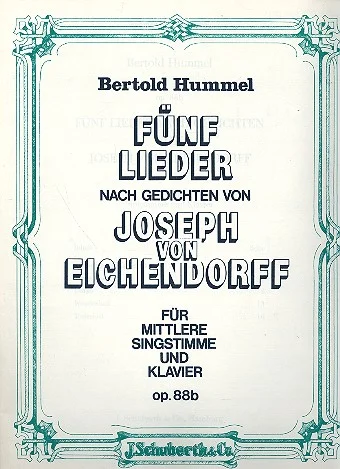
for my son Martin
I. Aus schweren Träumen, II Der wandernde Musikant, III Kurze Fahrt, IV Unfall, V Todeslust
The order of the songs given here was recommended by the composer for a cyclical performance.
Medium voice, piano
Duration: 13 minutes
Martin Hummel | Ernst Ueckermann
Title: 5 Lieder nach Texten von Jos. v. Eichendorff op. 88b - Length: 19 pages - Date: I. Aus schweren Träumen - / II. Wanderlied 28.12.87 / III. Kurze Fahrt 23.12.87 / IV. Accident 4.1.88 7 V. Todeslust 1.1.88 - Storage location:
Schott Music ED 20286 / ISMN: M-001-14991-4
Printing error in this edition:
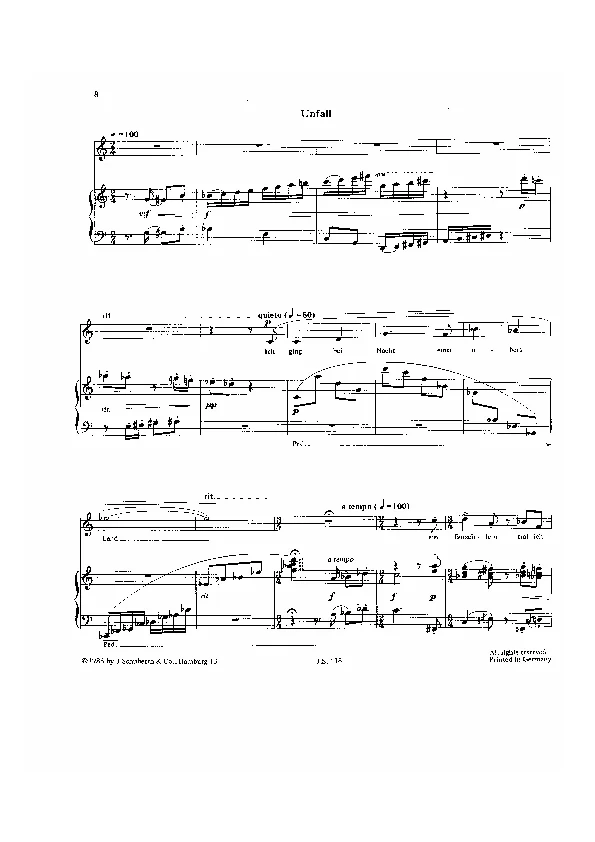
Page 11 ("Unfall"), 1st bar: left hand: treble clef instead of bass clef
page 11 ("Unfall"), 3rd stave, last bar: left hand: treble clef instead of bass clef, right hand: chord on the crotchet: mf with accent
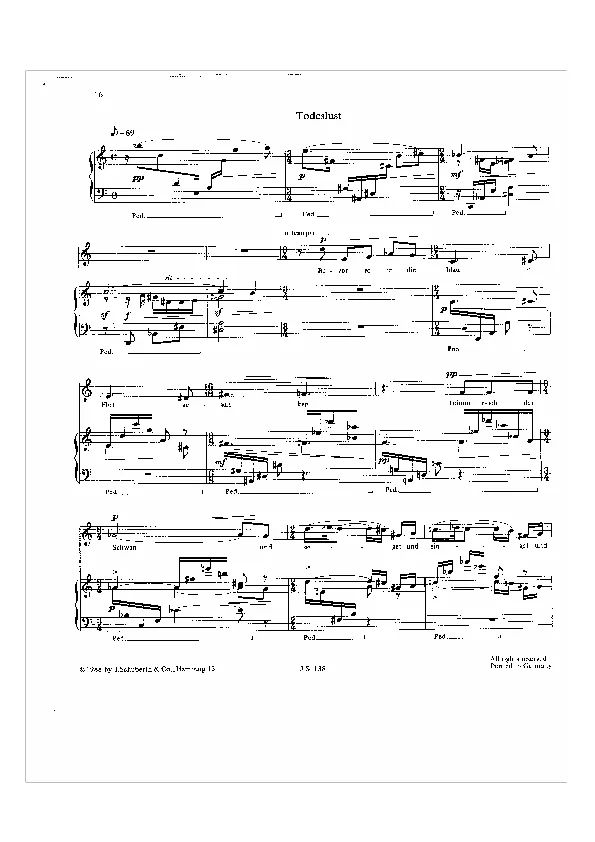
Page 17 ("Todeslust"), 4th stave, 1st bar: f mf instead of fp
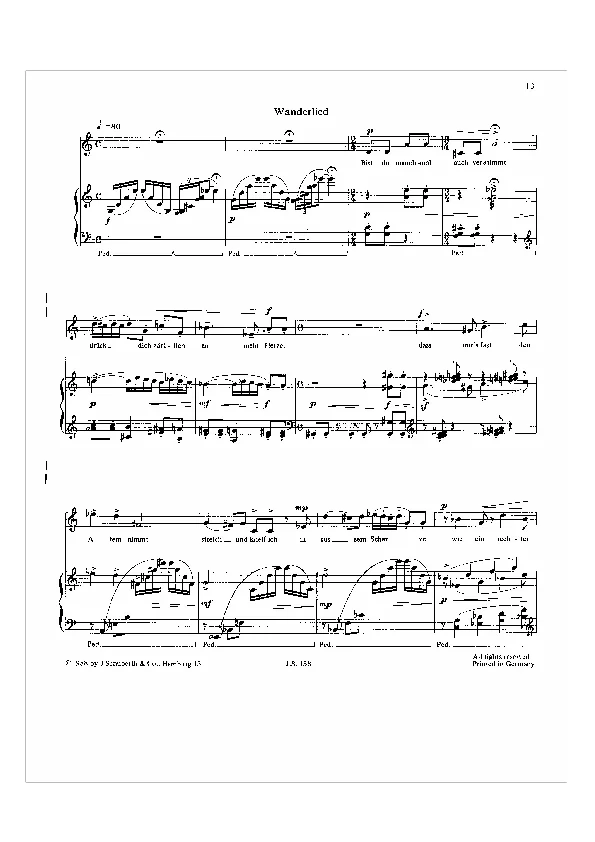




The songs written for the 200th birthday of the poet J.v. Eichendorff (1988) represent an attempt to trace the "tone" of the poems in our time - not in strophic songs but in "song scenes", in small "dramas" in which the piano characterises in a differentiated way what the singing voice performs.
Bertold Hummel
"Aus schweren Träumen" ("From burdensome dreams") is significantly placed at the beginning of the latest Hummel cycle (1988) on poems by Joseph von Eichendorff, for the poet had this very verse as the motto at the beginning of his "Romanzen" ("Romances"). Setting Eichendorff after Schumann was for Hugo Wolf a great challenge. He therefore emphasised, in contrast to Schumann, Eichendorff's realistic and humorous side. Bertold Hummel does the same in "Der wandernde Musikant" ("The wandering musician") and in "Unfall", songs marked by love for the violin. In the latter, the composer extracts much more grotesque results from the unexpected encounter with Amor and his arrow than Hugo Wolf with his leisurely setting. Here, frequent changes of time signature as well the often rapid transitions to the extremities of the piano's range contribute to the effect.
But it is not the serious motto alone that sounds the "right fundamental tone" for this cycle (in the last seven bars of "Aus schweren Träumen", the note A is circled by the vocal line and the piano, until it finally asserts itself as a held bass note): in "Kurze Fahrt" ("Short journey") and in the closing "Todeslust" ("Hunger for death"), ultimate feelings find strong expression. The "right fundamental tone" (D) of this final song - basis for the evocation of the "wunderbaren Nacht" ("wonderful night") - finally leaves the deep regions and fades away in the bright middle range of a widely spread D major in first inversion. Although a pure triad, it leaves - as in most of Hummel's songs - the cadence open.
Wolfgang Osthoff (in "Zu den Liedern Bertold Hummels", Tutzing 1998)