Adagietto for string sextet (op. 75d, 1978)
2 violins, 2 violas, 2 cellos
Duration: 7 minutes
Georg Döring | Wiebke Corßen | Beate Corßen | Gregor van den Boom | Bertold Hummel | Michael Corßen
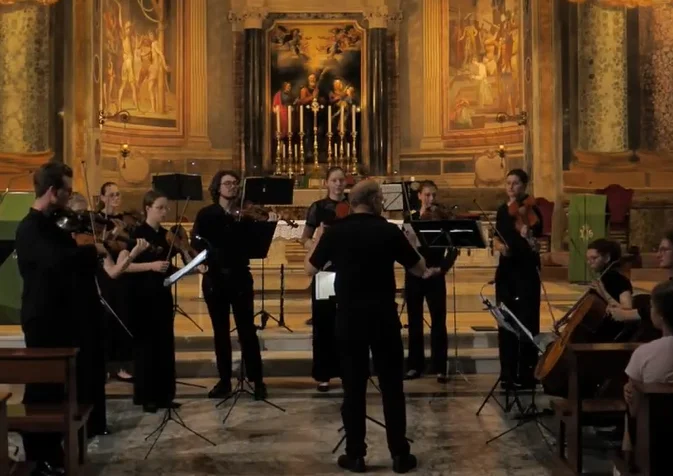
Bella Musica Ensemble des Mozarteums Salzburg | Stefan David Hummel
Title: Adagietto sacrale for string sextet op. 75e (sic) (1980) - Length: 12 pages - Date: 5.12.78 - Location: Bayerische Staatsbibliothek Munich
Schott Music ED 20289 / ISMN: M-001-14994-5
First edition: J. Schuberth & Co., Eisenach 1993
Many a composer spends an entire musical lifetime working on a single work, reworking it, discarding it, reimagining it or publishing it in ever new versions. Richard Wagner's preoccupation with his Tannhäuser is one such example; according to its self-critical creator, the opera was never finished - and yet it is a masterpiece.
Bertold Hummel's Tannhäuser is his Adagietto for string sextet op. 75d. The composer reinterpreted it several times and had already published it once before the final version was written in 1999. For Hummel, this concise and straightforward string piece seems to have been a kind of inner retreat, a very important fixed point in his work. And the composer was also directly involved in the premiere in Gütersloh three years before his death as a cellist.
As so often in Bertold Hummel's works, the immediate musical gesture of his writing is striking. The enormous differences in dynamics alone give the Adagietto an expansive liveliness and a very direct effect. In terms of sound, the composer utilises the full range of expressiveness of the string section. The six voices are required to present considerable contrasts in a relatively confined space and yet never neglect the flow and forward movement of the music; a forward movement that does not exhaust itself in the merely motoric, but strives purposefully towards a relaxed, balanced end.
Before this peaceful conclusion, however, highly condensed musical impressions develop from the smallest tonal and motivic cells. The two violins, violas and cellos create structures that are always clearly recognisable and vividly delineated in their development and changes. The performers are required to achieve a high level of transparency in their interplay, an extremely sustainable tone in all dynamic gradations and expressive lines.
Bertold Hummel's Adagietto may have undergone many changes over the decades of its composition. In any case, however, the final stage of development presents itself to us as a concentrate of tonal and structural depth of focus - as music in which everything simply seems to be in the right place.
Daniel Knödler
A work from the 20th century took us into a completely different world:"Adagietto for string sextet" by Bertold Hummel (1925 - 2002). Clusters of notes and clouds of sound, expressive and full of dissonances, savoured with relish by the instrumentalists. Then again sounds like an outcry or the uniform repetition of a melody that seemed to come from another sphere: pure atmospheric images. It took seconds for the tension in the audience to be released by the first round of applause.
New scores - revised by Reinhard Schulz
Short piece, widely singing, full string writing
Expanded tonal, broad lines with a chorale-like, sacred background
Normal notation, approx. 6 minutes, not difficult
Very fulfilling, devotional string sextet, "big sound"




Preface (Schott Music ED 20289)
This Adagietto occupied Bertold Hummel for many years. Conceived in 1965 as an Elegy for strings, it was transformed into an Adagietto for string sextet in 1978 and printed for the first time in 1993. In 1999, he reworked the work once again and premiered it himself with musician friends. One score bears the addition"sacrale" in the title, which speaks in favour of the religious background of this music.
"In a time of increasing secularisation, the creative and probably also the post-creative artist has the task of pointing his fellow human beings towards the transcendent, the inexplicable and also the unprovable. The language of music - perhaps the most universal - is of particular importance here. The depiction of suffering and horror alone cannot be the immanent component of a work of art. The reference to consolation and hope is indispensable. Beyond that, life, nature and, for the believer, the knowledge of God also give sufficient cause for praise and thanksgiving."
With these words, my father once formulated his artistic self-image. The concept of "musical sound speech", which he liked to adopt, seems to me to be particularly vividly realised in the Adagietto.
Martin Hummel
In his Adagietto for string sextet, the variety results from the playing with two violins, two violas and two cellos.
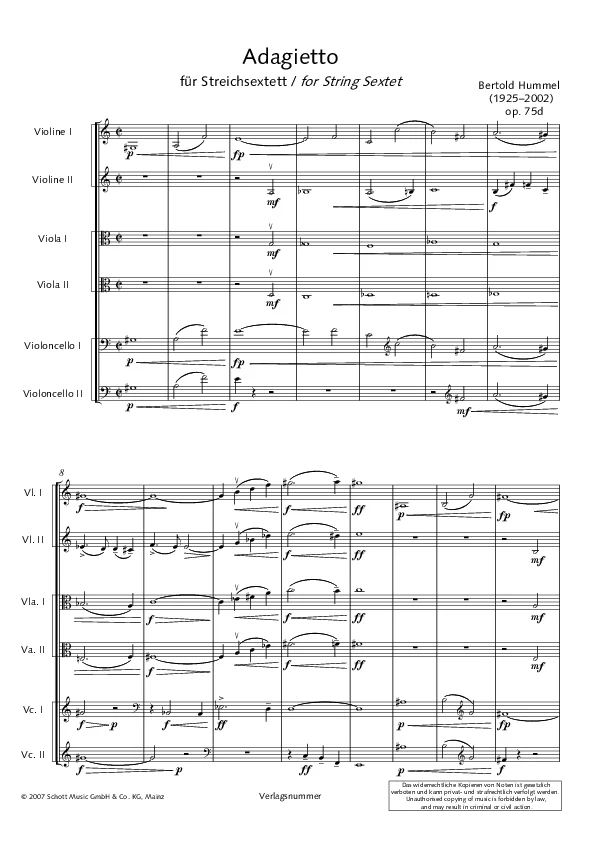
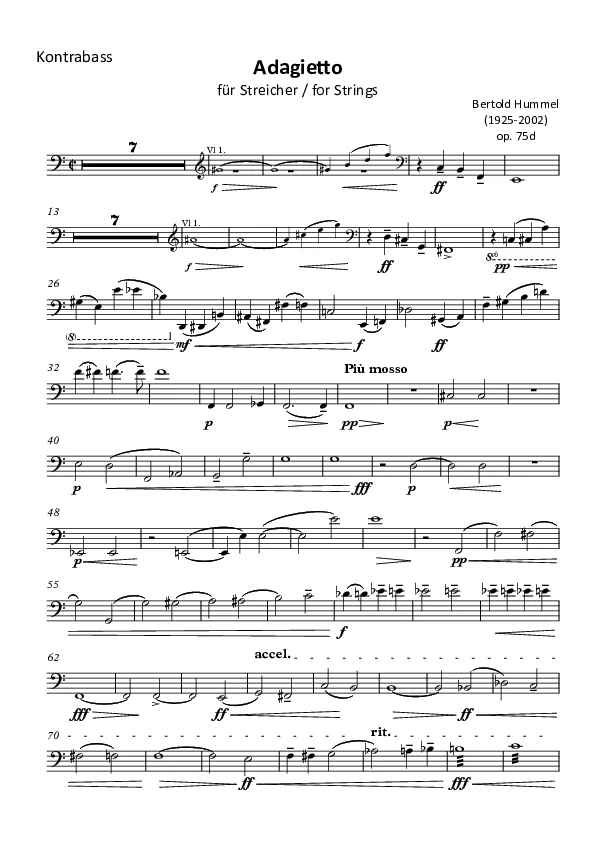
An ascending melody beginning in unison from the first violin and both cellos in p leads to the ff chord in 12 bars, only to immediately begin again from below, one tone higher, thus increasing its effect. The instruments continue the theme together in close intervals, building up to powerful chords or exhaling in pp. In a largely homophonic movement of the voices, tension is built up in the close contrast of pp and ff. Such dynamics continue throughout the piece and are capable of taking our breath away.
The ascending movement with which the piece begins is contrasted by a rhythmically lively second motif, which is introduced as a descending line in the second violin right at the beginning. In the course of the adagietto, it develops independence before the piece comes to rest in ppp and a quietly luminous E major .
Hans Jürgen Kuhlmann (in the programme booklet of the ensemble "Il Cappricio" July 2003)