Adagio for strings "in memoriam Benjamin Britten" (op. 62a1, 1976)
Instrumentation
String orchestra or string trio
Duration: 6 minutes
Premiere
of the string trio version: 19 December 1976,
Karlstadt, Zur Hl. Familie
Inken Hummel | Florian Hummel | Cornelius Hummel
First Performance
of the string orchestra version: 6 August 1977,
Steingaden, Wieskirche
Orchester der Werkgemeinschaft für Musik e.V. | Bertold Hummel
Bezirksjugendsinfonieorchester Unterfranken | Hermann Freibott
Autograph
Title: Funeral music for B. Britten - Length: 4 pages - Date: 4.12.76 Würzburg - Location: Bavarian State Library Munich
Publisher
Schott Music ED 20280 / ISMN: M-001-14972-3
First edition: J. Schuberth & Co., Hamburg 1977
New version: J. Schuberth & Co., Eisenach 1999
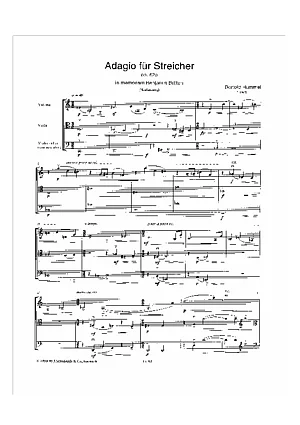
Bertold Hummel: Adagio for B. Britten, Op. 62a, No. 1 (sheet music)


Westdeutsche Zeitung, Düsseldorf, 19 November 1994
A moving, single-movement work that uses a thoroughly "modern" tonal language on a tonal, emphatically diatonic harmonic basis.
Main-Post, Würzburg, 5 April 2017
... an indulgently beautiful funeral music with a late-romantic aura and soft lines ...




The Adagio for strings in memoriam Benjamin Britten op.62a1 was composed immediately after receiving the news of the death of the great English composer and was written on 4 December 1976 between 8pm and 9.30pm. It is a three-part composition that can be performed as a solo or choral work. A gesture from Britten's 'Simple Symphony' concludes the short expressive piece.
Bertold Hummel
I met B. Britten at various music festivals. He was a marvellously sensitive person and colleague. Not only as a composer of important operas of our century and significant works of absolute music, but also as a conductor, chamber musician and song accompanist, B. Britten was an important encounter for me.
Bertold Hummel
Among his scores I found an Adagio for three strings on the death of Benjamin Britten. It is in a tradition with Lutoslawski's Funeral Music on Bartók and a number of other pieces that are very beautiful. It's an adagio with lots of long notes, with many plaintive seconds and sustained chords that drift away, and has something of a reminiscence and sadness about it. It really grabbed me.
Wilfried Hiller (in the programme of the Munich Chamber Orchestra: Subscription Concerts 2002/2003)
In the Adagio op 62a, Hummel honours Benjamin Britten, who himself had also listened to Henry Purcell, the Orpheus Britannicus of the Elizabethan era. Hummel is thus following in the footsteps of a great tradition that has always retained a number of special features compared to continental musical developments.
A melody that descends with a leap of a fifth and then ascends again with a seventh and vibrates with intervals is melodically and rhythmically taken apart almost playfully in the piece and assembled into new sequences. Attractive sounds in the accompanying voices accompany the development of the melody with bold harmonic lines of tension. It is always the falling and rising lines that are led into one another up to fff and finally end in a muted ppp
Hans Jürgen Kuhlmann (in the programme booklet of the ensemble "Il Cappricio" July 2003)