Sonata for violin and piano (op. 6, 1952)
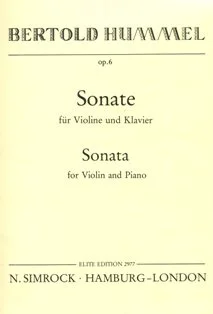
I. Burlesque, II. recitative and aria, III. finale
Violin, piano
Duration: 15 minutes
Emil Maas | Helmut Barth
Title: Sonata for violin + piano in g - Length: 37 pages - Date: 10 February 1952 - Location: Bavarian State Library, Munich
N. Simrock Hamburg-London (Boosey & Hawkes) ISMN M-2211-0895-1
Misprints:
1st movement:
m. 37: piano, chord 4th quarter: e flat not e.
m. 54: first note in the piano must be b flat.
M. 143: piano, 4th quaver not f but f sharp.
2nd movement
m. 11: clav. r.Hd. 2nd crotchet, 3rd 32nd of the triplet (resolved) b
m. 47: clav. r.Hd: triplet with 64th-notes
3rd movement
m. 1: cross accidentals also for the "tenor part" in the piano.
m. 26: clav. r.Hd. 2nd quaver b instead of b
m. 125: piano, r.Hd., treble clef after the 5th quaver.

In his early Sonata for Violin and Piano, Op. 6 – now available in print after more than twenty years – Bertold Hummel proves himself to be a musician through and through, who has enriched the violinist’s repertoire with a challenging piece of great impact. Two lively outer movements, characterised by a wry critique of tradition, frame a deeply felt slow movement to be performed with rubato: the centrepiece of this early work, marked by virtuosic pathos. Here, the finest traditions of modern chamber music converge to form a compelling work that is focused less on finding novel effects and techniques and more on bringing out the full range of instrumental qualities.
Klaus Hinrich Stahmer
Hummel’s Sonata in G for violin and piano, which has also been performed in Berlin and other cities, once again impressively confirms the extraordinary talent of this pupil of Genzmer. In it, the influences of the modern masters are already incorporated in a highly idiosyncratic manner, somewhat unruly and exuberant in the introductory burlesque, with occasional flashes of almost Western elegance in the finale. In between, the middle movement consists of a powerfully tense, extended recitative and a classically concise aria. The composer could scarcely have found his intentions more effectively realised than here, through the devoted performance of the two artists (Francine Guignard and Wolfgang Fernow), which left one wishing to hear the work all over again straight away.
An early masterpiece is the Sonata for Violin and Piano, Op. 6, which was composed whilst he was still a student in Freiburg. The sonata’s burlesque and dance-like qualities come into their own, as do its rhythmic verve and melodic line. The score reveals a chamber-music-like refinement. Light, dotted touches alternate with vigorous bow strokes. Inthe ‘Recitative and Aria’ of the middle movement, one can hear Baroque influences, yet the structure is classical and formally coherent, with the piano gaining a distinct voice of its own. With this sonata, Hummel presents a concert piece that is written in full consideration of the character of both instruments.
A remarkable talent was evident in the Sonata in G by the young Freiburg composer Bertold Hummel, with its powerful, gripping outer movements and, in particular, the middle movement, whose repeatedly soaring melodic arc develops from a stark opening chord.
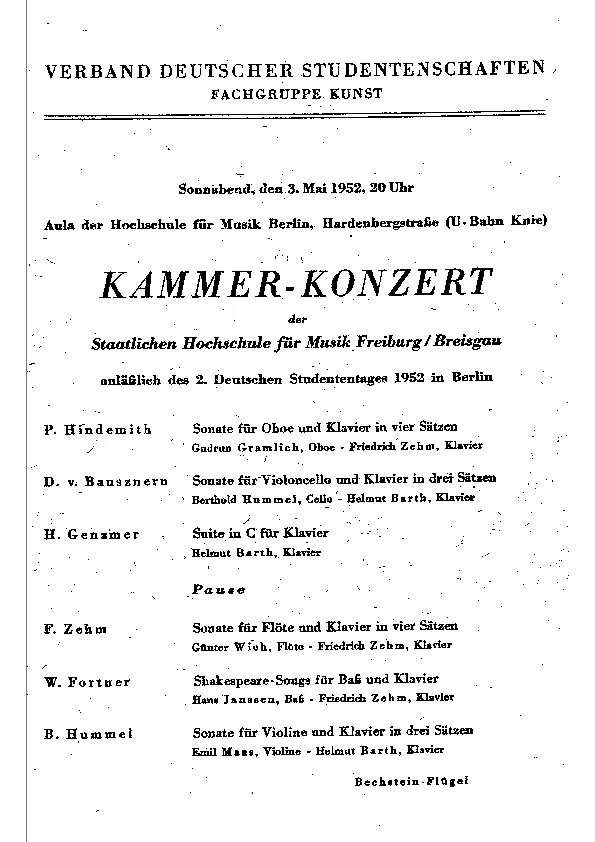
The programme concludes with a new work by Bertold Hummel, already well-known as a composer: a sonata for violin and piano brimming with boldness and impetuosity, in which the brooding middle movement is particularly captivating. Here, a young composer speaks his own language uncompromisingly, a musician who is evidently wrestling with his inner demons and makes things no easy task for himself or for us, a composer who is capable of putting his technical skill at the service of a genuine creative vision – and whose work, for that very reason, will have to be followed with particular attention. Emil Maas (violin) and Helmut Barth (piano) championed the work with fanatical dedication.




Bartók seems to have been a bit of a godfather, and yet everything sounds completely independent. Free structures of recitatives, cadenzas and arbabesques form the antithesis to rhythmically stabilised passages, formally captured in a highly original solution: instead of a sonata movement, Hummel opens this sonata with a burlesque! This is followed by a middle movement that alternates several times between recitative and aria, followed by a finale that turns into a waltz in the middle section - what exuberance! And yet the work is pervaded by a motivic and thematic commitment that betrays a school of rigour.
Klaus Hinrich Stahmer (in: Chamber music as a personal confession, Tutzing 1998)