Duo concertante für Violoncello und Harfe (op. 33, 1967)
Dedicated to Helga and Klaus Storck
I. Fantasia appassionata, II. Burleske
Violoncello, harp
Duration: 14 minutes
Klaus Storck | Helga Storck
Schott Music ED 20283 / ISMN: M-001-14978-5
First edition: J. Schuberth & Co., Eisenach 1996
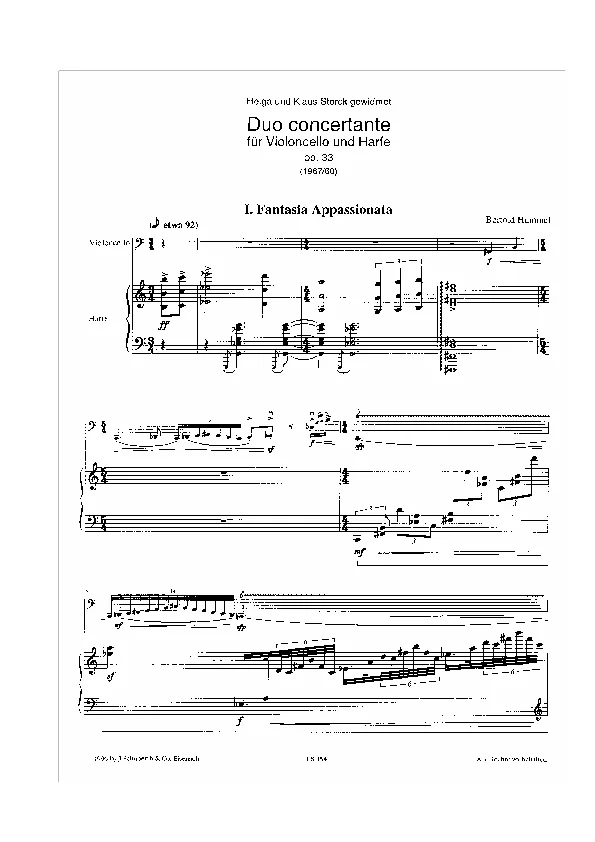
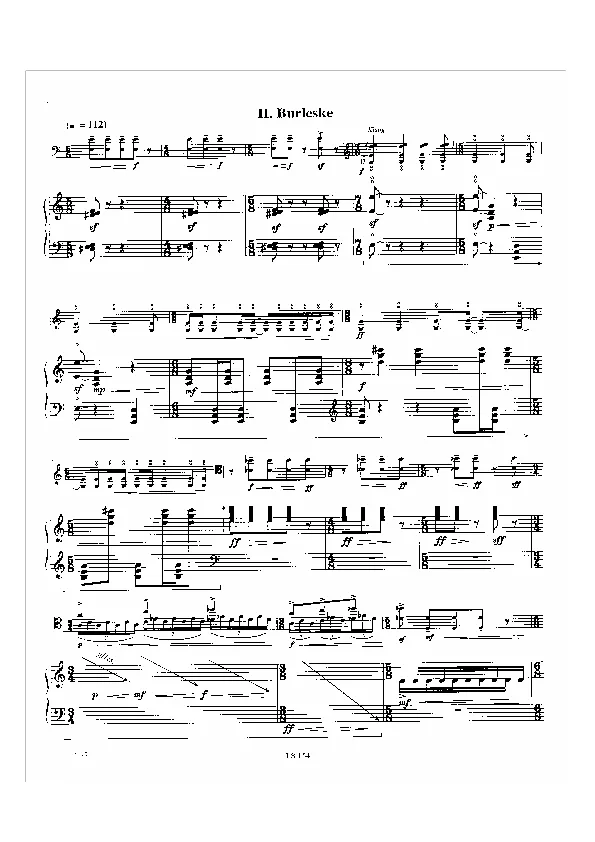
A very pleasing new discovery was the"Duo concertante" by Bertold Hummel from 1968, evidence that today's music can also find new possibilities in the conversation between the two instruments if it engages with them thoroughly, as Hummel does. This work also begins with a fantasia, but "appassionata", very spirited and with a powerful style, followed by a burlesque that lives entirely from the rhythm. Piquant details make the work rewarding to listen to, such as when both instruments pay homage to the harmonics, whereby the harp in particular is technically richly considered with its possibilities such as glissandi, trills and tremolos or the born arpeggio attack.
The expressive piece, in which the cello or the harp alternately take the leading part, exploits the limits of both instruments and creates extreme dramatic effects.
The "Duo concertante" by Bertold Hummel, dedicated to the Storck duo, captivates with its musical vitality in the character of an appassionata, with the imaginative virtuosity that Hummel leaves to the instruments, with the rhythmic fantasy and the undogmatic treatment of motifs. The Burleske had to be repeated as an encore: The audience had enjoyed this lively work and was delighted by the captivating interplay of the Storck duo.
Literature list of the German Music Council for the "Jugend musiziert" competition: Level of difficulty 5/very difficult (upper level)




Divided into two movements - Fantasia appassionata and Burleske - the work gives both instrumentalists the opportunity to develop their virtuosity.
The first movement begins with a motto played by the harp, which appears repeatedly throughout the movement. Metamorphoses over a march-like rhythm are interrupted by solo cadenzas by the two players. A reprise-like swan song ends the movement in the extreme pp.
The motoric character of the burlesque is determined by variable metrics. Rhapsodic passages divide the movement into 7 easily recognisable sections.
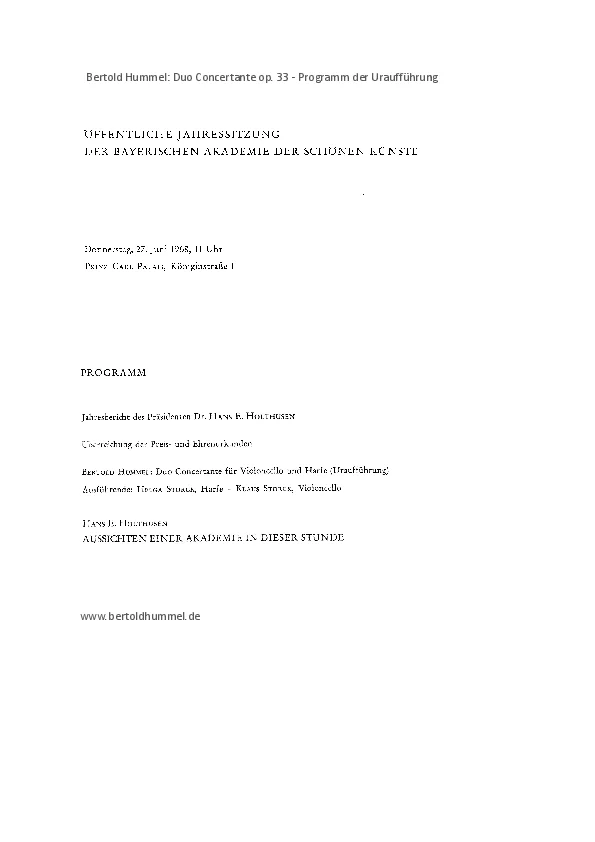
The work was commissioned by the Bavarian Academy of Fine Arts in Munich in 1967/68 and was premiered by the Storck Duo at their annual meeting in 1968.
Bertold Hummel
Asked to make a few comments about my opus 33, I would first like to draw your attention to the title "Duo concertante" , which indicates that this piece is committed to a virtuoso-musical gesture.
A special feature of the piece is the basic tuning of the harp to the tone sequence:
B - C - D - E flat - F sharp - G - A, which is not altered during the entire 1st movement. (So there are no disturbing retuning noises). All of the melodic and chordal structures of the harp part are derived from this range of notes. The violoncello naturally makes the most of the opportunity to complete the chromatic total.
A motto - performed by the harp - opens the movement, contrasted by arabesques in the cello. A march-like rhythm is hinted at and undergoes multiple variations. The basic material - derived from the harp mode - is permanently present - also in transpositions - in the cello part. The two fully composed cadenzas offer both instruments the opportunity for soloistic development. The motto - as at the beginning - strikingly introduces the farewell, which fades away in the outermost pp. One could speak of a wide-ranging variation form in this Fantasia appassionata .
The 2nd movement - entitled Burleske - works with variable metre, i.e. the number of such values varies from bar to bar while the basic time values remain the same. This results in fluctuating rhythmic structures. This method is not exactly new; we often encounter it in Stravinsky. Boris Blacher systematised it; as far as I know, he also coined the term "variable metrics". Insertions, quasi in "free speech", structure the movement.
Despite the often 12-note habitus, tonal surfaces are created by means of organ dot effects. (A technique that was relatively rare in the 1960s. - In more recent times this is more common).
The "Duo concertante" was commissioned by the Bavarian Academy of Fine Arts in 1967 and was premiered at their annual meeting in 1968 by the Storck Duo, to whom the two-movement work is also dedicated.
Bertold Hummel (on 15.12.1985 on Bavarian Radio)