To the king of eternity (op. 17, 1958)
Cantata for mixed choir and instruments
I. To the King of Eternity, II From Eternity to Eternity, III. Farewell, my soul, IV. Worthy is the sacrificed lamb
Mixed choir, 2 oboes, 2 bassoons, trumpet in C, trombone, double bass
Duration: 16 minutes
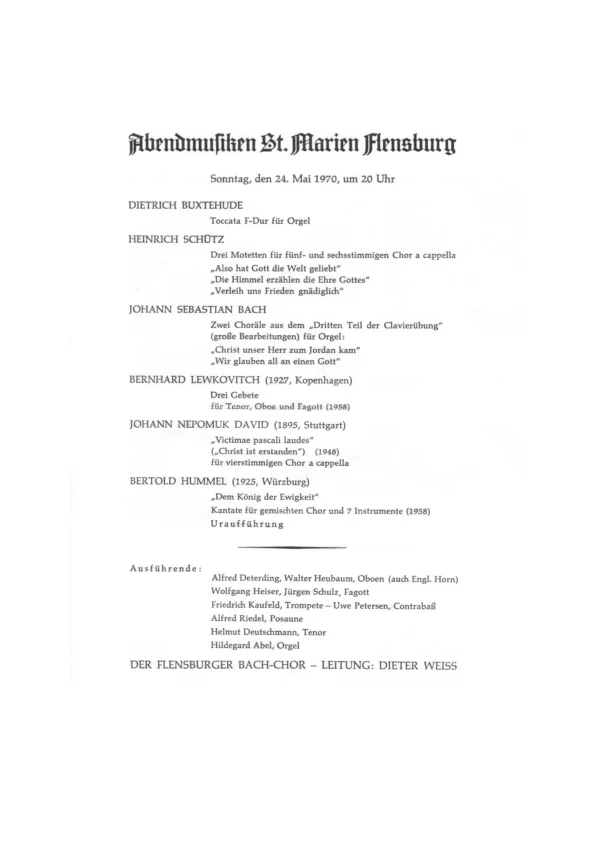
Flensburg Bach Choir | Dieter Weiss
Chor der Pädagogischen Akademie I Freiburg | Alfons Hug
Title: "To the King of Eternity." Cantata for mixed choir and 7 instruments - Length: 36 pages - Date: Jan. 58 / 1985 - Location: Bayerische Staatsbibliothek Munich
Schott Music
score: ED 21286 / ISMN 979-0-001-18039-9 | choral score: ED 21286-1 / ISMN 979-0-001-18042-9 | parts ED 21286-11 / ISMN: 979-0-001-18043-6
Misprint: III, bass: bars 59-60: text as in tenor | bar 108, text: upright instead of upright
First edition: Bertold Hummel: "Dem König der Ewigkeit", Anton Böhm & Sohn Musikverlag, Augsburg 2002
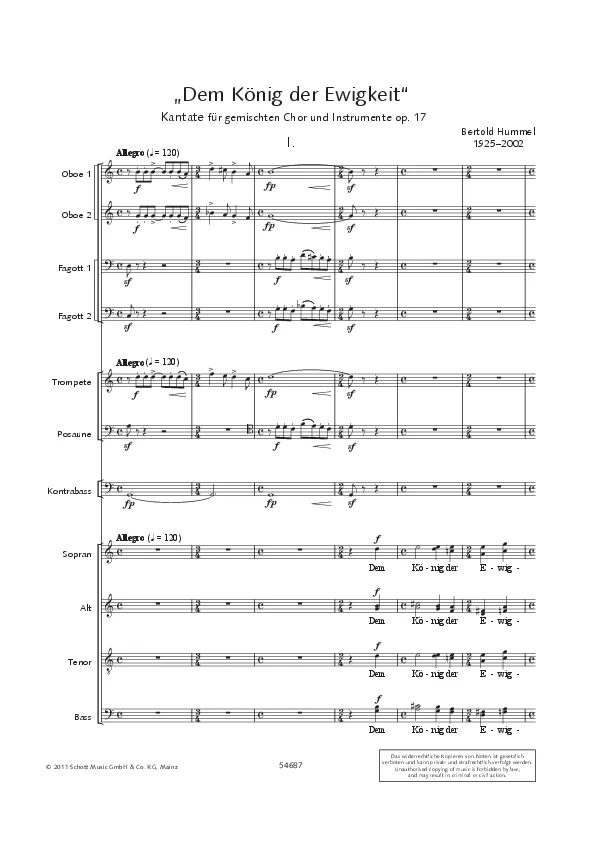
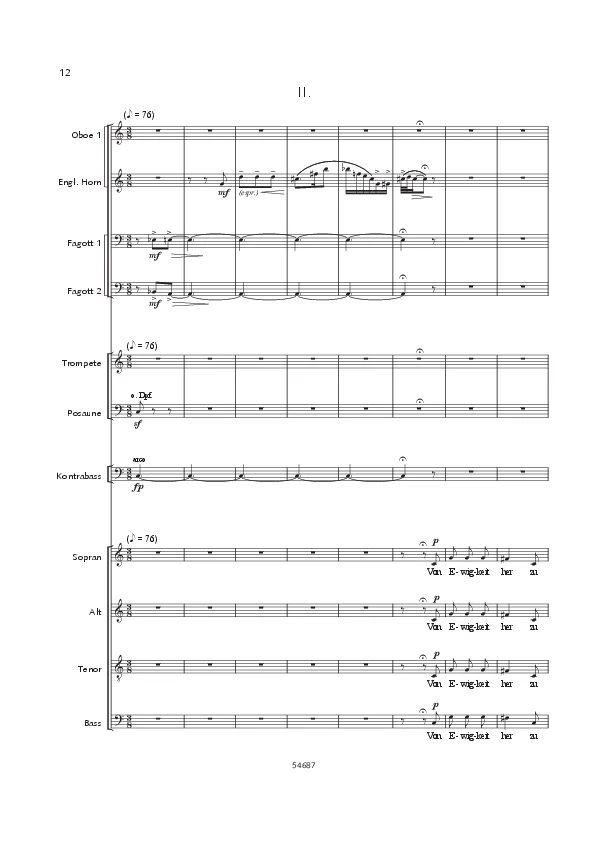
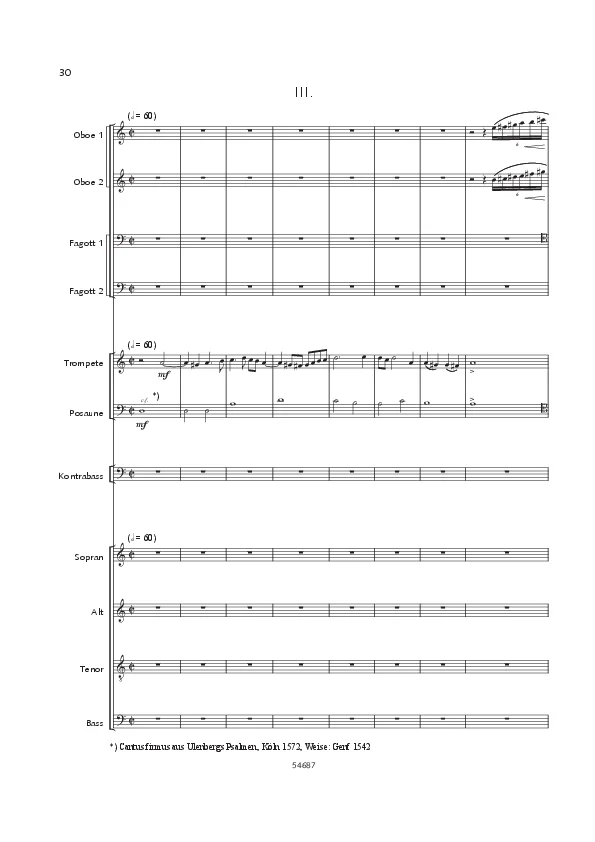
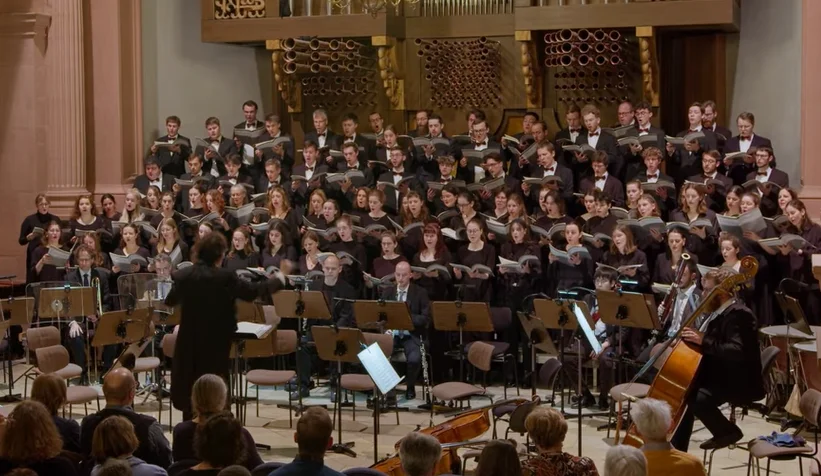
Hummel | To the King of Eternity | Monteverdi Choir, Würzburg

Hummel | To the King of Eternity | Munich Madrigal Choir
Bertold Hummel is one of those who not only write music for the eyes and for high-sounding arguments, but who are in the neighbourhood of a Joh. Nep. David or Kaminsky and defend a front of genuine values, albeit of course with stylistically novel means. The cantata is divided into four movements. All of them are characterised by conciseness of formulation, with the lively, rousing opening, and interesting things happen almost throughout. This is because Hummel creates a charmingly cohesive and varied combination of sounds. Seven solo instruments serve as psychological preparation or as an introduction to the choral phases, which operate with a modern reed beat and which they also play along to illustrate. The third movement contains an a capella choral passage of praiseworthy delicacy, and the "Abgesang" with the praise of God afterwards is one of the most beautiful contemporary compositions. Hummel composes for our time. His music is intellectually demanding, but it also reaches the listener through the heart and soul. His psalm cantata is likely to make its mark after the first performance.
Bertold Hummel's "Dem König der Ewigkeit", a cantata for mixed choir and seven instruments op. 17, became the focal point of the concert. Hummel's concept of contrasting the dissonant-homophonic choral writing, also developed in elementary unison, with a counter-element of woodwind, brass and double bass had a very compelling effect in the textually and dynamically clear rendition. A process that creates a remarkable tension between incompatibility and convergence in Hummel's tonal language.
The compositional work of Bertold Hummel (1925-2002) is characterised by his studies with Julius Weismann and Harald Genzmer and certainly also by his experience as a professional cellist. Not least as a university teacher and director in Würzburg for many years, he was always open to new developments. The present cantata was composed in 1958 for a composition competition organised by Südwestfunk, but with a choral setting fanned out to eight voices, it did not meet the formal criteria of the competition and was only premiered in 1970 and revised in 1985.
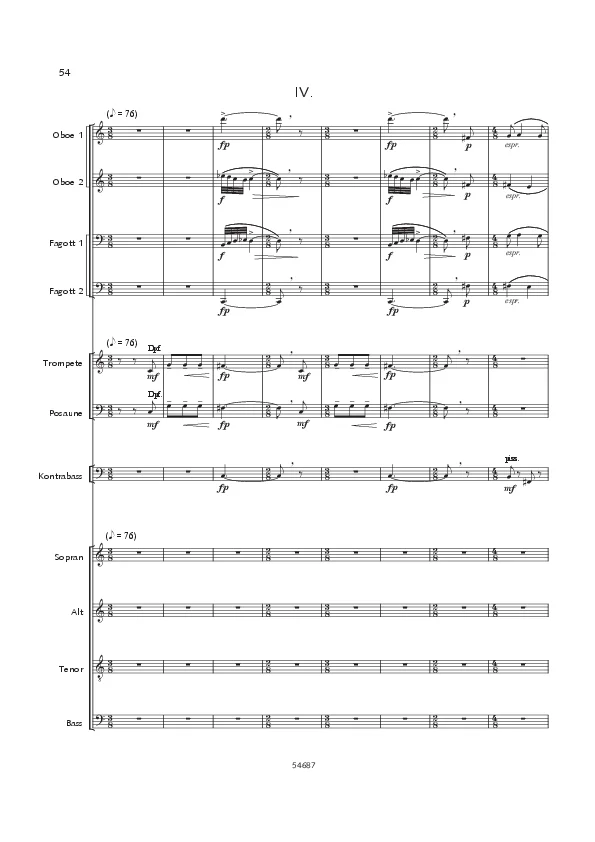
The texts are taken from Romano Guardini's German Psalter (1950), which endeavours to approximate the use of language in the 20th century. A modified reprise of the introduction at the end of the fourth movement, the tonal disposition and motivic links in the instrumental parts of the inner movements reveal a symmetrical structure, the central third movement of which is characterised by a modal cantus firmus from the 16th century. This runs through the brass and choral parts and is combined with concisely archaising counterpoint parts, whereby the individual chorale lines are treated in a varied manner in terms of compositional technique and instrumentation. The woodwinds structure the individual sections with short, concise interjections, imitating each other in constantly changing intervals. The choral parts are largely homophonic, the male and female voices often in octaves; the chorale moves in strict straightforwardness, melismas are only found in the six-part final line. The treatment of the chorale in the other movements is similar, except that here syncopations and frequent changes of metre sharpen the rhythmic profile. The style of the instrumental parts is largely vocal in character, while smaller solos, particularly those of the oboe and cor anglais, are derived motivically from the vocal theme. In the second movement, ostinato semiquavers illustrate the fleeting nature of human life, which is mentioned in the text.
Striking fundamental notes (G at the beginning and end, D in the middle) create a stable tonal framework, on which traditional chords are often placed, but which are alienated by dissonant notes - often several at the same time. The melody moves freely, sometimes very freely, in the aura of the church modes. The contours of the choral writing are reminiscent of the work of Hugo Distler. The technical demands are moderate and can also be mastered by a good amateur choir. If the work had been published fifty years ago, at a time of a radical belief in progress, it would certainly have been accused of eclecticism. From today's perspective, this "gleaning" from an extensive musical life's work needs no justification, as the composer has succeeded in combining simplicity and structural logic in an ideal way and making this audible and understandable. The sacred music of our time could not be better.
Jürgen Hinz




With the composition "Dem König der Ewigkeit" (To the King of Eternity), Bertold Hummel took part in a "composition competition for church music organised by Südwestfunk" in 1958. All composers in the broadcasting area who had not yet reached the age of 35 were eligible to take part. The title was to be "Zum Neujahrstage". The text, the use of the melody of the Ulenberg Psalm and the scoring "for 4-6-part choir with small instrumental ensemble" were specified. However, Hummel did not adhere to the rules for the choir. Shortly before the deadline, the first performance took place on 19 January 1958 in an evening concert at St. Konradkirche in Freiburg with the choir of the Pädagogische Akademie I Freiburg under the direction of Alfons Hug. The official premiere was in Flensburg in 1970. Hummel revised the work in 1985 and prepared it for its first printing in the last year of his life.
Martin Hummel