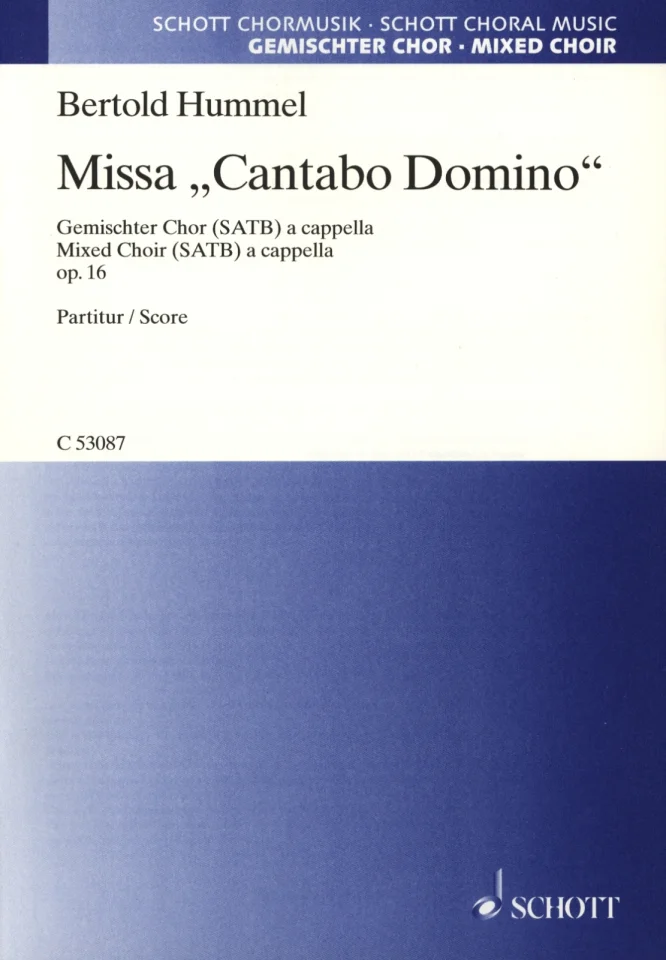
Missa Cantabo Domino (op. 16, 1958)
I. Kyrie, II. Gloria, III. Credo, IV. Sanctus, V. Agnus Dei
Mixed Choir a cappella
Duration: 14 minutes
Geistlicher Chor der Pädagogischen Akademie I Freiburg | Alfons Hug
Schott Music C 53087 / ISMN: M-001-15431-4
First edition: Musikverlag Alfred Coppenrath, Altötting 1958
This mass, now published by Schott, was composed as early as 1958. The complete Oridnarium Missae is set to music in a relatively concise form. The composer paid great attention to the comprehensibility of the text. Anyone familiar with Bertold Hummel's compositions will also recognise the desire for variety in the structures here, which are, however, brought together into unity by the typical sound characterised by vocal couplings and friction sounds. The Gloria is particularly convincing in this original form. Whether the sentence in the foreword "The piece should be performable by an amateur choir without too much effort." is correct is, as always, decided by the actual choir performing it and not least the approach of the choir director. The piece is not easy, but the work on intonation and declamation based on the accent of the words is worthwhile.
Robert Göstl
It was an exhilarating mass that was very harmoniously integrated into the liturgy of the Eucharistic celebration. The call to God in the Kyrie' impressively expressed the joyful thanks to God, which then increased in the Gloria' to powerful praise. The Credo' manages with only three chord patterns, the Gregorian tradition is already united with newer sound patterns - one is reminded of Stravinsky's "Mass", which has already been performed several times in St. John's. A powerful heavenly choir in the Sanctus and a very intimate and moving Agnus round off the musical experience of the "Missa".
Horst Fischer
Bertold Hummel's Missa "Cantabo Domino" must first be mentioned as a pleasant exception. Here, the demands of the church for the text to be more foregrounded are happily married with a contemporary sound and ease of performance. The frequent voice doublings and verse repetitions, together with the catchy lines (which are always in the best registers), also guarantee that rehearsals can be completed quickly. The connoisseur will find echoes of Stravinsky's Mass (in the Credo). The exemplary, easy-to-read score is also highly recommended for smaller choirs.
H.L. Schilling
During its Sunday visit to Weil, the "Spiritual Choir" of the Freiburg Pedagogical Academy sang the new mass composition"Cantabo Domino" by the young Freiburg composer Bertold Hummel at the high mass of the Pax Christi curacy. This work, written for four-part mixed choir, fitted seamlessly into the liturgical organisation of the service and forms a deliberately harmonised stylistic unit with the Gregorian chants performed by the Schola. Hummel's work is concise in its melodic formulation and adheres strictly to a superficial comprehensibility of the text; it is always mindful that the proclamation of the word must be the starting point and the centre of the music intended for the liturgical service, which must always be striven for. The harmonic component takes a back seat to other functions. In the Credo, where the four choral voices are led rhythmically in a long chordal chain, it is given more weight.




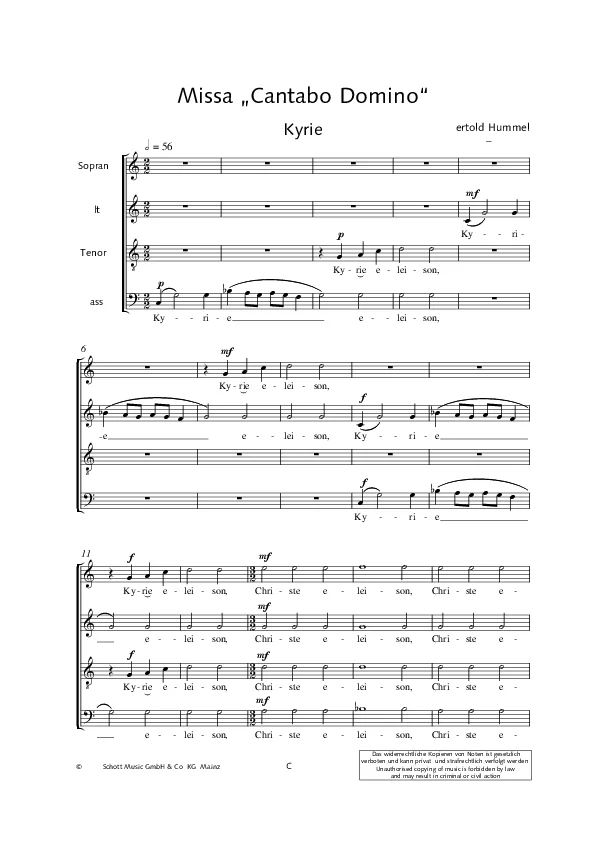
The Missa Cantabo Domino op. 16 for four-part mixed choir a cappella was composed in 1958 for a mass liturgy of a Catholic student community in Freiburg im Breisgau. The composition was intended to be performed by an amateur choir without too much effort. It is therefore of exemplary brevity and conciseness and, with a few exceptions, refrains from repeating the text.
The Kyrie is in three parts; at the end of the movement, the sound material of the "Christe" is heard once again as a kind of coda.
In the Gloria, the bass contrasts with a chorale-like melody and the entire choir with reciting homophonic blocks.
The long text of the Credo is integrated into three modal chord patterns in the manner of a psalmody. This achieves a high degree of objectivity, reinforced by the alternating choral presentation of the individual creeds.
In the Sanctus, homophonic and canonical sections are juxtaposed.
Finally, the threefold petition of the Agnus Dei is each begun a whole tone higher and the "Dona nobis pacem " is repeated three times as a kind of swansong.
In the performance (especially in the Gloria and Credo), great importance is attached to a flowing rhythm with a natural accent on the words, whereby the note values are retained, as in Gregorian chant. The dynamics are largely subordinate to the declamation of the text.
Bertold Hummel