Mimi's finger fun (1998-2002)
Six piano pieces for grandchildren young and old
for Johannes Augustin, Sven Lukas, Jakob and Mimi
I. Little Fanfare, II. Good Mood, III. Lullaby, IV. Single File, V. Cradle-song, VI. Short Carnival March
Piano
Duration: 6 minutes
I. Title: Kleine Fanfare für Johannes Augustin (Hummel) zum 12. August 2001 vom Großvater - Length: 1 p. - Date: - - Location:
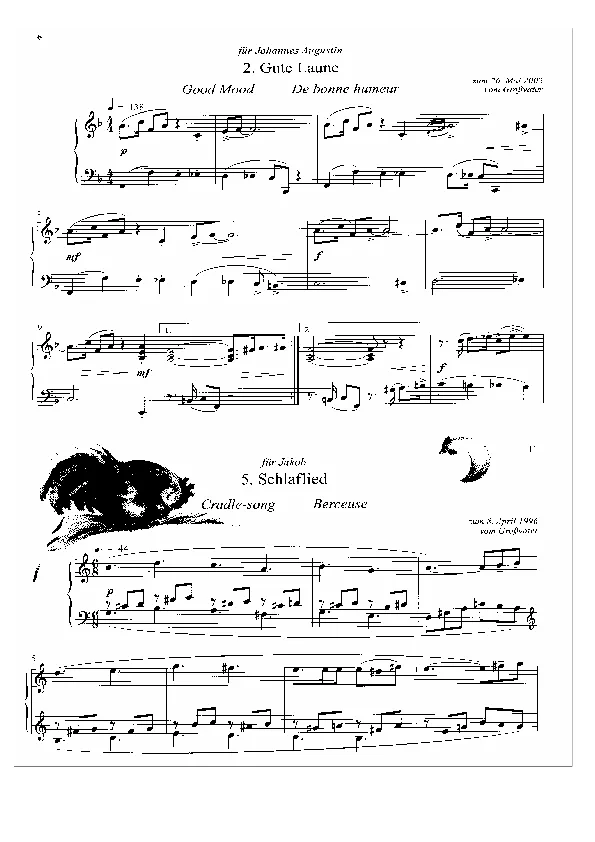
II. title: For Johannes Augustin on 26 May 2002 from the grandfather - Length: 1 p. - Dating: - - Location:
III. title: Lullaby for Sven Lukas from his grandfather- Length: 1 p. - Date: 17.10.98 - Location:
IV. Title: Little March - Length: 1 p. - Date: 12.4.97 - Location:
V. Title: Cradle-song for Jakob on 8 April 1996 from his grandfather - Length: 1 p. - Date: - - Location:
VI. title: Short Carnival March for Mimi by her grandfather - Length: 1 p. - Date: 26.2.1995 - Location:
Robert Lienau Musikverlag RL 40990 ISMN M-011-40990-9
These six piano pieces for small and large grandchildren were written by Bertold Hummel (1925-2002) and are humorous declarations of love from a grandfather in musical form. His son Martin Hummel acts as editor; after all, he found the miniatures, which were written to celebrate the birth of his grandchildren or on similar joyous occasions, in his father's mountains of sheet music. In fact, these are wittily illustrated little pieces, not difficult to play, with a sense for the demands of young people. As an introduction, there is a "Fanfare", in which the names of the grandson and grandfather are hidden."Gute Laune" swings heartily, the"Gänsemarsch" is lively,"Kleiner Fastnachtsmarsch" toots and drums cheekily, contrasting with"Schlaflied" and"Wiegenlied" (well-considered presents for the first birthday ...) Different characters naturally also entail special technical requirements. Here they can certainly be mastered in a very pleasant way!
Anke Kies
Pieces 2-6 are conceived in a clear major key, but this is attractively coloured with chromatic additions, most effectively in pieces 2 and 6. The child's tonal perception may initially be irritated by this, but only temporarily. Very soon they will realise and learn to appreciate the reasons for these additions. The first piece, "Kleine Fanfare", goes its own way: it follows the musically usable letters in the name of the grandson Johannes Augustin (Hummel), and at the end also Bertold Hummel and Bach. It ends in E major. The fact that the D flat was notated as such in this movement was, of course, for forgivable reasons.
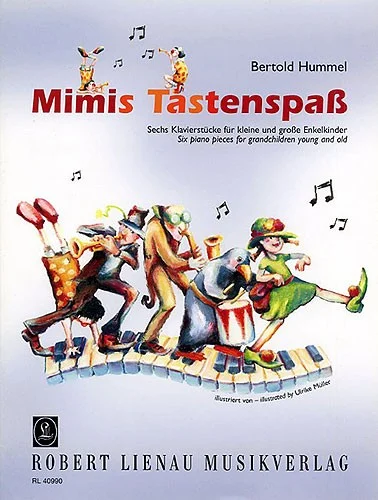
Piano students and teachers can rejoice: the publisher Lienau has published a new volume with pieces by Bertold Hummel - "for small and large grandchildren". It is an appealing continuation of the collection Tastenspiele and the illustrations in Mimis Tastenspaß by Ulrike Müller are both amusing and affectionate.
Bertold Hummel studied composition with Harald Genzmer and cello with Atis Teichmanis in Freiburg from 1947. He breathed the spirit of the "catch-up euphoria of the returnee generation", as he himself put it, and was carried away by the spirit of optimism of the 1950s. Alongside Genzmer, Hindemith, Messiaen and later Stravinsky were the influences that had the greatest impact on Hummel.
Basically, the late miniature pieces for his grandchildren represent a compilation of his work. He himself once commented: "In this way, I see an opportunity for our current situation to intellectually process the many and varied insights - in a synthesis, so to speak, of the many and varied stimuli available. My love of tradition and meaningful (subjectively speaking) progress has always characterised my musical language."
Hummel, who never counted himself among the avant-garde but was nevertheless familiar with its trends, uses a kaleidoscope of compositional methods in these children's pieces - rows, ostinati, modal tonalities, polytonality, polyphony, jazz building blocks, etc. The pieces are extremely melodious and by no means experimental. The appealing titles and dedications make them all the more suitable for opening up the horizons of New Music to younger pupils.
The foreword by Hummel's son Martin adds an intimate nuance that harbours a further incentive - the impetus for the individual compositions takes on a vivid form. It states, for example: "With the Little Fanfare he greeted Johannes Augustin on the first day of his earthly existence." It is not only the titles and dedications that reveal Schumann's album for young people. The two lullabies in particular are reminiscent of this composer's musical language in their cantabile and intimacy.
The pieces are also educationally valuable from a pianistic point of view. The players open up the piano space, cross their hands, let melodies wander into other registers, join individual notes together in the flow of notes to form a cantabile or simply let their fingers run briskly and articulately - and all this with a simplicity well thought out by the composer that is never overwhelming.
Mimi's keyboard fun is aimed at pupils at the upper elementary level - children ("younger and more grown-up") and older people who are young at heart alike - and is likely to inspire everyone with its dazzling joy of music-making.
Barbara Pikullik




Foreword (Robert Lienau Musikverlag)
Dear Mimi,
While looking through my grandfather's mountains of sheet music, I found six little piano pieces that he wrote for you grandchildren in the last years of his life.
He greeted Johannes Augustin on his first day on earth with this Little fanfare. It's quite ingenious how he put the two names together to create beautiful music. (Incidentally, another composer signed his name at the end - perhaps you can find out who). The second composition was a favourite piece of his, because when he was in a Good mood , he always played it quietly and happily for himself at the piano. As a passionate babysitter, I don't need to explain to you why he wrote a Lullaby for Clara and Sven for their first birthday. With the Single File for Rafael and your Short Carnival March, my dad once again enjoyed challenging the dexterity of your hands by reaching over and playing octaves in more remote regions of the keyboard. If you practise well, you'll soon be having fun with the keys.
With best wishes
Your Martin