J.S. Bach: Invention a-moll BWV 784 (1996)
arranged for 4 marimbas (or 2 vibraphones and 2 marimbas)
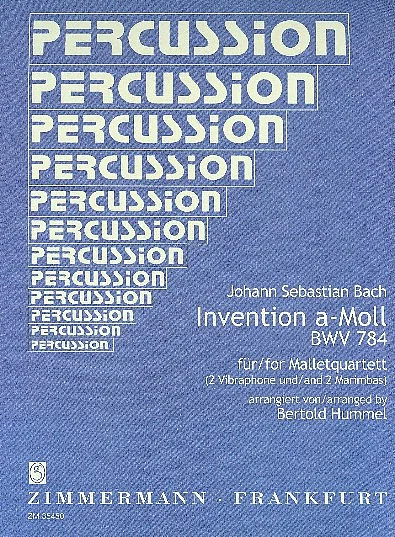
4 marimbas (or 2 vibraphones and 2 marimbas)
Duration: 2 minutes
Title: J.S. Bach: Invention a-minor arr. B. Hummel 4 Marimbas (or 2 VIB + 2 Ma) - Length: 4 pages - Date: arr. B. Hummel 8.6.96 - Location: Bayerische Staatsbibliothek Munich
Zimmermann Frankfurt ZM 35450 / ISMN M-010-35450-7
If Bach had known the marimba instrument, would he have composed differently for it than for all other keyboard instruments? His polyphony allows such transfers without hesitation, such "gimmicks", as Bertold Hummel, who died five years ago, deliberately undertook "in order to practise cantabile playing on the mallet." But in doing so, he also gives the mallet players, whether in a marimba quartet or trio, or mixed with other mallets, a meaningful gift of repertoire.
Eckart Rohlfs
This keyboard percussion quartet is scored for two vibraphones and two marimbas (one low-A and one four-octave). The editor also gives the option of using four marimbas. The parts are equally distributed in difficulty among the four players. Brackets are provided to identify the inventions, and should be performed louder than the counterpoint material.
Each part can be performed with two mallets, although if using vibra-phones, four mallets might facilitate dampening. There are a few sticking and hand suggestions, but these are only suggestions. This is a terrific setting of the famous invention and a challenge for all four players.
George Frock




After attending an audition of young percussionists in June 1996, at which a talented student attempted to perform Bach's A minor Invention alone on the marimba, Bertold Hummel felt inspired to arrange the same Invention for 4 marimbas, although he could also imagine the instrumentation for 2 vibraphones and 2 marimbas. His comments on this: The parts in brackets are original and should be played louder than the "counterpoints" I invented, which mostly use Bach's harmony (i.e. could be created by any other composer). The whole thing is an experiment - a gimmick - perhaps it will be fun to play. I came up with it because the inventions are very well known (in the original) and are much more difficult on marimba alone than on the piano.
Preface (Zimmermann Frankfurt ZM 35450)
"Invention in A minor for 4 mallet Instruments" by Bertold Hummel was the result of an idea for an attempt at musical experimentation and refers to the well-known "Invention in A minor" by Johann Sebastian Bach. Originally, J. S. Bach wrote down these musical ideas in 1723 as didactic pieces and as an instruction in how to "achieve a cantabile style of playing". This collection of pieces has served as ideal material for the musical education of young artists for nearly 300 years now.
In B. Hummel's arrangement, the two-part piano piece is presented as a patchwork divided among four parts, thus giving four percussionists the opportunity to practise cantabile playing on mallet Instruments. In his draft of the score, B. Hummel prescribes the use of 4 marimbas (with the possible alternative of 2 vibraphones and 2 marimbas). He explains this as follows: "The parts contained in brackets are original and should be played louder than the "counterpoints" l have invented throughout". In his Inventions, J.S.Bach is known to have done without dynamic instructions, and, therefore, in the first 4 bars of the arrangement, the musical Interpretation is suggested by the dynamic marks added for guidance. As in the original, the musicians are given free rein to apply their musical creativity as the composition progresses.
A carefully considered stroke sequence has been added below each of the individual parts, which lends itself particularly well in terms of improved practicability. These stroke sequences, which are always followed by a change of hands, are placed as sparingly as possible, but wherever they are helpful and necessary. The suggestions of alternatives in Instrumentation provide further recommendation of the piece as teaching material.
A performance of this score true to the original requires:
Soprano: c-marimba (4-octave)
Alto: c-marimba (4-octave)
Tenor: A-marimba (4 1 /3-octave)
Bass: C-marimba (5-octave)
As an alternative, Hummel suggests using two vibraphones (1: soprano, 2: alto) in place of the 2 marimbas in the upper part.
In order to ensure that the parts are conducted homogeneously when this Version is performed, particular attention should be given to the differences in tone duration between the marimba and the vibraphone.
The following is another alternative suggested for performance practice in music schools:
Soprano: Xylophone
Alto: marimba (together with bass)
Tenor: vibraphone
Bass: E, For A-marimba
By shifting only a few notes, it is possible in this case to perform the score on only three mallet Instruments.
Thomas Keemss