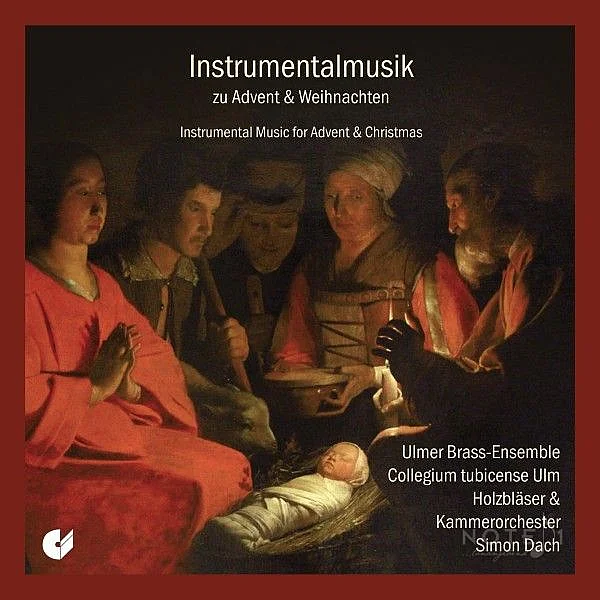
Christmas miniatures for woodwinds, guitar and percussion
Let us now go to Bethlehem - Instrumental music for the Christmas season
Performers: Collegium tubicense, Ulm / Woodwind ensemble and chamber orchestra of the Army Music Corps 10, Ulm / Karl-Heinz Schulz and Matthias Hanisch, violin / Willi Emmrich and Harald Recktenwald, oboe / Conductor: Simon Dach
MARIA ANNUNCIATION
Theme and variations "La Folia"
Arcangelo Corelli / Max Reger
And our dear women 1'14''
Song arrangement by Bertold Hummel
Come, saviour of all the world
Canonical song arrangement by Johann Schelle
VISITATION OF MARY
Mary went through a thorn forest 0'41"
Song arrangement by Bertold Hummel
Over the mountains Mary goes
Motet setting by Johann Eccard
There comes a ship, loaded
Song movements by Ernst Pepping, Karl Heinz Weber and Max Reger
IN BETLEHEM
Who knocks? 0'37"
Lied arrangement by Bertold Hummel
Lift up the door
Song movements by Fr. Hänßler, Karl Norbert Schmid and Max Reger
Simphonie de noel
Michel-Richard de Lalande
CHRIST BIRTH
The Saviour is born 1'17''
Lied arrangement by Bertold Hummel
Pastorale
from the Christmas Concerto by Francesco Manfredini
When I watched with my sheep
Carol setting by Otmar Faulstich
Pifa
from the oratorio "The Messiah* by George Frideric Handel
An angel came safe and sound
Song movements by Michael Praetorius, Johann Crüger, Georg Forster and Johann Sebastian Bach
ADORATION OF THE SHEPHERDS
Come, ye shepherds 0'49"
Song arrangement by Bertold Hummel
Shepherds' music (skipping dance)
Bernnhard Krol
Christmas Pastoral
Gaetano Maria Schiassi
Joseph, dear Joseph mine 0'40"
Song arrangement by Bertold Hummel
I stand here at your cot
Johann Sebastian Bach
ANGELS CONCERT
Praeludium
on "Es ist ein Ros entsprungen" by Bernhard Krol
Pastorale
from the Christmas Symphony by Giuseppe Valentini
THE WISE MEN FROM THE ORIENT
A child born in Bethlehem
Song movements by Michael Praetorius, Bartholomäus Gesius and Melchior Vulpius
Homage of the Orient 0'35"
Bertold Hummel
Concerto in E minor
Georg Philipp Telemann
Praise God, ye Christians
Intonation by Josef Stein Lied setting by Leonhart Schröter
Recording: ?
Sonata "La Folia" (Variations on a theme by Farinelli) by Arcangelo Corelli (1653-1713), op. 5 no. 12 (comp. 1700) for solo violin and orchestra in an orchestration by Max Reger (1873-1916). We are familiar with the depiction of the various "stations" of the Christmas story from many examples in the history of art. It has also inspired the sacred folk song, the numerous choral works and the "Christmas concerts" in instrumental music on this theme.
"And our dear women dreamed a dream: a tree, Kyrieleison, had grown under her heart. And our dear wife, who bore a little child, of this we will now sing and be merry!" (Miniature on the sacred folk song for woodwinds, strings and percussion by Bertold Hummel. *1925). The oldest Advent hymn in our Western tradition - the text dates from the 4th century, the melody from the 12th century - is "Veni redemptor gentium". "Come, Saviour of all the world; Son of the Virgin, make yourself known. Let all that lives marvel at this: Thus God will become man." (Canonical chorale arrangement for six instruments by Johann Schelle, 1648-1701).
In legend and song tradition, many generations have depicted and embellished the events surrounding the mystery of God's incarnation: "Maria durch ein Domwald ging - Kyrieleison! - that has not borne leaves in seven years. Jesus and Mary. The roses bore thorns - Kyrieleison! - as the child was carried through the forest. Jésus and Mary." (Miniature by Bertold Hummel)
"Across the mountains Mary goes to her Bas' Elisabeth. She feels an urging in her breast, the Spirit's word she must proclaim; she greets the Lord's mother confidently, Mary sang joyfully and loudly: My soul exalts the Lord, my spirit rejoices in God; he is my Saviour and my God. He will always be merciful!" (5-part hymn motet by Johann Eccard, 1553-1611) Poetry also takes up the theme. Some hymn verses are not only successful poetry, but also a profoundly faithful proclamation and interpretation of the Christmas event: "A ship is coming, loaded to its highest deck, carrying God's Son full of grace, the Father's eternal word. The anchor is on earth, the ship is on land. The Word will become flesh, the Son is sent to us. In Bethlehem born in the stable a little child, gives himself up for us: Praise be to him!" (Songs by Ernst Pepping, *1901, Karl Heinz Weber, *1927, and Max Reger, 1873-1916) Many Christian customs are also associated with the preparation for Christmas, e.g. the "Frauenfragen" or the search for a hostel, which is linked to the following Tyrolean folk song: "Wer klopfet an? - "Oh, two very poor people!" - What do you want then? - "O, give us shelter today! Oh, by God's love we pray, open your huts to us!" - Oh no, no, no! - "We want to be grateful!" - It cannot be! - Oh, do let us in!" - No, it can't be for once. Just go away, you won't get in!" (Miniature by Bertold Hummel)
As a sign of pious devotion ("Godliness"), people decorate their houses with fir branches and open the doors to the King: "Open wide the door, open wide the gates, the Lord of Glory is coming.... . Open wide the door, open wide the gate, prepare your hearts for the temple. Put up the branches of godliness with devotion, joy and gladness; then the King will come to you, salvation and life at the same time. Praise be to my God, full of counselling, full of action, full of grace." (Song movements by Fr Hänßler, Karl Norbert Schmid, *1926, and Max Reger, 1873-1916)
"Simphonies de noels" by Michel-Richard de Lalande, 1657-1726, for woodwinds, strings and basso continuo. Some of these Christmas pieces were played in the royal court chapel of Louis XIV in Versailles between the end of Matins and the hour of midnight, when mass began.
"The Saviour is born! Rejoice, O Christendom! Otherwise we would be lost for all eternity. Rejoice with all your hearts, all you Christians, come to the little child in the stable!" (Miniature by Bertold Hummel)
On Christmas Eve, music composed especially for this purpose was played. In a way, the shepherds and their music-making at the manger were joined by so-called "pastorals". The instrumental movements entitled "Pastorale" utilise the lullaby-like 12/8 time signature typical of the folk music of the Italian shepherds (which is why they are often called "Siciliana"). ("Pastorale per il Santissimo Natale" by Francesco Manfredini, 1680-1748, for string orchestra) Many Christmas carols recount the events of Bethlehem in the words of the shepherds: "As I watched with my sheep, an angel brought me the message. I am glad, glad, glad, glad! Benedicamus Domino!" (Song composition by Otmar Faulstich, *1938)
The music of the shepherds was also a constant source of inspiration for composers. They often named their works accordingly, such as Handel in his oratorio "The Messiah", who called a shepherd's music. Pifa" ("piffaro" - shawm or flute players with the shepherds). ("Pifa" from the oratorio "The Messiah" by George Frideric Handel, 1685-1759)
The words of the angels and shepherds in the fields of Bethlehem are the starting point for many Christmas "narrative songs": "An angel came bright and clear from God into the field to the shepherds; he was very glad from the heart and spoke to them cheerfully like this: 'From heaven on high I come, I bring you good new tales; I bring you so many good tales that I want to sing and say. A little child has been born to you today, born of a virgin, a little child, so tender and fine, that shall be your joy and delight!'" (Text: Martin Luther. Hymn settings by Michael Praetorius, 1571-1621, Johann Crüger, 1598-1663, and Georg Fôrster, 1510-1568. Choral arrangement by Johann Sebastian Bach, 1685-1750)
The singers of Christmas folk songs have always liked to identify themselves with the shepherds; they went with them to the manger to worship and make music. "Come, ye shepherds, ye men and women! Come and see the lovely baby! Christ the Lord is born today, whom God has chosen to be your Saviour. Fear not!" (Miniature by Bertold Hummel)
The idea that the shepherds also played music for dancing out of joy has always been part of this: Shepherds' music ("Springtanz" for 6 woodwinds from the cantata "In dulci jubilo" op. 25 by Bernhard Krol, *1920."Pastorale per il Santissimo Natale di nostro Sgnr Jesu" by Gaetano Maria Schiassi, 1698-1754.).
The old folk song from the 14th century tells of the "lullaby": Joseph, dear Joseph mine, help me cradle my little child! God, he will be your lullaby in the kingdom of heaven, the Virgin Mary's son." (Miniature by Bertold Hummel)
"I stand here at your manger, O Jesus, my life. I come, bring and give you what you have given me. Accept, it is my spirit and mind, heart, soul and courage, accept everything and let it please you." (Text: Paul Gerhard. Tunes: Johann Sebastian Bach)
But it was not only the music-making of the shepherds at the cot that people tried to recreate; the concert of the angels, who certainly could not have been kept in their heaven, was also a popular performance. Praeludium from the cantata op. 25 "In dulci jubilo" by Bernhard Krol. The lower part of this composition features the old melody of the song "Es ist ein Ros entsprungen aus einer Wurzel zart" (Michael Praetorius). "Sinfonia per il Santissimo Natale" for strings and basso continuo op. 1 no. 12 by Giuseppe Valentini, 1681-1746.
The homage of the Wise Men from the East has also inspired the imagination of all artists who have concerned themselves with the story of Bethlehem. A reworking of the hymn "Puer natus in Betlehem" is one of the oldest "Epiphany songs": "A child born in Bethlehem, Jerusalem rejoices. Hallelujah! The kings of Sheba came here; they brought gold, frankincense and myrrh. Alleluia! They entered the house and greeted the child and his mother. Hallelujah! They fell on their knees and said, 'God and man are here! Hallelujah!" (Hymns by Michael Praetorius, 1571-1621, Bartholomaus Gesius, 1562-1613, and Melchior Vuipius, 1570-1615)
The "exoticism" of these oriental composers is of course also musically appealing. It has often found expression in instrumental music and is often brought into play in this context, as in the "Huldigung der Morgenländer". (Miniature by Bertold Hummel)
Presto movement from the Concerto in E minor for recorder, flute, strings and B.C. by Georg Philipp Telemann, 1681-1767.
The aim of contemplating the Christmas story - in whatever form it is presented - is to lead Christians to praise and thanksgiving for what God wanted to do for us humans in this event - effective for all time. "Praise God, all you Christians, in his highest throne, who today closes his heavenly kingdom and gives us his Son. Today he opens again the door to the beautiful paradise; the cherub no longer stands for it. To God be praise, honour and glory!" (Intonation: Josef Stein, * 1910, setting: Leonhart Schröter, 1532-1601)
Simon Dach