Trio "in memoriam Olivier Messiaen" for flute, oboe and piano (op. 95c, 1992)

I. Melismas, II. Monograms, III. Metamorphoses
Flute, oboe, piano
Duration: 15 minutes
Trio Papillon: Thomas Richter | Gerhard Schnitzler | Monika Stöhr
Title: Trio for flute, oboe and piano op. 95c - Length: 20 pages - Dated: I. 18 May 92 II. 23 Nov 92 III. 18 Dec 92 in memoriam O. Messiaen - Location: Bavarian State Library Munich
Zimmermann Musikverlag Frankfurt ZM 31290 / ISMN: M-010-31290-3
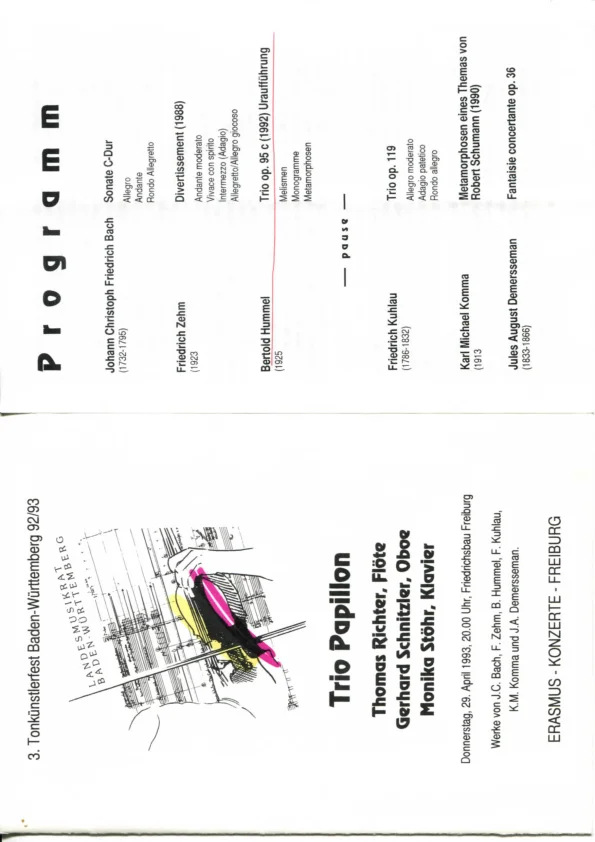
The first movement was a real homage to Messiaen: bizarrely moving bird cries, played perfectly in parallel by the flute and oboe. Sensitively modulated individual notes brought the actual funeral music in the middle movement"Monogramme". The final movement"Metamorphoses" concluded Hummel's work with chamber music rigour, musically dense and entertaining.
Bertold Hummel wants his three-movement trio, which was premiered in Freiburg in April 1993, to be understood as a personal homage to the French composer Olivier Messiaen, who died in 1992. Messiaen used and imitated birdcalls in almost all of his works, so it seems almost natural for Hummel - especially as he composes for the flute - to write "birdcall-like melismas" for both woodwinds. The first movement is dedicated to these melismas. On the one hand, the piano functions as a counter-voice (organ point); on the other, it takes part in the lively rhythmic events. Slurs, short suggestions, trills, glissandi, pedalling, tremolos and flutter tonguing are used as effects. Both winds create cadenzas that can be played very freely.
The second, slow movement is entitled "Monogram", which, in contrast to the first, is sparsely scored and is mainly carried by the two wind instruments. The piano takes on rhythmic accents when the winds pause or remain in dulcet tones. In the third movement, "Metamorphoses", the composer uses the letters of Messiaen's name (E-E-Es-Es-A-E) for his main motif. Transposed and rhythmically varied, the material appears after a short interlude containing a melodic sequence from Messiaen's opera Franziskus in a coda before the movement fades away into nothingness. Bertold Hummel dedicated the work to the Trio Papillon, who also performed it at the premiere.
Cornelia Fäh
Bertold Hummel commemorated the mystic of birdsong, Olivier Messiaen, in his Trio op. 95c - and so it is not surprising that the piece begins like a concert of mourning birds: the trills, calls and suggestions combine in the hauntingly "speaking" phrasing of the winds to form fragments of lyrical lamentation and painful outbursts, until the piece increasingly detaches itself from naturalistic imitation and follows purely musical impulses - and finally falls silent in the noise.




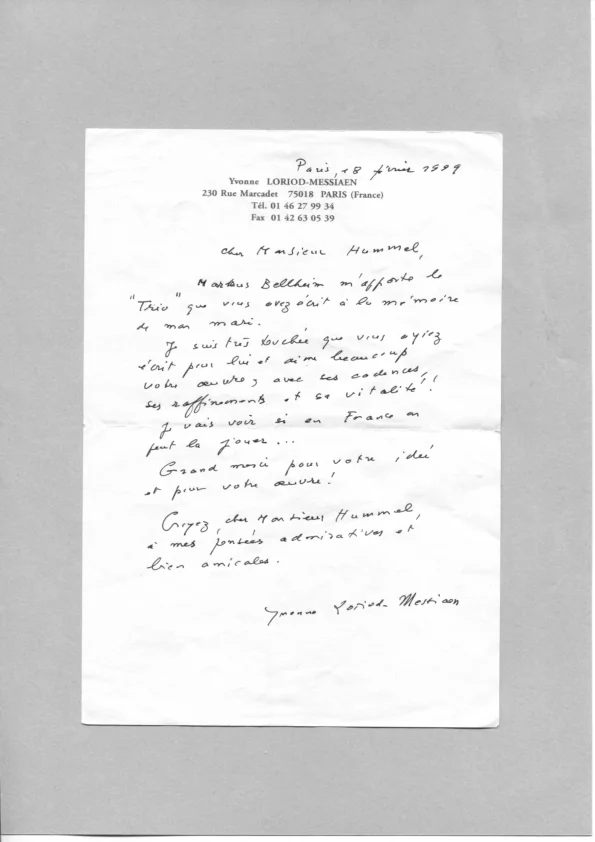
The Trio for flute, oboe and piano op. 95c is intended as a personal homage to Olivier Messiaen, whose death became known shortly before the composition began.
Birdcall-like melismas - transformed many times - characterise the first movement, which is structured by a cadenza for each of the wind soloists. Developmental ideas in the smallest of spaces can be found in the intermediate sections. Finally, the flute quotes the opening material once again in a decrescendo over an oboe pedal point on A flat .
Long sustained notes with short motifs characterise the 2nd movement. In its economy of means, it stands in stark contrast to the outer movements.
In the 3rd movement, the source material goes back to the sound letters of the name OLIVIER MESSIAEN (E-E-Es-Es-Es-A-E), which can be set to music. In the middle section, a melodic line from Messiaen's opera "Franziskus" is heard over a recurring chord sequence - as a kind of short passacaglia. After a continuation of the "Franziskus" tone sequence, the original material experiences a climax with an unexpected coda. With the main motif, the work fades away in a delicate noise.
The premiere took place on 29 April 1993 in Freiburg im Breisgau by the Trio Papillon , to whom the work is also dedicated.
Bertold Hummel
Of the more recent works, one composition deserves special mention, the "Trio" for flute, oboe and piano op. 95c. It demonstrates Hummel's closeness to Olivier Messiaen, which was repeatedly evident in his composition lessons, which he taught at the Wüzburg Academy of Music until 1987. Perhaps more than any other admirable role model, it was his great Parisian colleague whose thinking and compositional technique had a lasting influence on Bertold Hummel's work. Shortly after Messiaen's death became known, he created a musical monument to him. Not only do the bird calls - as Hummel often did - remind us of the music-loving ornithologist, but it is not only the E-E-Es-Es-A-E motif that recalls the name Olivier Messiaen: the entire "sonority" of the composition brings the model to life. Melismas, monograms, metamorphoses: three movements - and the letter M three times! Only rarely has Hummel acknowledged a model as clearly as here. This can be interpreted as a testimony to genuine sorrow at the loss of an esteemed master and is probably one of the most important roots of Bertold Hummel's chamber music.
Klaus Hinrich Stahmer (in "Kammermusik als persönliches Bekenntnis", Tutzing 1998)