Faust scenes - ballet (op. 72a, 1979)
after a dance poem by Heinrich Heine for wind and percussion ensemble
I. Incantation, II. Seduction, III. Witches' Sabbath, IV. Helena, V. Fair and Faust's damnation
2.2.2.2 - 3.2.2.1 - perc. <5>
Duration: 48 minutes
Wind section and percussion ensemble of the Junge Deutsche Philharmonie | Lutz Köhler
Commissioned by the Berliner Festwochen 1979
Title: "Faustszenen" op. 72 for 16 wind instruments and 5 percussionists after a dance poem by Heinrich Heine - Length: 182 pages - Dated: I. 23 June 79 II. - III. 30 July 79 IV. 19 Aug. 79 V. - VI. 1 Sept. 79 - Location: Bavarian State Library, Munich
Schott Music
... His Faust scenes are crafted with an eminent sense of sound and effects. You don't experience such a collection of differentiated percussion effects every day. The piece should make its way ...
... (Hummel's) music has a striking scenic effect and is very audience-friendly ...
The composer demonstrated great craftsmanship and a sure instinct for wind and percussion effects ...
The very first movement, "Höllenzwang", plunged into the maw of bleating woodwinds and brazen trombone sounds, underpinned by percussion excesses ...
The undeniable Romantic pathos of Heinrich Heine's dance poem is rescued in a new tonal language that is primarily pictorial and associative ...




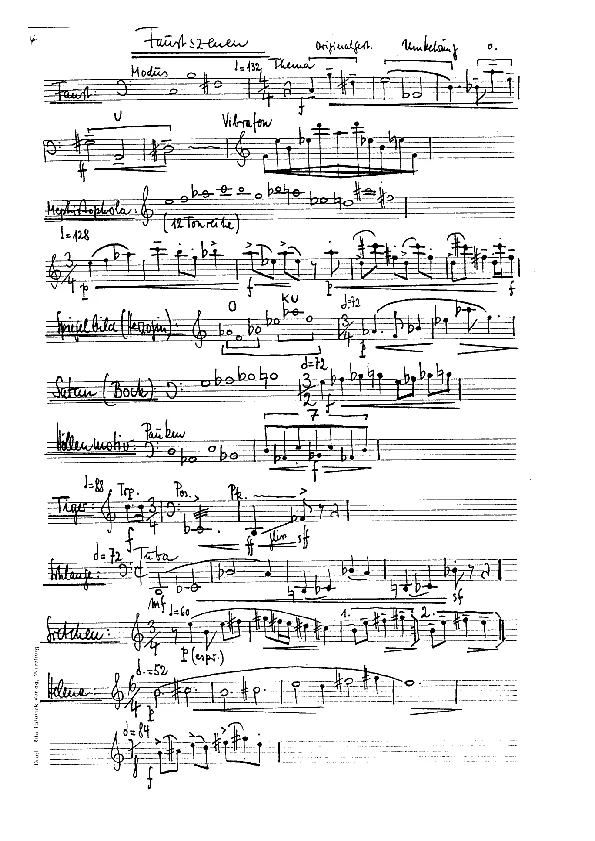
The highly imaginative Faust poem by Heinrich Heine served me as a stimulus for the five scenes in which I tried to capture the colourfulness of the images of reproach in a condensed form. The characters in the plot are provided with melodic and rhythmic leitmotifs, which are subjected to permanent metamorphoses in accordance with the progress of the work. The work was composed for the Berliner Festwochen with woodwinds, brass and five percussionists.
Bertold Hummel (Programme booklet of the Berliner Festwochen 1979, page 140)
Franz Rauhut: Interview with Bertold Hummel
At the request of an English theatre director, Heinrich Heine (1847) devised a Faust in ballet form, which was bold but feasible, as Gluck had composed a Don Juan ("Le festin de Pierre") as a ballet, but the hope of a spotlight for "Doktor Faust, ein Tanzpoem" was not fulfilled. The poetically detailed depiction caught on with the composer Bertold Hummel, whose "Faust Scenes for Winds and Percussion" obeyed the poet's intentions in a strictly adhered to sequence with incredibly suggestive music. The world premiere at the "Berliner Festwochen" on 25 September 1979 by the wind section of the Junge Deutsche Philharmonie in the theatre hall of the Hochschule der Künste was enthusiastically received.
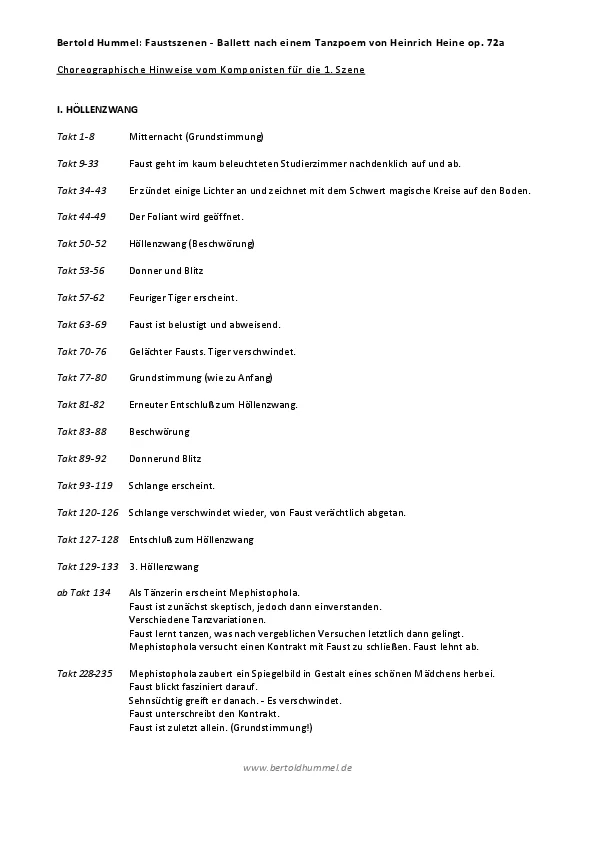
In the first act, Incantation, in which Dr Faust conjures up the spirits of the underworld in his study and Mephistophela tempts him to sign the pact with the seductive image of the Duchess in the mirror, the demonic motifs of the music resound with overwhelming horror, which continues in variations, with occasionally bizarre onomatopoeia, through all the acts.
The second, Seduction, set at the ducal court, has the Duchess dancing with Faust and the Duke, in ironic contrast, with Mephistophela.
The Witches' Sabbath, in the third act, is the climax of the whole and is the most lyrically and musically saturated with themes and motifs. One witch after another comes hissing in; a blasphemous parody of the mass is dedicated to Satan, who appears as a goat; he dances a minuet with the Duchess, who is a Satan's bride; Faust experiences a disappointment with her that exposes the great art of seduction of hell as rotten magic. Mephistophela then makes the ancient Helen appear to Faust, who is seized by a longing for the pure and beautiful, and her leitmotif enchants with its changing tonal colours.
Faust's attempt in the next act, entitled Helena, to unite with the famous beauty fails when the jealous Duchess storms in; the ancient world falls into decay, which Faust avenges by killing the Duchess.
The final fifth act offers a funfair festival with the charm of lively music. Dr Faust, appearing as a quack, believes he will finally find happiness in domesticity with a lovely mayor's daughter, whom he wants to marry on the spot, but then Mephistophela intervenes with the blood-signed pact and the sinner is transported to hell with a powerful spectacle, whereupon the Faust leitmotif is heard one last time as a sweet echo.
What prompted you to reach for Heine's "Tanzpoem"?
I was asked by the Berlin Festival organisers to write a Faust composition. I had written incidental music for Marlow's Faust when I was a student. I had always been interested in the Faust theme. I was particularly interested in Heinrich Heine's adaptation of the material as a dance poem. I saw this as an opportunity to write varied music.
Why did you use Wagner's leitmotif for the structure?
To make it easier for the listener to understand the "plot", I gave the characters a sequence of notes - as a kind of "leading mode" - which changes its form depending on the situation of the plot.
Can your work be categorised as "symphonic poem" or "programme music" or do you prefer a performance in ballet form? Would a concise programme be helpful for understanding?
A concise programme could make it easier to understand in a concert performance. I think a ballet version is the most ideal form of performance, as long as the choreography and staging are harmonised with the music.
Am I mistaken if I occasionally feel that there is some kind of comparability with Dukas' "Sorcerer's Apprentice" or Stravinsky's "Firebird"?
I can't say whether there are any musical cross-references to the works mentioned, as I still have too little distance from my work for that. In any case, I wouldn't mind if my "Faust Scenes" were as well integrated into the literature as the works mentioned.
Do you have a personal relationship to the human problem of Faust?
I believe that every creative person has a personal relationship to the Faust problem. I must confess that I have a particularly strong affinity with the Faust character, not least because of my long-standing friendship with Luigi Malipiero, whose Faust productions are unforgotten.
You stuck faithfully to Heine's description of the events, but at the very end you deviate from it by replacing the Christian bell and organ sounds with the Faust motif one last time. What prompted you to do this?
At the very end of my Faust scenes - in the echo, so to speak - the Faust motif is heard once again. It is intended to indicate that the Faustian element has not finally disappeared from this world with the descent into hell.
Why did you reduce your orchestra to wind instruments and percussionists?
This instrumentation was a condition of the commission. Originally, I would have preferred to write for full orchestra. While I was working on it, I was tempted to produce a score that was as colourful as possible and I hope that I succeeded in doing so despite the scoring restrictions.
Did you encounter any particular difficulties while composing?
I only encountered difficulties in my tight schedule and the resulting hectic pace of producing the performance material.
Do you attach importance to your work being easy for the audience to understand?
I attach great importance to the comprehensibility of my work and would rather be accused of being too clear than hopelessly confusing the audience.
May I ask you about the duration of the work on your opus?
The work was mainly composed and orchestrated in July and August 1979 and demanded an extraordinary amount of work from me.
(from the programme of the 1979 Berlin Festival, whose theme was "Faust")