Fantasia gregoriana for large orchestra (op. 65, 1977)
3.3.3.2 - 4.3.3.1 - timpani, percussion (vibraphone, 3 cymbals, sizzle cymbal, gong, tam-tam, triangle), harp, strings
Duration: 8 minutes
Orchestra of the Giessen Municipal Theatre | Bertold Hummel
Title: Fantasia gregoriana - Length: 43 pages - Date: 23 February - 4 March 77 Dorfgastein - Location:
Schott Music ED 20694 / ISMN 979-0-001-16897-7 (study score)
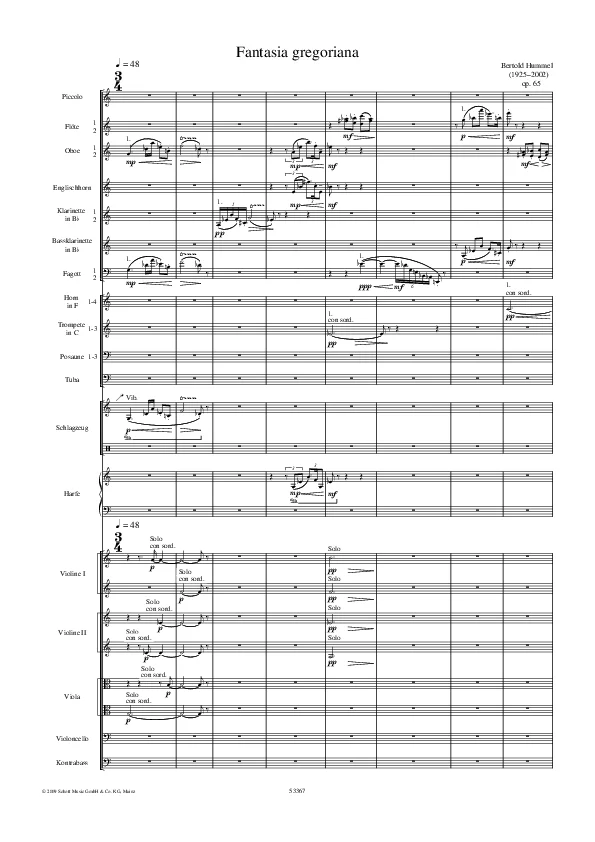

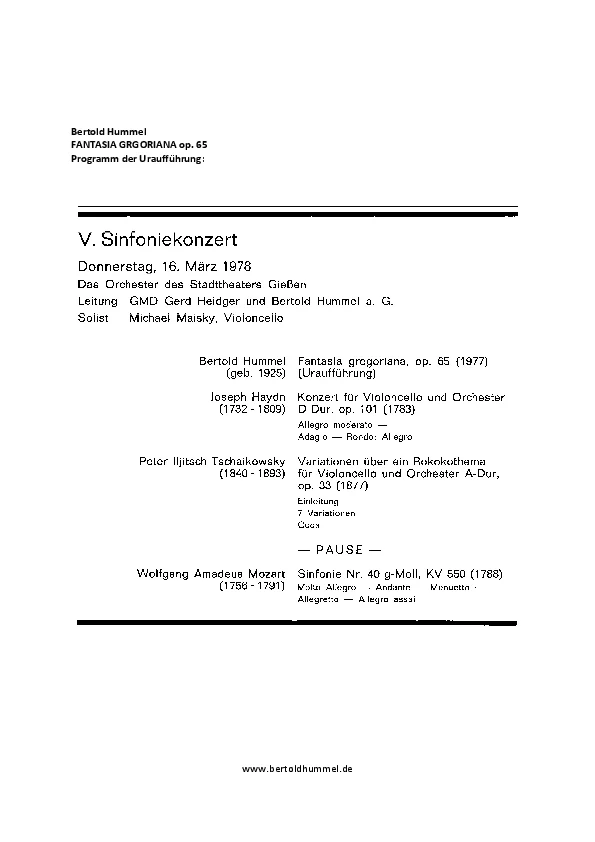
The Fantasia gregoriana op. 65 is based throughout on the time-honoured Alleluia motif of "Gregorian chant". According to Hummel himself, he was inspired to compose it when he took part in a monastic resurrection celebration in the Gregorian rite one Easter night. And indeed - a succinctly rhythmic resurrection and a rousing mood of awakening are signalled in the orchestra by radiant wind effects and full, rich string sounds.
As Hummel himself writes, the almost ten-minute fantasy is based on the Gregorian Easter Alleluia; "as in a mosaic, the individual heterogeneous episodes of a lyrical, dance, hymnal and dramatic nature are brought together into a unity by the permanent presence of the theme". (programme booklet). An elaborate, colourful orchestration realises this concept, whereby the aforementioned theme is presented with particular emphasis in a rich wind section, in which the fantasy then also comes to a festive close. The composition, which begins with calm sounds from the woodwinds, works with alternating sustained and lively passages and with different rhythms. Hummel, who moves in the realm of tonality and, as it seemed, also resorts to church modes, does not shy away from flashy effects. The cleanly crafted music, which is also quite catchy on first hearing, was received with applause and a few bravos. The fact that the composer himself conducted the premiere guaranteed an adequate performance.
Otto Gärtner
A piece that stands in the musical tradition and shows that there are still contemporary statements in addition to the avant-garde.




The almost 10-minute Fantasia gregoriana, op. 65 is based on the Gregorian Easter Alleluia. As in a mosaic, the individual heterogeneous episodes of a lyrical, dance-like, hymnal and dramatic nature are brought together into a unity by the permanent presence of the theme.
Bertold Hummel
The Gregorian "Alleluia " is present as a quasi-mode in every bar of the work. A restrained introduction, which is characterised by the tritone-shifted structure of the original material, is followed by a sharply accentuated presentation of the theme in the bass. A first bitonal climax (F minor and D major simultaneously) is reached via the variants, some of which dissolve like garlands. The dramatic development is repeated - interrupted by arioso interruptions - until the main idea is brought to a close in radiant instrumentation. The final chord is composed of all the notes of the theme.
Bertold Hummel